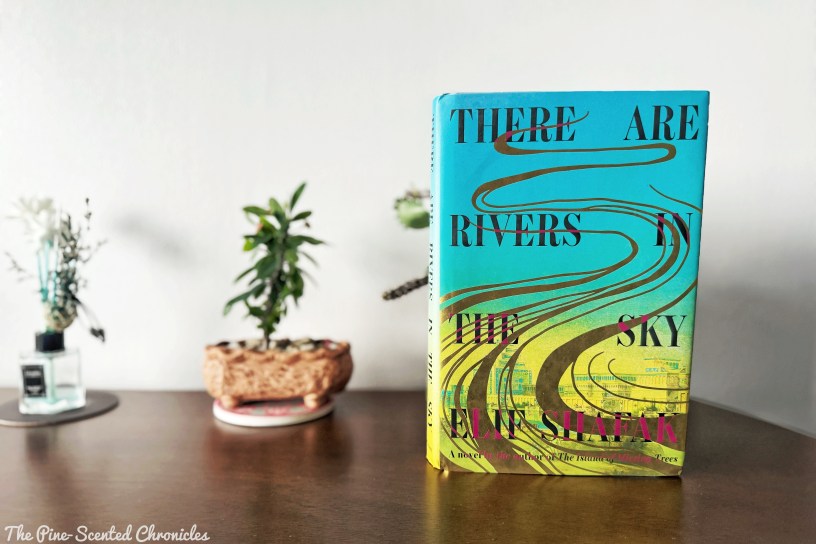
The Cycle of Life
In contemporary Turkish literature, Elif Shafak is, without a doubt, one of the most influential, and prominent. With a prolific literary career that spans over three decades and an oeuvre that covers a vast genre, Shafak has earned her stripes and is widely regarded by literary pundits across the world as one of the leading voices of her generation, not just within Turkey but outside of it. She broke into the literary scene in 1998 with Pinhan which was an immediate success. It catapulted her to glory within local literary circles and earned her accolades. She built on this success as she published more critically acclaimed works such as The Bastard of Istanbul and The Forty Rules of Love. However, her works and political stance – vestiges of her activism and political ideologies have been subtly integrated into her novels – have also earned her the ire of Turkish nationalists, particularly for The Bastard of Istanbul.
For all the controversies her work incited, it cannot be denied that Shafak has earned her place among contemporary Turkey’s and, by extension, the world’s most influential literary figures. Her works have also explored a plethora of themes and subjects. One facet, however, stands out: her works are primarily anchored in history or germane historical events that shaped modern history, not only of her homeland but the world. The controversial The Bastard of Istanbul, for instance, grapples with the legacy of the Armenian genocide in the twilight years of the Ottoman Empire. It is also a sharp critic of the hypocrisy of her homeland in its failure to acknowledge the role it played in the purging of Armenians. Its content irked Turkish nationalists and, in no time, Shafak found herself at the center of a lawsuit. The global literary community rallied behind her and the case against her was eventually dropped.
Remaining true to herself, Shafak takes the readers on a magical literary ride across history in her latest novel, There are Rivers in the Sky. Like a river, the book promises to take the readers on a journey. It is, at its heart, the journey of a single drop of water as it falls and regenerates, as it is consumed and transformed across time and continents. There Are Rivers in the Sky opens in Mesopotamia in the 640s BCE. A raindrop fell onto the head of Assyrian King Ashurbanipal. Considered an “erudite king”, the Assyrian despot boasts an extraordinary library that includes the Epic of Gilgamesh. This is in direct contrast to his reputation of being a tyrannical king. He was also cognizant of the powers of storytelling, hence, his extensive collection. The opening sequence barely scratches the surface but it, nevertheless, establishes the tone for the rest of the story.
But there is something else separating these communities, something less visible and tangible. It is their relationship with time. The wealthy do not have to rush after ticking clocks; they simply glide through each day, dandling the hours in their hands, wearing them like elegant gloves. For the poor, however, time is mere rags, tattered scraps that are never enough, no matter how much you pull and tug at them, neither covering goose-pimpled flesh nor providing any warmth.
Elif Shafak, There are Rivers in the Sky
From Ancient Mesopotamia, the story moves in time to, over a millennium to Victorian England. What was once a raindrop has transformed into a snowflake as it slowly settled fell on the tongue of Arthur Smyth as his mother was giving birth to him in 1840 by the River Thames; Arthur would be the first of three characters whose fortunes were charted by the novel. Arthur was born to a destitute household. His father was also occasionally in absentia. Their abject poverty, however, did not hamper Arthur from dreaming big. After all, Arthur was born with the memory of a savant and an affinity for languages. These skills and talents would be his ticket to getting out of the dregs of poverty. It all started with an apprenticeship in a printing press as a young boy. His devotion to his vocation also earned Arthur the owner’s admiration and trust.
Arthur, christened “King Arthur of the Sewers and Slums,” read all the books printed by the press. One book, however, caught his fascination: Nineveh and Its Remains. Arthur has long been fascinated by Mesopotamia after his interest was piqued by stone sculptures called lamassus, freshly excavated from the banks of the River Tigris, being brought into the British Museum. It was through his job that Arthur encountered Charles Dickens. It was a serendipitous meeting. When the author learned about Arthur’s interest in ancient civilization, Dickens sent Arthur some clothes he could wear to visit the British Museum. Once allowed entry to the Museum, Arthur spent his lunch breaks deciphering cuneiform writing on the clay tablets. It was during one of his studies that he was discovered by Samuel Birch, one of the museum officials. Amazed by Arthur’s ability to read the tables, Birch offered Arthur a part-time job at the museum to pursue what he had started. It was an opportunity for the young Arthur.
The story then moves forward to 2014 to the city of Hasankeyf (previously Castrum Kefa) in southeastern Turkey where nine-year-old Yazidi girl Narin was about to be baptized on the banks of the River Tigris. The ceremony, however, was disrupted by men working on a dam. Her grandmother Besma, a renowned healer, then decided to take her granddaughter to Lalish, the holiest of Yazidi sites located in neighboring Iraq. However, Iraq was ravaged by war and the growing militarization does not bode well for Narin’s family. They were also warned by their relatives about the dangers of crossing the borders to Iraq. Besma, however, was adamant. The completion of her granddaughter’s baptism is of utmost importance. Narin’s father Khaled, a qanun player did not heed the advice of his relatives. With their journey riddled with danger, will they be able to complete their mission?
Completing Shafak’s triumvirate is Zaleekhah Clarke, a thirty-one-year-old female hydrologist of Turkish origin living in 2018 London. Following a bump in her marital life – she recently separated from her husband – Zaleekhah decided to move into a houseboat on the Chelsea Embankment of London’s River Thames. This went against Zaleekhah’s nature and even caught Uncle Malek, her adopted father, off guard. Zaleekhah was orphaned when she was just seven; her parents were swept by a flash flood when they were camping by the River Tigris. Zaleekhah was then raised by her mother’s brother, Uncle Malek, who tried to persuade his niece to save her marriage. In her new community, Zaleekhah befriends Brennen, or “Nen”, an Irish woman who owns Zaleekhah’s houseboat. She owns a tattoo shop where she tattoos customers in cuneiform.
If poverty were a place, a hostile landscape into which you were deliberately pushed or accidentally stumbled, it would be an accursed forest—a damp and gloomy wildwood suspended in time. The branches clutch at you, the boles block your way, the brambles draw you in, determined not to let you out. Even when you manage to cut down one obstacle, instantly it is replaced by another. You tear the skin off your hands as you work doggedly to clear a path elsewhere, but the moment you turn your back the trees close in on you again. Poverty saps your will, little by little.
Elif Shafak, There are Rivers in the Sky
While the three characters were separated by time and physical boundaries, they were, in one way or another, linked by coincidences. For one, they all had connections to Mesopotamia, albeit some were superficial. Arthur’s fascination with Mesopotamia and cuneiform – the region’s ancient form of writing – eventually opened up an opportunity for him to travel to the region and pursue his study of and research on cuneiform. Nen shared Arthur’s childhood fascination with Mesopotamia. When she put up her own tattoo shop, her tattoo art was inspired by cuneiform. Lalish, located in the Nineveh Plains, is part of ancient Mesopotamia, the very same region that took Zaleekhah’s parents’ lives. Interestingly, it is in this region that the main protagonists’ paths would cross in a serendipitous moment.
What forges the characters’ destinies together, however, is water; a single drop of water serves as a witness to the momentous events in the characters’ lives. One facet of the story that immediately floats to the surface is the characters’ proximity to rivers. Arthur was born by the River Thames. It was on the River Thames’ embankment that Zaleekhah chose to rebuild her life. The River Tigris of the Mesopotamian region also played a germane role in the characters’ lives. Paris’ River Seine was also featured in the novel. This subtly underscores how some of the world’s greatest and most powerful civilizations and cities sprouted and flourished along great rivers and, by extension, bodies of water. These three rivers are just some of the many examples. Each chapter also introduces the setting with phrases such as “By the River Thames” or “By the River Tigris.”
The characters have a personal connection with rivers and their stories are interconnected. The single drop of water that connected them also underlines the cyclical nature of life. Water evaporates, condenses, precipitates, and eventually falls down on earth before repeating the same cycle. The characters’ lives and how they are also interconnected are the same. Water also has the power to give life and bind people together; this can also be gleaned from how rivers birthed great civilizations. Beyond the cyclical nature of life, the novel also explores the intricacies of memory. Memory is a germane and ubiquitous subject in Shafak’s body of work; she explored the memory of trees in The Island of Missing Trees and how the Armenian genocide is commemorated in The Bastard of Istanbul. Meanwhile, There Are Rivers in the Sky revolves around the memory of water. Zaleekhah was fascinated by the notion that water might have memory.
The relevance of memory was further underlined by the story of Yazidis, a Kurdish-speaking religious group indigenous to Kurdistan. In the modern Middle East, the majority of the Yazidis live in Iraq, primarily in the governorates of Nineveh and Duhok. Historically, they have been frowned upon by their fellows. On his journey to Nineveh, Arthur settled in a Yazidi village, Zêrav, which is located near his excavation site. Arthur experienced the hospitality of the locals firsthand, with some of them becoming his friends. This prompted him to choose to stay in their community for the duration of his work despite the disapproval of the local officials. Officials were critical of Arthur’s friendship with the Yazidis who they called “devil-worshippers.” Leila, the adopted daughter of Arthur’s host, foretold the prophecy of a coming massacre. Interestingly, Narin’s ancestors were water dowsers. They were endowed with the ability to read water.
The divisions that make up class are, in truth, the borders on a map. When you are born into wealth and privilege, you inherit a plan that outlines the path ahead, indicating the shortcuts and byways available to reach your destination, informing you of the lush valleys where you may rest and the tricky terrain to avoid. If you enter the world without such a map, you are bereft of proper guidance. You lose your way more easily, trying to pass through what you thought were orchards and gardens, only discover they are marshland and peat bogs.
Elif Shafak, There are Rivers in the Sky
On their way to Lalish, Besma told Narin stories about her Yazidi heritage. Besma also told Narin about her grandmother Leila and how their group has been slowly purged by history. Indeed, the persecution and erasure of the Yazidis persist in the contemporary. Yazidi people were abducted and slaughtered by ISIS forces, with men being herded into mass graves and shot. The women and young girls, on the other hand, were taken to be brides or concubines for ISIS soldiers. Shafak lent a voice to a minority whose voices have been stymied for centuries, underscoring the importance literature plays in providing voices to those who have been muted by history. The story also underlines the importance of memory for a group of people being erased by the forces around them: For us, memory is all we have. If you want to know who you are, you need to learn the stories of your ancestors.
There Are Rivers in the Sky is a multifaceted and multilayered novel. It detailed the discovery of The Epic of Gilgamesh, a germane cultural heritage. Shafak also subtly takes a swipe at the complicity of the British Museum. It is portrayed as a repository for ancient knowledge but it is also an institution that “steals” ancient treasures such as the tablets where The Epic of Gilgamesh was written. Historical figures such as Charles Dickens further added texture to the story. In a way, Arthur’s story echoes Dickensian details. More modern concerns were astutely woven into the story. The novel highlights the importance of water in our lives, particularly at a time when water scarcity has become a concern. With garbage and human refuse continuously being dumped into the seas, the novel’s message becomes timely and relevant.
The novel’s wonderful elements were woven together by Shafak’s dexterous hands. While the stories can be uneven at times, Shafak’s vivid and descriptive writing complemented the novel’s atmosphere. She has the uncanny ability to make the seemingly mundane look and feel special and magical. Her writing style also reels the readers in, making them part of the characters’ lives and journeys. The characters were also well-developed. Shafak provided intimate glimpses into their minds and emotions. Their moments of vulnerability make them relatable. Hints of lesbian relationships further added a layer to the story as it was backdropped on a culture and society that objects to such kinds of relationships. With the swirl of various and contrasting subjects and themes, it can be easy to get lost in the labyrinth of the novel. However, Shafak remained in control, steering the story toward a fulfilling conclusion.
There Are Rivers in the Sky soars in various aspects. In her latest novel, Shafak once again takes the readers to a magical literary ride. At its heart, it is the story of three characters whose lives have been symbolically woven together by a single drop of water. From ancient Mesopotamia to Victorian England to modern Iraq, the polyvocal novel offers a literary adventure both fulfilling and tender. At its heart, the novel is an homage to one of the world’s most important resources, water, particularly in a period when it has been neglected and dismissed. It is water that gives life and binds us, like how it binds the characters together despite living in different periods. Beyond the preciousness and the politics of water, the novel lent a voice to the Yazidi people whose voice history has been muted and whose heritage it has slowly erased. There Are Rivers in the Sky is a lush and evocative novel about the importance of water, the tides of history, and the chains that link us all together.
Grown ups are not good at masking their concerns, although they can hide their delights and curiosity surprisingly well. Whereas with children it is the other way round. Children can tactfully mute their anxiety and conceal their sorrow, but will struggle not to express their . This is what growing up means, in some simple way: learning to repress all expressions of pre happiness and joy.
Elif Shafak, There are Rivers in the Sky
Book Specs
Author: Elif Shafak
Publisher: Alfred A. Knopf
Publishing Date: 2024
Number of Pages: 434
Genre: Literary, Historical
Synopsis
This is the story of one lost poem, two great rivers and three remarkable lives – all connected by a single drop of water.
In the ruins of Nineveh, that ancient city of Mesopotamia, hidden in the sand, lie the fragments of a long-forgotten poem: the Epic of Gilgamesh.
In Victorian London, an extraordinary child is born at the edge of the dirt-black Thames. Arthur’s only chance of escaping poverty is his brilliant memory. When his gift earns him a spot as an apprentice at a printing press, Arthur’s world opens up far beyond the slums, with one book soon sending him across the seas: Nineveh and Its Remains.
In 2014 Turkey, Narin, a Yazidi girl living by the River Tigris, waits to be baptized with water brought from the holy city of Lalish in Iraq. The ceremony is cruelly interrupted, and soon Narin and her grandmother must journey across war-torn lands in the hope of reaching the sacred valley of their people.
In 2018 London, brokenhearted Zaleekhah moves to a houseboat on the Thames to escape the wreckage of her marriage. Zaleekhah foresees a life drained of all love and meaning – until an unexpected connection to her homeland changes everything.
A dazzling feat of storytelling from one of the greatest writers of our time, Elif Shafak’s There Are Rivers in the Sky is a rich, sweeping novel that spans centuries, continents and cultures, entwined by rivers, rains and waterdrops. It asks who gets to control memory. And it tells a powerful story about the cost of forgetting.
About the Author
To learn more about Elif Shafak, click here.
As she closes her eyes, waiting to descend into a drugged sleep, she can hear a gentle lapping in the distance. They are all there. The lost rivers of time, out of sight and out of mind but notable in their absence, like phantom limbs that still have the power to cause pain. They are here and everywhere, eroding the solid structures on which we have built our careers, marriages, reputations and relationships, evermore flowing onwards – with or without us.
Elif Shafak, There are Rivers in the Sky
 The Pine-Scented Chronicles