The Decay Within and Without
Toward the end of 2019, an unknown pathogen was unleashed in the Chinese city of Wuhan. Unsuspecting denizens, having no iota about what was happening within them, started getting sick, manifesting symptoms they initially thought were of ordinary flu. What they did not know is that they have been infected by what would be one of the deadliest pandemics in recent memory: the COVID-19 pandemic. With no initial safeguard to filter the disease and safeguard against its spread, unsuspecting carriers spread the virus across the world. Slipping right under everyone’s noses, the number of cases started to increase exponentially within three months of the first recorded cases. With the body lacking the required immunity against the unseen enemy, casualties have been recorded. This sent the world into panic, prompting global health officials and leaders to scramble for the closure of physical borders to mitigate the further spread of the disease.
With cases rising across the world, world leaders have implemented the closure of physical borders. Denizens, except those who perform critical roles such as medical personnel, were prevented from going out of their houses. Food supplies were personally delivered to the household. Everyone was required to wear face masks and, in extreme cases, face shields. The world was at a virtual standstill. With everyone locked up and movements restricted, the streets, railway stations, offices, airports, and various public spaces that once brimmed with life have echoed with resounding silence. Economic regression was inevitable and it was felt across the world. Meanwhile, researchers, scientists, and pharmaceutical companies were in a race against time to formulate a vaccine. A couple of years later since the unimaginable happened, life started to go back to normal, albeit a new normal. The pandemic has shown that we can reimagine the way we live. It also underscored the resilience of the human spirit.
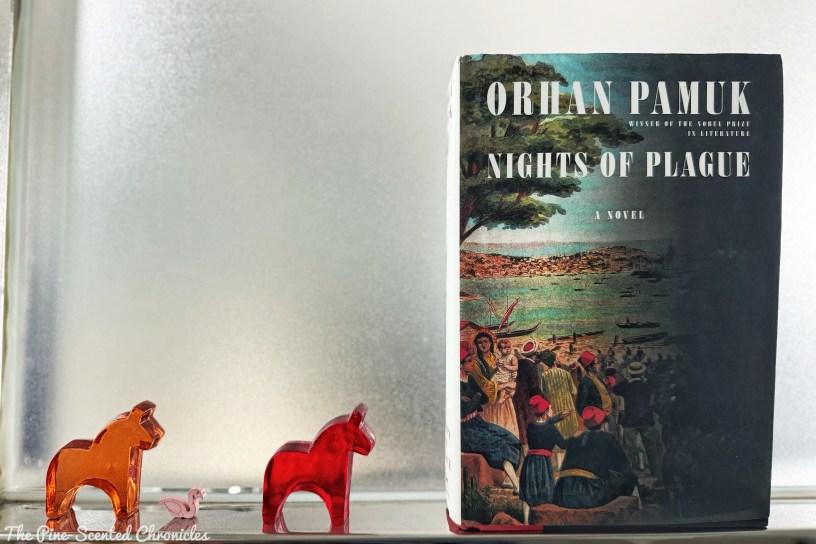
With the pandemic officially under control, the pandemic has nevertheless found its niche in various details of our quotidian existence. In the realm of literature, it was a catalyst for the rise of the pandemic literature. Isabel Allende’s Violeta (2022), for instance, is bookended by the two most recent pandemics that swept humanity. It is a sobering reminder about the lingering presence of pathogens that can shape the landscape of history. Sequoia Nagamatsu’s How High We Go in the Dark (2022), on the other hand, is a literary science fiction fantasy that takes the readers into the future. It paints a world that has been irreversibly altered by various pandemics. Even Hanya Yanagihara’s To Paradise (2022) takes inspiration from the pandemic. Another highly-heralded writer who lent his voice to the growing pandemic literature is Nobel Laureate in Literature Orhan Pamuk with his most recent novel, Nights of Plague.
Nobody ever wants a quarantine, not governors or mayors, not shopkeepers nor the rich. Nobody wants to accept that the comfortable lives they are accustomed to might suddenly come to an end, let alone that they might die. They will reject any evidence that disrupts their usual ways, they will deny any deaths, and even resent the dead.
Orhan Pamuk, Nights of Plague
Originally published in Turkish in 2021 as Veba Geceleri, the novel takes the readers to the early 20th century. At midnight in 1901, an unscheduled ferry, the Aziziye, “stealthy as a spy vessel and bearing the Ottoman flag,” approaches the Arkaz Harbor of the fictional Mediterranean island of Mingheria which is located between Crete and Cyprus; the ship departed from the Ottoman capital of Istanbul. On the island, a health crisis is looming, and to contain the spread of the disease, Sultan Abdul Hamid II (1842-1918) dispatches his top public health official, Bonkowski Pasha; the first cases of the plague were forced into silence lest chaos ensue. The Chief Inspector of Public Health and Sanitation is also a renowned chemist and pharmacist who was fresh from containing a possible outbreak of the bubonic plague in Smyrna. Also aboard the Aziziye were Princess Pakize, the niece of the Sultan, and her husband, Prince Consort Doctor Nuri Bey. The newlywed couple were enroute to China for a diplomatic mission.
After dropping off, the Aziziye – and consequently, the Princess and her husband – proceeded with their journey. Before disembarking in Mingheria, Bonkowksi confides to the newlywed about the emerging outbreak. When the ship docked on the harbor of Alexandria, an urgent and ominous message was waiting for the newlyweds. They were being recalled, ordered by the Princess’ uncle to return to Mingheria. They are to help stymie the spread of the plague. Doctor Nuri Bey happens to be a renowned epidemiologist and a quarantine doctor. With an outbreak evident, his expertise is urgently needed. But there is a more sinister reason for the urgent call to return. Bonkowski Pasha, who also happens to be Nuri’s mentor, was murdered shortly after he arrived on the island. His assistant was also killed by a poisoned rose-and-walnut biscuit. What unfolds is a two-tiered story. Nuri Bey was not only tasked with containing the outbreak but he was also given the responsibility of resolving the murder of his mentor.
Like the orders provided to Bonkowski, Nuri Bey’s mission was to be done under the cloak of secrecy. Both the sultanate and the governor’s office did not want to stir panic. The couple was even assigned by Sami Pasha, the provincial governor, to the most inconspicuous of accommodations. This was, in a way, to assuage any fears and reassure the denizens that everything was fine. Despite the threat of the contagion, the governor also convened a crowd for a welcome ceremony for the newlyweds. This nonchalance displayed by the local officials was an ominous sign for Nuri Bey in his mission to control the outbreak of the contagion. Further, Nuri Bey’s actions vis-à-vis the containment of the plague, including sanitary measures, have to go through Sami Pasha, the governor. It did not help that the ambitious governor initially dismissed the idea of an outbreak.
As events on the island start to unfold and intensify, it starts to feel all too familiar. While the novel was set at the turn of the 20th century the fine prints of the novel eerily recall the events that transpired at the start of the COVID-19 pandemic. Considering the point in time when Pamuk worked on the novel- he started working on the novel even before the onset of the COVID-19 pandemic – it is unsurprising to find details that parallel our experience of the recent pandemic. It is in this facet that the novel slowly turns political. For one, the governor’s initial reaction to the news of the outbreak in his province is akin to how governments across the world downplayed the more recent pandemic. Their apprehension is similar to Sami Pasha’s. Political stonewalling was also prevalent. However, once the unimaginable turns into reality and an emergency, everyone starts to act accordingly.
People would die alone while hiding from the plague and the world in some invisible, untraceable recess they had so proudly made their own, and only be discovered when their corpses began to reek. Cooks, maids, watchmen, and married couples would break into empty homes that had been boarded up and abandoned after their owners had fled the outbreak, and die in there with no one finding out for days.
Orhan Pamuk, Nights of Plague
Despite the urgency and the magnitude of the situation, the populace remains reluctant. In particular, merchants, traders, and shopkeepers were resistant to lockdown. These are among the early challenges health professionals faced during the COVID-19. It was not only the traders and merchants who were resistant to the quarantine measures. The denizens of the island were also reluctant to submit themselves to the restrictions and measures related to the containment of the pandemic. There was an utter disregard for hygiene which came with great consequences. This exacerbated the exponential increase in cases. In no time, lifeless bodies were ubiquitous. As the island was locked up from the rest of the empire, the olfactory senses were offended by the unbearable stench of decaying corpses intermingling with the smell of Lysol.
The recent pandemic has altered the landscape of our time and the way we understand and appreciate health protocol, hygiene, and quarantine measures. In particular, the recent pandemic has challenged our view of vaccines. The attitude of Mingherians, in a way, mirrors the anxieties of the populace when the pandemic spread globally. In this way, the novel has become a reflection of contemporary rather than historical events. Nevertheless, both the fictional and the reality have become catalysts for drastic but timely changes. In the present, the COVID-19 pandemic ushered the advent of the new normal which also dismantled and challenged traditional views of various aspects of our quotidian existence. Office working arrangements, for one, were revisited. The recent pandemic also drastically changed the general public’s understanding of healthcare and vaccines.
The novel’s political overtones were further portrayed through the lives of a bevy of characters, among them Sami Pasha. The governor has been a career colonial officer but his career has been anything but stellar. He is easy-going but also ambitious with tendencies for cruelty. Princess Pakize, on the other, has lived a sheltered life. Her husband has been chosen for her by her uncle, the Sultan whose presence in the novel, ironically, has been minimal. The novel’s main narrative frame came from the letters the Princess wrote to her sister in Istanbul. These letters provide intimate glimpses into society’s struggles and the stark dichotomies between the privileges of the affluent and the struggles of the destitute. It is these letters that would be narrated by Mina Mingher, an academic and the Princess’ great-granddaughter, in 2017; in the novel’s Preface, she was introduced as the novel’s spiritual guide – and perhaps Pamuk’s alter ego. The local government was also overrun by informers and spies. Interestingly, power on the island rests on the shoulders of the Chief Scrutineer.
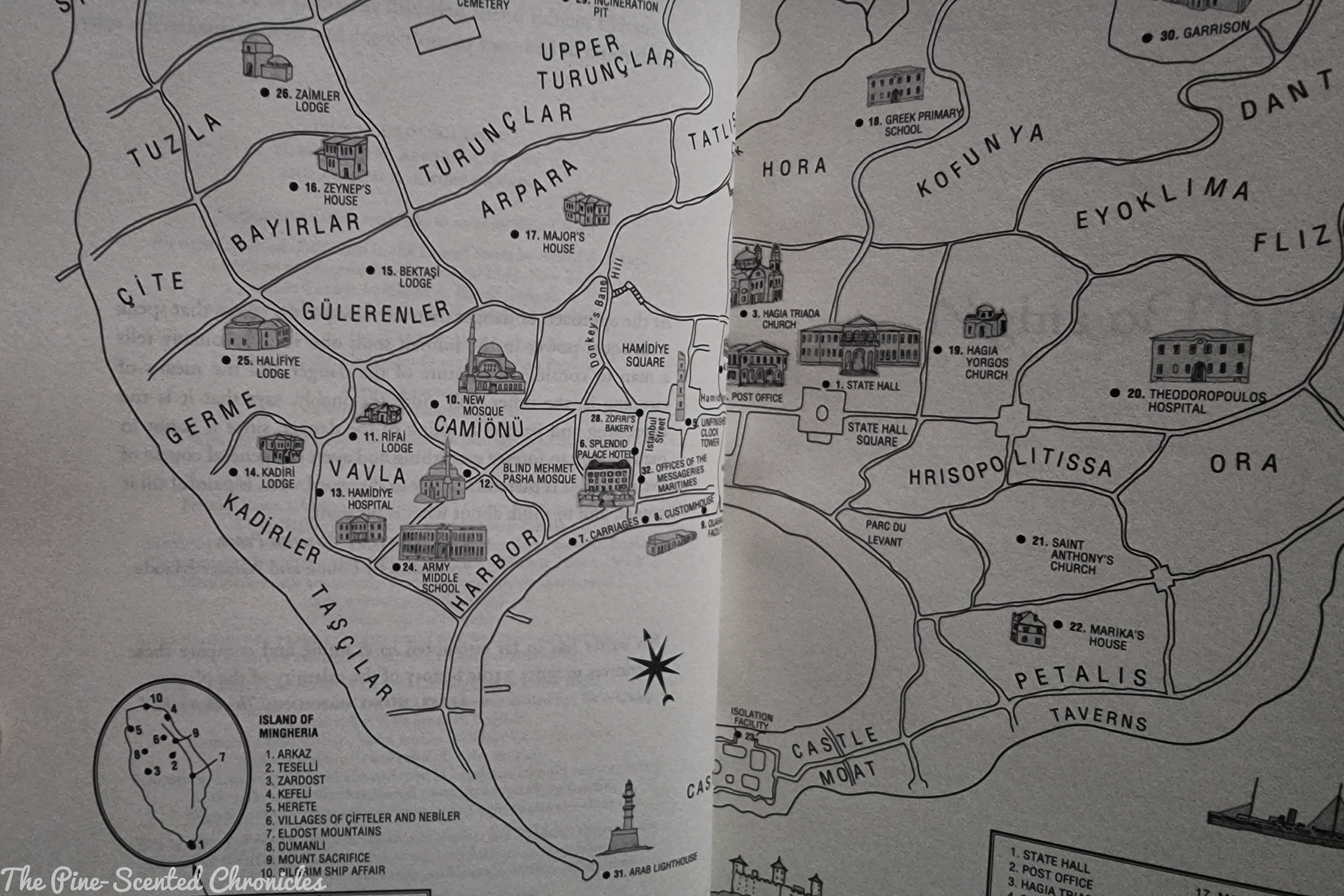
In Pamuk’s eleventh novel, the plague has set into motion a different kind of movement that would redefine the landscape of history. Tucked in the Aegean Sea, Mingheria was more than just a fictional setting. It was crafted by Pamuk with his literary élan to be an allegory. Pamuk does not spare any detail in breathing life into Mingheria; his vivid worldbuilding was one of the novel’s highest achievements. His brilliant strokes – remarkable albeit lengthy descriptions – brought Mingheria to life. This was complimented by a detailed map of Arkaz which lent the novel a sense of realism that appeals to the readers’ imagination. The home to over 80,000 people, Mingheria is an island utopia famed for its pink stone, drenched in “pink, yellow, and orange hues.” It is a jewel riddled with mountains and spires that have enchanted travelers. is an island paradise that has even inspired Homer and Pliny.
Instead of considering the injustice we have suffered, locked up in harems like caged birds, they mocked us and dared to laugh at us for knowing nothing of the world outside! But perhaps all of these people are right to find satisfaction in our misery and invent all kinds of tales and drolleries about us.
Orhan Pamuk, Nights of Plague
But these details merely scratch the surface. As the pandemic comes to a head, the island and its populace are placed at the center of history as it grapples with the growing call for identity, nationalism, and independence. With a religious and ethnic demography equally divided between Christians and Muslims, and Greeks and Turkish, the island is a cultural melting pot. But it is also the stark dichotomies between these ethnic groups that also resulted in divides. With this divergent population, the novel examines cultural tensions and religious fractures that permeate the twilight of the once-mighty Ottoman Empire; this is similar to the case of Cyprus which would eventually be divided between the Greek Christians and the Turkish Muslims. Transcending their religious, ethnic, and cultural differences, the Mingherians were able to create a collective identity.
Not only were the denizens of the island faced with the challenge of the pandemic, but they were also confronting the oppressive regime that has repressed the island for centuries. The islanders take matters into their own hands. What was once a health crisis haphazardly snowballs into a struggle for independence. But as the Mingherians rose to the occasion, what was glaringly absent was the communal violence that was prevalent in the other parts of the Ottoman Empire fighting for their independence. This can be attributed to the isolation of the island, physically and also due to the lockdown imposed to stymie the spread of the plague. It is detached from the realities that permeate the Empire. As such, Mingheria transforms into a microcosm for the rest of the Empire while being its own. The locals’ growing call for liberty from the Empire and its oppression resonated with the rest of the Empire which was slowly inching toward collapse. All the while, actual historical figures and characters based on them populate the novel.
Pamuk’s novel came at the most opportune time. Politics, mystery, science, and the pandemic converged for an intriguing read that is, at the same time, a timely read but also a richly textured historical chronicle. Nights of Plague vividly painted the portrait of the decline of the Ottoman Empire which was slowly undone by its weak-willed leaders and its oppression of its subjects. This paved the way for a growing call for independence not only in Mingheria but across the Empire; the case of Mingheria only underscores the internal decay that has dismantled the once-influential and powerful Ottoman Empire. On a broader scale, the novel examines identity and nationalism. The novel also finds relevance in its depiction of the effects of the pandemic timely reminder and a sobering call on the dangers of the pandemic, of how the refusal to submit to protocols can exacerbate a health crisis. Nights of Plague is an immersive read albeit too long for its own good, in dire need of taut editing. Digressions and unnecessary details that do not further the novel undermine it. Nevertheless, it accomplishes what it has set out to achieve: transport the readers to an enchanting world.
As soon as this magnificent image—which Homer described in the Iliad as “an emerald built of pink stone”—appeared on the horizon, ship captains of a finer spiritual disposition would invite their passengers on deck so that they could savor the views.
Orhan Pamuk, Nights of Plague
Book Specs
Author: Orhan Pamuk
Translator (from Turkish): Ekin Oklap
Publisher: Alfred A. Knopf
Publishing Date: 2022 (2021)
Number of Pages: 683
Genre: Historical, Literary
Synopsis
It is April 1901 on the imaginary island of Mingheria – the twenty-ninth state of the Ottoman Empire – located in the eastern Mediterranean between Crete and Cyprus. Half the population is Muslim, the other half is Greek Orthodox, and tension is high between the two. When a plague arrives – brought either by Muslim pilgrims returning from Mecca or by merchant vessels coming from Alexandria – the island revolts.
To stop the epidemic, the Ottoman sultan Abdul Hamit II sends his most accomplished quarantine expert, an Orthodox Christian, to the island. Some of the Muslims, including followers of a popular religious sect, refuse to take precautions or respect the quarantine. And then a murder occurs.
As the plague continues its rapid spread, the Sultan next sends his niece, Princess Pakize, and her husband, an acclaimed doctor (and a Muslim), to manage the crisis. But the incompetence of the island’s governor and local administration, and the people’s refusal to respect restrictions, doom the quarantine to failure – and the death count continues to rise. Because of the danger that the plague might spread to the West, the people of Mingheria are cut off and left to defeat the plague themselves.
Steeped in history and rife with suspense, Nights of Plague is an epic story of love, politics, and a nightmarish plague that threatens to bring an end to an empire. It is a stunning work from one of our most essential writers.
About the Author
To learn more about the 2006 Nobel Prize in Literature awardee and esteemed Turkish writer, click here.
 The Pine-Scented Chronicles