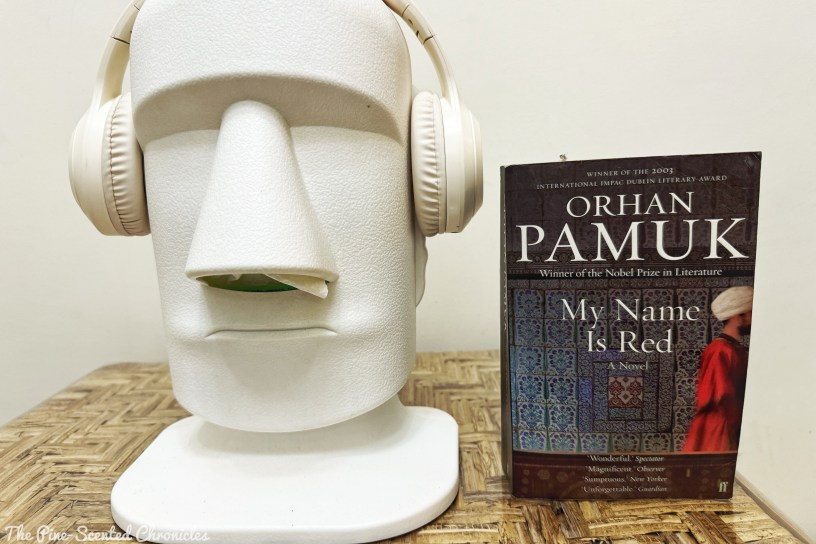
When West Meets the East
In the realm of contemporary Turkish literature, one of the most influential and prominent names is Ferit Orhan Pamuk. Born on June 7, 1952, in Istanbul to an affluent but declining family, Pamuk was raised in the city’s westernized and prosperous district of Nişantaşı. Interestingly, writing was not a vocation that initially caught Pamuk’s fancy; his is a story not uncommon among the world’s most prominent writers—he dreamed of becoming a painter. Pursuing this dream, Pamuk studied architecture at Istanbul Technical University after graduating from the secular American Robert College. However, as fate would have it, he eventually gave up his aspirations of becoming an architect and artist. Instead, he completed a degree in journalism at Istanbul University—though he never worked as a journalist. At the age of twenty-three, Pamuk decided to become a novelist.
In 1974, Pamuk began to take his writing seriously. The fruit of this labor was Cevdet Bey ve Oğulları or Karanlık ve Işık (Cevdet Bey and His Sons or Darkness and Light), which was published in 1982. The novel was an immediate critical success, earning the budding writer the Orhan Kemal and Milliyet literary prizes. Notably, Pamuk’s debut novel remains the only one of his works not translated into English. Further success followed with the publication of his second novel, Sessiz Ev (1983; Silent House). A global breakthrough was within reach, and sure enough, international fame arrived with his third novel, Beyaz Kale (1985; The White Castle), which won the 1990 Independent Award for Foreign Fiction. The rest, as they say, is history. With millions of copies of his books in print, Pamuk is Turkey’s best-selling writer. In 2006, he received one of the world’s highest literary honors when the Swedish Academy awarded him the Nobel Prize in Literature.
In awarding the Prize to the Turkish author, the Swedish Academy cited two of Pamuk’s works. The first was his debut novel; the second, My Name is Red. For readers around the world, it is a literary experience par excellence. The book earned Pamuk widespread acclaim and several prestigious literary awards, including the 2003 International Dublin Literary Award, the Prix du Meilleur Livre Étranger for its French translation, and the Premio Grinzane Cavour for its Italian translation. It is no wonder that many literary critics have cited it as his magnum opus. Like most of his works, the novel is set in Istanbul, Pamuk’s home city. Istanbul is the muse of Pamuk’s oeuvre, and his vivid portrayal of it earned him the Swedish Academy’s recognition. In their citation, the Academy praised Pamuk, “who, in the quest for the melancholic soul of his native city, has discovered new symbols for the clash and interlacing of cultures.”
I do not conceal myself: For me, delicacy manifests itself neither in weakness nor in subtlety, but through determination and will. So, I draw attention to myself. I’m not afraid of other colours, shadows, crowds or even of loneliness. How wonderful it is to cover a surface that awaits me with my own victorious being! Wherever I’m spread, I see eyes shine, passions increase, eyebrows rise and heartbeats quicken. Behold how wonderful it is to live! Behold how wonderful to see. I am everywhere. Life begins with and returns to me. Have faith in what I tell you.
Orhan Pamuk, My Name is Red
Originally published in 1998 as Benim Adım Kırmızı, My Name is Red transports readers to late sixteenth-century Constantinople, where the story unfolds over nine snow-filled days. It opens with the voice of a recently deceased man. In the first chapter, titled “I Am a Corpse,” the dead man, Elegant Effendi, recounts his own murder as his body lies at the bottom of a well. Elegant Effendi was an illuminator in a workshop of miniaturists during the reign of Sultan Murad III. Speaking directly to the reader in the afterlife, he speculates about the motives behind his murder. He suspects it is tied to attempts to challenge Muslim artistic traditions and redefine the purpose of art. However, he cannot name his killer, as he becomes lost in his memories. Still, from the afterlife, he hopes that his body will be discovered and that justice will be served.
Shortly after Elegant Effendi’s murder, thirty-six-year-old Black — a once-promising apprentice miniaturist — returns to his birthplace after twelve years working as a civil servant elsewhere far from the imperial capital. He had been virtually banished from the city by his maternal uncle and former mentor, Enishte Effendi, a book dealer. Now, Black hopes to reconcile with his uncle, who has recently been facing financial hardship. Enishte, for his part, is pleased with Black’s newfound maturity. When Elegant’s body is finally discovered, the story begins to unravel. Grief-stricken by the death, Enishte confides in Black: the Sultan has commissioned him to create a secret book.
This mysterious book becomes the backbone of the novel. Completing the Sultan’s request is no simple task. Enishte assembles a group of skilled miniaturists—bound by an oath of secrecy—to work on the project, with Elegant originally serving as the gilder. Even before Elegant’s murder, Enishte had struggled to finish the final illustration. Now, he turns to Black for help. Meanwhile, suspicion falls on the other three miniaturists involved in the book’s creation: Stork, Olive, and Butterfly. All four miniaturists were trained under Master Osman, the Head Illuminator of the court. Notably, Enishte and Master Osman are intellectual rivals, each holding opposing views on art and tradition. Tensions rise sharply when yet another murder occurs, further complicating the intrigue.
I’m a dog, and because you humans are much less rational beasts than I, you’re telling yourselves, ‘Dogs don’t talk.’ Nethertheless, you seem to believe a story in which corpses speak and characters use words they couldn’t possibly know. Dogs do speak, but only to those who know how to listen.
Orhan Pamuk, My Name is Red
At this juncture, Black finds himself unwittingly—and unwillingly—entangled in a web of intrigue, murder, and mystery. With the Sultan’s fury reaching a boiling point, Black is summoned to the Palace and added to the list of suspected murderers. To prove his innocence, he must work with Master Osman to uncover the real killer. The Sultan issues an ultimatum: Black has just three days to solve the case, or he will face dire consequences. The only clue in Black’s possession is an illustration of horses found on Elegant’s corpse. Kabilye, Elegant’s widow, insists the drawing is not her husband’s work. In a race against time and with very few leads, Black launches a rigorous investigation, leaving no stone unturned. Who killed Elegant, and what motivated the murder? What is the nature of the mysterious book the miniaturists were working on? And why was its creation cloaked in secrecy?
As these questions come to the fore, My Name is Red evolves into a murder mystery that captures the reader’s imagination. Clues about the murderer’s identity are subtly scattered throughout the novel—dropped not only by the killer but also by seemingly inanimate objects that witnessed various interactions. The novel invites the reader to solve the mystery alongside Black, making them an active participant in the unfolding drama. Adding depth to this mystery is the novel’s polyphonic structure. The narrative is told from multiple perspectives, including coins, trees, a dog, a horse, and even the color red. These seemingly innocuous entities offer their own testimonies, revealing what they have seen or sensed. Even the murderer is granted a voice, drawing readers into a world where every perspective matters. It is around these distinctive and often unexpected viewpoints that the novel is artfully constructed.
Yet, My Name is Red is far more than a simple whodunit. As the plot progresses, the novel becomes a sophisticated and nuanced exploration of the nature of art itself. Early on, Enishte recounts a journey to Venice, where he was both fascinated and unsettled by the realism of European Renaissance painting. While he admired the detail and perspective, he was also disturbed by its intensity and departure from Islamic artistic traditions. In stark contrast, Ottoman miniature painting emphasized anonymity, repetition, and spiritual reflection. Signature and portraiture—hallmarks of European art—were often considered idolatrous in Islamic contexts. The focus was not on the individual, but on the eternal and the divine. As one character expresses, “It is important that a painting, through its beauty, summon us toward life’s abundance, toward compassion, toward respect for the colors of the realm which God created, and toward reflection and faith.”
Maybe you’ve heard the story of the man who was so driven by this curiosity that he roamed among soldiers in battlefields. He sought a man who had died and returned to life amid the wounded struggling for their lives in pools of blood, a soldier who could tell him about the secrets of the Otherworld. But one of Tamerlane’s warriors, taking the seeker for one of the enemy, cleared him in half with a smooth stroke of his scimitar, causing him to conclude that in the Hereafter man is split in two.
Orhan Pamuk, My Name is Red
With Westernization looming, Ottoman artists began to fear the disintegration of their artistic tradition. It was becoming increasingly evident that Ottoman methods and aesthetic principles were slowly being forgotten or dismissed. Some miniaturists had already begun to incorporate Western influences into their work—an act viewed by many as a deviation from Islamic ideals. This shift incited anger among purists and extremists, who perceived such foreign elements as a threat to the preservation of their culture and heritage. The discourse on the stark dichotomies in artistic representation, however, was far from superficial. It served as one of the driving forces behind the murders in the novel. As Pamuk demonstrates, art is not neutral—it has the power to provoke deep emotional responses. On one hand, it can incite fear, resentment, and even violence. On the other, it can inspire and unify. As Master Osman reflects, art—through the faithful recreation of the same images over centuries—has borne witness to the gradual transformation of their world into something new.
Within this crucible of artistic tension, seemingly innocuous details can spiral into far-reaching consequences. In My Name is Red, art becomes both a battlefield and a bargaining tool. It is used to appeal to the West, sometimes at the expense of Islamic tradition. Yet the novel’s exploration of the Western impact on Oriental art extends far beyond aesthetics; it becomes a metaphor for larger cultural and political tensions. Pamuk uses this artistic conflict as a microcosm to explore the broader effects of Western encroachment on Eastern ideals. Although the theme is familiar, Pamuk crafts a compelling and original story by infusing it with his own literary and cultural sensibilities. Several characters express the fear that Western influence on their art will inevitably seep into their religious beliefs and cultural practices. Despite its historical setting, the novel’s central tension remains deeply relevant today, especially as modern Turkey continues to navigate its complex identity within a multicultural and increasingly globalized society.
The change captured by art is mirrored in the transformation of Istanbul itself—a city Pamuk vividly and lovingly brings to life in the novel. Strategically located at the intersection of East and West, Istanbul has long stood as a symbol of cultural convergence. Its layered history and evolving landscape make it the perfect backdrop for a narrative rooted in the tension between tradition and innovation. Pamuk approaches the subject with a liberal and reflective sensibility. He suggests that cultural interaction need not mean cultural erasure. Fundamentalism, he implies, is ultimately futile because history has always been shaped by the interplay of influences. Even Ottoman miniature painting, revered for its purity, was originally influenced by the masters of Herat in the East. In that light, innovations from the West deserve recognition as well. This balance between tradition and change is acknowledged by several characters in the novel. When Enishte accepts the Sultan’s commission—to create a book that subtly integrates Western elements—it becomes a quiet, yet politically significant, act of negotiation between two worlds.
We embraced. This so pleased me that I felt no guilt. I let myself be borne away by sweet emotion. I hugged him tighter. I let him kiss me, and I kissed him back. And as we kissed, it was as if the entire world had entered a gentle twilight. I wished everybody could embrace each other the way we did. I faintly recalled that love was supposed to be like this.
Orhan Pamuk, My Name is Red
In this labyrinthine and multifaceted novel, life and death emerge as subtly prominent themes explored through the lens of Islam. Several characters express a belief in the afterlife. As Elegant reflects on his own death, he declares: “There is indeed another world, thank God, and the proof is that I’m speaking to you from here. I’ve died, but as you can plainly tell, I haven’t ceased to be.” Even inanimate objects and animals are imbued with consciousness. Viewed from one perspective, this is an extension of art imitating life. The inclusion of these non-human perspectives not only adds unique texture to the narrative but also invites readers to question how the objects surrounding us might perceive our existence. Beyond art, Pamuk explores religion with depth and nuance. He advocates for a separation between religion and state affairs. With an unflinching yet objective gaze, he illustrates how religious extremism can hinder the progress of multicultural societies—Turkey being a prime example. Through his exploration, Pamuk critiques the rigidities of dogma while still acknowledging the spiritual weight that religion holds for his characters.
Pamuk weaves these themes into a rich narrative tapestry with his deft storytelling. Beyond the recurring motifs of murder, art, and religion, he introduces a third vital dimension: love and desire, most poignantly expressed in the story of Black and the beautiful Shekure, once childhood sweethearts. When their illicit affair was uncovered, Enishte orchestrated Black’s banishment and arranged Shekure’s marriage. But Shekure’s husband was sent to war and has not returned. Though Shekure believes her husband is dead, society refuses to acknowledge her as a widow. Living in the household of her father-in-law and brother-in-law Hasan, she suffers from Hasan’s menacing presence and sexual aggression. This prompted her to return to her father’s house, along with her sons. With Black’s return, old emotions resurface, and the two lovers rekindle their romance amid uncertainty and fear.
All of these narrative elements—life, death, love, faith, politics, and art—are seamlessly and masterfully woven together. Pamuk crafts a richly layered and evocative literary masterpiece that subtly and astutely illuminates the identity crisis experienced by the Ottomans—a crisis that continues to echo in modern Turkey. Art and its intersection with religion become the crucible through which Pamuk examines the West’s looming influence on the East. This central theme intersects with others: mortality, desire, autonomy, and ideology. My Name is Red is also a cautionary tale about the dangers of extremism and fundamentalism. Just as art can elevate and preserve beauty, it also holds the power to destroy. At once a murder mystery, philosophical reflection, love story, and historical narrative, My Name is Red stands as a literary tour de force from a master wordsmith.
Before the art of illumination there was blackness and afterward there will also be blackness. Through our colors, paints, art and love, we remember that Allah had commanded us to “See”! To know is to remember that you’ve seen. To see is to know without remembering. Thus, painting is remembering the blackness. The great masters, who shared a love of painting and perceived that color and sight arose from darkness, longed to return to Allah’s blackness by means of color. Artists without memory neither remember Allah nor his blackness. All great masters, in their work, seek that profound void within color and outside time.
Orhan Pamuk, My Name is Red
Book Specs
Author: Orhan Pamuk
Translator (from Turkish): Erdağ M. Göknar
Publisher: Faber and Faber
Publishing Date: 2001 (1998)
Number of Pages: 666
Genre: Historical, Literary
Synopsis
In Istanbul, in the late 1590s, the Sultan secretly commissions a great book: a celebration of his life and his empire, to be illuminated by the best artists of the day. But when one of the miniaturists is murdered, their master has to seek outside help. Did the dead painter fall victim to professional rivalry, romantic jealousy or religious terror?
A thrilling murder mystery, My Name is Red is also a stunning meditation on love, artistic devotion and the tensions between East and West.
About the Author
To learn more about the 2006 Nobel Prize in Literature awardee and esteemed Turkish writer, click here.
When faced with Death, people lose control of their bodily functions—particularly the majority of those men who are known to be brave-hearted. For this reason, the corpse-strewn battlefields that you’ve depicted thousands of times reek not of blood, gunpowder and heated armor as is assumed, but of shit and rotting flesh.
Orhan Pamuk, My Name is Red
 The Pine-Scented Chronicles