A Strongman in Decline
Like much of the world, Latin America had, for the most part, been a colony of various maritime powers—primarily Spain and Portugal. This colonization coincided with the erosion of some of the most prominent civilizations the world has ever seen: the Mayans, Incas, and Aztecs. For centuries, the continent witnessed oppression and exploitation by its European subjugators. Tired of these injustices and atrocities that effectively silenced them, the populace began to band together, giving rise to a surge in nationalist sentiment. Independence movements soon swept across the continent during the latter half of the 18th century. As tensions peaked, several Latin American colonies successfully overthrew their colonizers, reclaimed sovereignty, and installed their own leaders in the first half of the 19th century. Instrumental to this process was a select group of courageous individuals who led these uprisings.
Among this group of heroes who played a seminal role in the continent’s liberation was General Simón José Antonio de la Santísima Trinidad Bolívar y Palacios, a Venezuelan aristocrat more widely known as General Simón Bolívar. Orphaned at a young age, Bolívar grew up in affluence and was educated in Europe. His brilliance was apparent early on. He stood apart from his peers in ideas, vision, and values. A voracious reader, he immersed himself in the works of European rationalist thinkers. In the military, he quickly distinguished himself, rising through the ranks. As the Latin American independence movement gained momentum, he became one of its most fervent advocates. Starting in his homeland, Bolívar led numerous liberation campaigns that resulted in the independence of several Latin American colonies.
For his pivotal contributions, Bolívar—often referred to as Latin America’s George Washington—built a legacy that transcended both time and geography. His role in liberating the continent cannot be overstated. Beyond his military achievements, he served as the President of Gran Colombia from 1819 to 1830 and as Dictator of Peru from 1823 to 1826. In the contemporary, his influence is enshrined in the names of towns and provinces throughout Latin America. Most notably, the present-day nation of Bolivia bears his name. Venezuela’s official title is the Bolivarian Republic of Venezuela, and its currency is the bolívar. Numerous public monuments have been erected in his honor. UNESCO even created the International Simón Bolívar Prize to recognize actions of outstanding merit aligned with his ideals.
Then he crossed his arms over his chest and began to listen to the radiant voices of the slaves singing the six o’clock Salve in the mills, and through the window he saw the diamond of Venus in the sky that was dying forever, the eternal snows, the new vine whose yellow bellflowers he would not see bloom on the following Saturday in the house closed in mourning, the final brilliance of life that would never, through all eternity, be repeated again.
Gabriel García Márquez, The General in his Labyrinth
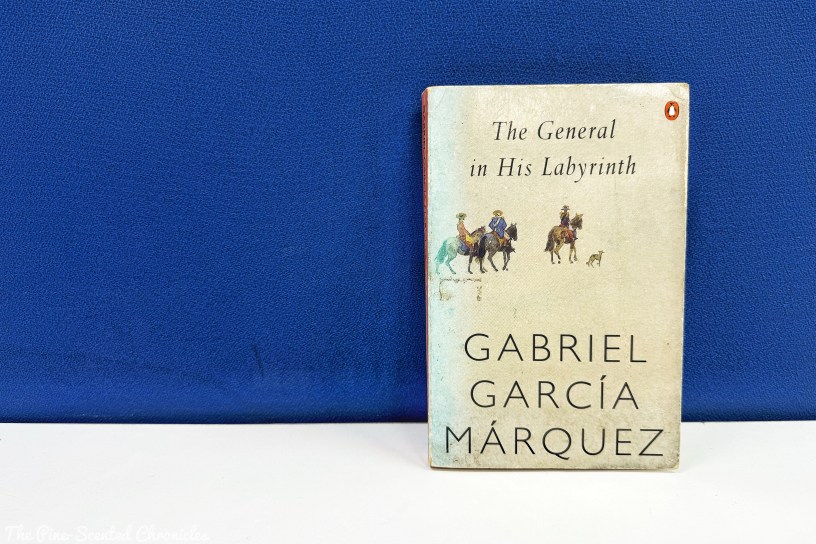
The General’s influence is so vast and far-reaching that legacy has inspired countless works of literature. Among these works inspired by the General’s life was Gabriel García Márquez’s novel, The General in His Labyrinth. Originally published in Spanish as El general en su laberinto in 1989, the idea for the novel was born after Gabo read an unfinished novel by his friend Álvaro Mutis. Through a translation by Edith Grossman, the novel was eventually made available to Anglophone readers a year after its initial publication. The story centers on the titular General — named only once throughout the novel — and begins on May 8, 1830, as Bolívar prepares to travel from Santa Fe de Bogotá to the port of Cartagena de Indias. He intends to journey to Europe. The novel traces his river voyage along the Magdalena River.
Nicknamed the Liberator for freeing the northern part of South America from Spanish rule, Bolívar dreamed of founding Gran Colombia — a unified federation of newly independent former colonies. Toward this dream, he led the overthrow of the Spanish in Venezuela in 1821. Years of warfare followed. Bolívar was involved in multiple uprisings and skirmishes across the region, and most of the former colonies eventually gained their independence. For a brief time, his vision materialized: Gran Colombia was born, and Bolívar was named its leader. But the unification was short-lived. Deep political divisions, economic instability, and the machinations of his adversaries — chief among them his rival Francisco de Paula Santander — led to its collapse. Interference from Mexican federalists and Bolívar’s own increasing authoritarianism further destabilized the fragile state.
By the time the novel opens, Bolívar is in his late forties and in a visibly weakened physical state. Decades of warfare have taken their toll on the General, and his failure to realize his ambition has further eroded his spirit. In The General in His Labyrinth, readers meet a Bolívar on the brink of decline. Unfolding over eight unnumbered chapters — corresponding to the eight ports along the river — the novel offers a fictionalized account of the last seven months of his life. The journey along the river — he was accompanied by an entourage consisting of José Palacios, five aides-de-camp, his clerks, and his dogs — was anything but uneventful; the General’s reputation, after all, precedes him. However, with every stop and every encounter with the populace he once governed, the General’s journey only underscored his waning prestige.
Throughout the voyage, Bolívar revisits the triumphs, tribulations, passions, and betrayals of his life. Some vestiges of his former glory were evident during the journey. He still had some loyal supporters amongst those whom he encountered during the journey. Still considering the General as the legitimate President of Gran Colombia, they hosted banquets in his honor. Meanwhile, news about the current state of affairs in Gran Colombia reaches him. Through General Daniel Florencio O’Leary, once the General’s most trusted aide-de-camp, the General learns how General Rafael Urdaneta is challenging the legitimacy of Joaquín Mosquera’s presidency. The Bolívar’s absence has created a political vacuum, and in response to the instability gripping the region, calls for his return to power grow louder.
He covered her from head to foot with shaving lather, and with a pleasure like that of love he shaved her clean with his razor, sometimes using his right hand and sometimes his left as he shaved every part of her body, even the eyebrows that grew together, and left her doubly naked inside her magnificent newborn’s body. She asked, her soul in shreds, if he really loved her, and he answered with the same ritual phrase he had strewn without pity in so many hearts throughout his life: “More than anyone else in this world.”
Gabriel García Márquez, The General in his Labyrinth
Ultimately, the aspirations of the General were slowly crumbling before his very eyes. The irony is inescapable: the very government he helped build now rejects him. In a way, the Gran Colombia he created and the General share a common destiny. At the onset, both were brimming with dreams and ambitions. Fresh from its liberation from its subjugators, Gran Colombia was brimming with promise. The General, on the other hand, was brimming with enthusiasm. They were both filled with vitality. However, they were both undone by forces that were beyond them. Corruption, betrayal, and internal strife, coupled with the intervention of outside forces, undermined the newly-founded Gran Colombia. Meanwhile, the General was beset with a lingering mysterious illness that essentially reduced the General into a shadow of his old self.
García Márquez’s choice to focus on the twilight of Bolívar’s life is deliberate. The juxtaposition of the physical deterioration of Bolívar the man and the glorious exploits of Bolívar the legendary hero was one of the novel’s major theme. Through a mixture of flashbacks, memories, and dreams, the Nobel Laureate in Literature painted a vivid portrait of the hero the General once was. The novel was rich in historical context, highlighting the major political and military exploits that have shaped the General’s life. The General also reflected on the people that surrounded him: his great friends like Field Marshal Antonio José de Sucre; his lovers, particularly Manuela Sáenz; and even his significant enemies, such as General Santander. Each character provided a different dimension of the General’s character.
In a way, García Márquez was also dismantling the man of myth through his introspective work. Breathing life into one of the most renowned historical figures who shaped the modern landscape of the Latin American political map, García Márquez evoked both the General’s greatest feats with his tribulations. More importantly, glimpses into the General’s psyche humanized him. The General’s personal charm warmed both women and men alike, contrasted with his façade of courage and indomitability which inspires the same from those he leads. García Márquez takes the readers to private moments and public ceremonies, painting the General as the quintessence of Latin American machismo: virile and full of vitality. His verve saw him through several battles and adversities. On the other hand, García Márquez parses this mythic image by depicting the General’s flaws and moments of weakness.
Perhaps because of his vastly recognized acts of heroism — or in spite of it — Bolívar becomes fixated with his legacy. Cognizant of his role in changing the landscape of history, he desperately wants his strongman image preserved. Yet his deteriorating body and fragile mind betray him. He is forced to confront his mortality, clinging to dignity while wrestling with disillusionment. As the journey continues, he begins to understand how the people of Gran Colombia now view him. Though some remain loyal, others regard him with suspicion or disdain. As his political dream collapses, so too does the myth of the unassailable hero. Public opinion turns against him, and the lack of widespread support leaves him isolated and desperate.
He had fought all his wars in the front lines, without suffering a scratch, and he had moved through enemy fire with such thoughtless serenity that even his officers accepted the easy explanation that he believed himself invulnerable. He had emerged unharmed from every assassination plot against him.
Gabriel García Márquez, The General in his Labyrinth
As the story unfolds, the labyrinth becomes a powerful allegory. On the surface, it is a physical labyrinth that the General and his convoy navigated. It is Magdalena River and the towns and villages along its shores that the convoy dropped by. It is also Gran Colombia itself, with its dark corners and blind curves that filled with deception. Most profoundly, the labyrinth symbolizes Bolívar himself. He is a complex character with a long and winding life. In The General in His Labyrinth, we meet a man outside of the myth. He is deeply flawed and deeply human. The larger-than-life hero is a man of contradictions and his story meanders through a maze of regrets, memories, and ambitions. Though reduced to a frail and fading figure, Bolívar’s achievements and legacy endure.
Interestingly García Márquez admitted in the Author’s Notes that he was more interested in capturing the landscape of the adventure rather than in rebuilding Bolívar’s profile. He did a resplendent job in painting the adventure, the historical context, and the setting. A physical labyrinth was conjured through his magnificent prose. The larger-than-life hero, nevertheless, came to life with the Nobel Laureate in Literature’s superb prose, astutely weaving realism and fantasy into a lush tapestry. The man of the myth, despite his palpably physical decline, remained a compelling character. He was pared down, with the novel providing a different lens from which to understand and appreciate him. He was a hero but he was human, first and foremost. Through The General in His Labyrinth, the towering figure of Bolívar is not only remembered — but profoundly reimagined.
Book Specs
Author: Gabriel García Márquez
Translator (from Spanish): Edith Grossman
Publisher: Penguin Books
Publishing Date: 1991 (1989)
Number of Pages: 268
Genre: Historical, Dictator Novel
Synopsis
Gabriel Garcia Marquez’s most political novel is the tragic story of General Simon Bolivar, the man who tried to unite a continent.” Bolivar, known in six Latin American countries as the Liberator, is one of the most revered heroes of the western hemisphere; in Garcia Marquez’s reimagining he is magnificently flawed as well. The novel follows Bolivar as he takes his final journey in 1830 down the Magdalena River toward the sea, revisiting the scenes of his former glory and lamenting his lost dream of an alliance of American nations. Forced from power, dogged by assassins, and prematurely aged and wasted by a fatal illness, the General is still a remarkably vital and mercurial man. He seems to remain alive by the sheer force of will that led him to so many victories in the battlefields and love affairs of his past. As he wanders in the labyrinth of his failing powers – and still-powerful memories – he defies his impending death until the last. (Source: Goodreads)
About the Author
To learn more about one of the most-storied and prominent writers of the twentieth century, click here.
 The Pine-Scented Chronicles