Exposing the Underbelly of Modern Nigeria
Born on July 13, 1934, Akinwande Oluwole Soyinka made history in 1986 when he was awarded the Nobel Prize in Literature by the Swedish Academy. This marked the first time in the award’s history that an African writer was recognized. Moreover, he was the first Black African to receive the honor; the next was Tanzania’s Abdulrazak Gurnah, thirty-five years later in 2021. Soyinka was cited for his “wide cultural perspective and poetic overtones fashioning the drama of existence.” A respected figure in literary circles even before his Nobel recognition, the Nigerian writer first gained international acclaim through his plays. These plays defined his career, beginning with The Swamp Dwellers, written and published in 1958. Over the years, he has continued to prove his mettle as a dramatist, writing one successful play after another. Today, he is considered one of the world’s most important dramatists.
Soyinka is, without a doubt, an influential force in Nigerian drama. In recognition of his impact, Nigerian President Bola Tinubu renamed the National Arts Theatre in his honor during Soyinka’s 90th birthday celebration. Of Yoruba descent, Soyinka draws from a rich well of inspiration. Influenced by tradition, politics, and African mythology, he has published memoirs, essays, and poetry collections—his poems often closely tied to the themes and tone of his plays. Soyinka also excelled in prose, contributing short stories to numerous newspapers and periodicals. While he is best known internationally for his dramas and plays, he has also made significant contributions to long-form prose. His first novel, The Interpreters, was published in 1965, followed by Season of Anomy in 1973, before he returned his focus to the stage.
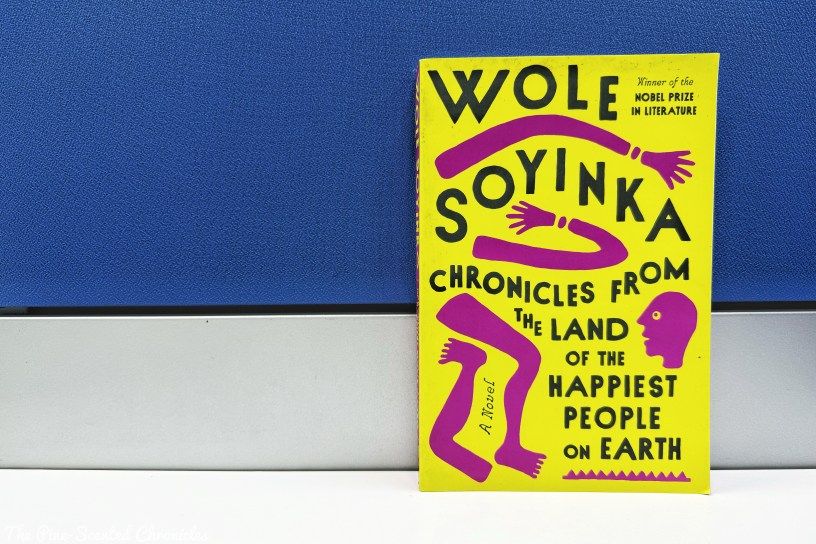
In 2021, nearly half a century after his last novel, Wole Soyinka made his long-awaited return to full-length prose with Chronicles from the Land of the Happiest People on Earth. In this latest work, Soyinka transports readers to a fictionalized version of his native Nigeria, captured through the experiences of a diverse cast of characters who drive the story forward. The novel’s first prominent layer centers on the convergence of the Gong of Four—a fraternity of like-minded, idealistic individuals born in Nigeria whose lives intertwined while studying at a university in England. Driven by a shared dream of returning to their homeland to effect meaningful change, they represent a hopeful vision for the nation’s future. The group’s leader, Duyole Pitan-Payne, is a charismatic and gifted engineer from a prominent family. At the story’s outset, he is preparing to depart for New York City after receiving a prestigious appointment to the United Nations Energy Commission.
The judge had the temerity to sentence him for some arcane crime called ‘mail fraud’. Yet the whole world knew that Divine’s crime was simply that he mobilized his fellow slave descendants to demand that they be repatriated to their continent of origin and that the government of white slaveowners pay their passage home and even pay compensation for generations of enslavement. No one could obscure that truth.
Wole Soyinka, Chronicles from the Land of the Happiest People on Earth
Meanwhile, Duyole’s long-time friendly rival, Dr. Kighare Menka—an accomplished surgeon based in the city of Jos, in Plateau State—has recently been awarded a National Medal of Honour for treating victims of Boko Haram and Islamic State – West Africa Province. Soon after receiving the award, Menka is approached by a mysterious group with a sinister proposition. They invite him to join the board of an illicit organization called Human Resources. This group traffics in body parts gathered from car accidents, gas-line explosions, and terror attacks, selling them to willing buyers. It becomes clear that Human Resources is no small operation—it is a vast, well-organized enterprise with a carefully curated clientele. Menka is targeted because of his access to the organs they need; they want him to serve as their supplier. To his horror, he is even given a tour of one of their facilities.
Though idealistic, Dr. Menka is conflicted. He wishes to expose the group, even sharing what he saw with his clubmates at Jos’ Hilltop Manor. But when the club is mysteriously burned down, he realizes the danger he is in. Relocating to Lagos, Nigeria’s bustling former capital, he accepts an offer from Duyole to stay with him. Together, they draft plans to build a rehabilitation clinic, financed by Duyole’s influential engineering firm, Brand of the Land. For Menka, this project represents the realization of a lifelong dream—to build a hospital in his impoverished hometown. But trouble looms. Despite moving to Lagos, Menka remains a target because of what he knows. Just before Duyole leaves for New York, Menka enlists his help in decoding an encrypted message retrieved from Human Resources’ base of operations.
Meanwhile, another member of the Gong of Four, Prince Badetona—nicknamed “Scoffer”—has also risen to prominence as a skilled accountant. However, his financial maneuverings catch up with him, and he finds himself imprisoned for money laundering. Before his incarceration, Scoffer seeks spiritual counsel from Papa Davina—also known as Teribogo—a mysterious preacher at the church of Ekumenika who goes by many aliases. Scoffer’s wife, Bisoye, also encourages him to visit Godfrey Danfere, or “Sir Goddie,” in Abuja to express thanks for nominating him to the UN post. Tensions escalate when one of the characters is murdered, and the story pivots into a mystery. The glaring absence of the fourth member of the Gong of Four, Farodion, is also notable.
As the story progresses, the story started to meander. Ironically, despite its many events, the novel often feels plotless—a challenge for many readers. However, as one wades through its many intertwining threads, a more coherent image beings to emerge. At its simplest form, the novel is a murder mystery. Chronicles from the Land of the Happiest People on Earth is a vivid portrait of contemporary Nigeria although, ironically, Nigeria was not explicitly mentioned in the story. The familiar social and political conditions make the setting unmistakable. It becomes clear that Soyinka’s true target is the entrenched dysfunctions of modern Nigerian society. Known for his fierce political activism, Soyinka transforms the novel into a sharp satire.
I was given a guided tour, all businesslike. The goods were on display. Rows and rows of body parts – thighs, ankles, necks, breasts, and fingers, hunchback tissue, well preserved. Foetuses and reproductive organs. There were entire ribcages suspended from hooks – that seemed strange to me at first. But apparently if you imprison an infant within the ribcage and leave it there to die naturally – yes, that was the word – naturally, that is from starvation, the baby’s vital organs produce a double, triple potency for something – I forget what precisely, but it had to do with longevity. Yes, all neatly arranged in refrigerated glass display cases. Preserved in alcohol. Sometimes in coconut oil. Professionally labeled. They even have a vault. Access granted to a very limited clientele.
Wole Soyinka, Chronicles from the Land of the Happiest People on Earth
Each character was carefully crafted by Soyinka to reflect the various elements of contemporary Nigeria’s complex social fabric. As the story progresses, a clear delineation between good and evil starts to take shape. On one side is the Gong of Four, a group of idealistic young men brimming with hopes and dreams for their home country. They wanted to champion change, prompting them to hone their skills, albeit in another country. Nevertheless, it was for the love of their country that they made the sacrifice. In their own words, they wanted to “Get back and make a difference!” Making a difference, however, was easier said than done. They had to start small and individually contribute to their country’s development. It took years but the slow realization of Dr. Menka’s dream is one manifestation of this dream.
In ironic but intricate details, Soyinka examines the factors that stifle such dreams. Evil forces lurked at every corner. Directly opposite Dr. Menka and Duyole and the Gong of Four’s aspirations were abominable characters like Papa Davina and Godrey Danfere. The former is both the personification and representation of one of the critical but prevalent features of modern Nigerian society. In the contemporary, Nigerians are fixated with cults, pastors, and faith healers. The novel opens with Papa Davina: You are the Seeker. I am the Guide. Our thoughts can only lead to revelation. Please – pull the curtain apart. It comes as no surprise that Nigeria is home to some of the world’s richest pastors. Whenever the populace encounter any physical malady or anomaly, their reflex action is to consult a pastor or a faith healer. The traditionalists also often resort to faith healers and pastors to ward off bad spirits.
The reliance on faith healing also allowed the proliferation of the illicit human body parts trade. These body parts were used for private rituals, underscoring a reality that long hounded Nigeria. Despite technological and medical advances, there remain individuals who believe in the magical powers possessed by human organs, driving ritual murders. In Soyinka’s imagined country, the main organization running the illegal trade is supported by the country’s high-ranking political officials. Members of the clergy were equally complicit in the cultivation of the illegal trade. Meanwhile, Godfrey Danfere, or Sir Goddie as he was referred to familiarly, represented one of the factors that undermined modern Nigeria. He was part of the bureaucracy undermined by corruption and greed. These are perennial concerns that continue to hold Nigeria down on the ground and prevent its development.
There are many, including our fellow citizens, who describe this nation as one vast dung heap. But you see, those who do, they mean to be disparaging. I, by contrast, find happiness in that. If the world produces dung, the dung must pile up somewhere. So, if our nation is indeed the dung heap of the world, it means we are performing a service to humanity.
Wole Soyinka, Chronicles from the Land of the Happiest People on Earth
Soyinka’s latest novel is brimming with subtle but powerful allusions to the maladies that continue to plague Nigerian society: sectarianism, corruption, greed, and terrorism. Groups like Boko Haram further destabilize the country, trapping its citizens in poverty. The very institutions meant to uplift them instead suppress progress. Through biting satire, Soyinka captures this grim reality. The government’s absurd response? A “Ministry of Happiness” and hollow awards like “Yeoman of the Year” meant to pacify the public. The title—Chronicles from the Land of the Happiest People on Earth—is an unmistakable jab at this dissonance between propaganda and lived experience.
A subtly obscured but equally germane theme is the idea and definition of home. When the Gong of Four studied in England it was with the idea of going back home to fulfill their promise to their land and family. But Nigeria is an equally diverse country, a home to a plethora of tongues and different tribes. The idea of home was more pronounced in the story of Dr. Menka. He was born in the “anonymous rockhill village” of Gumchi which was eventually overshadowed by Abuja, the planned city designed to be the new capital of Nigeria. Despite the level of success he achieved, Dr. Menka is drawn to his home. He yearns for it and dreams of eventually settling down there. Duyole, on the other hand, hails from Badagry. The idea of home resurfaces when a family debates where to bury a deceased character, bound by the Nigerian tradition of being buried in native soil.
Chronicles from the Land of the Happiest People on Earth is a literary smorgasbord. It contains multiple narrative threads, not all of which intersect. It begins as a murder mystery but transforms into a searing critique of contemporary Nigeria. Soyinka paints a vivid portrait of a nation mired in corruption, greed, materialism, and superstition—forces that weary even the most idealistic souls, like the Gong of Four. Yet amid the chaos, the novel offers glimmers of hope. While religious charlatans and corrupt officials weaponize the masses, characters like Dr. Menka and Duyole serve as reminders that integrity and commitment still have a place. Blending satire with keen social observation, Chronicles from the Land of the Happiest People on Earth is not an easy read—but it is undoubtedly a rewarding one.
The one thing that is difficult to find in their work is embarrassment, even though they are egregiously self-confident and supreme technicians. It is as if having achieved age, they want none of its supposed serenity or maturity, or any of its amiability or official ingratiation. Yet in none of them is mortality denied or evaded, but keeps coming back as the theme of death which undermines and strangely elevates their uses of language and the aesthetic.
Wole Soyinka, Chronicles from the Land of the Happiest People on Earth
Book Specs
Author: Wole Soyinka
Publisher: Pantheon Books
Publishing Date: 2021
Number of Pages: 444
Genre: Literary
Synopsis
The first Black winner of the Nobel Prize in Literature gives us a tour de force, his first novel in nearly half a century: a savagely satiric, gleefully irreverent, rollicking fictional meditation on how power and greed can corrupt the soul of a nation.
In an imaginary Nigeria, a cunning entrepreneur is selling body parts stolen from Dr. Menka’s hospital for use in ritualistic practices. Dr. Menka shares the grisly news with his oldest college friend, bon viveur, star engineer, and Yoruba royal, Duyole Pitan-Payne. The life of every party, Duyole is about to assume a prestigious post at the United Nations in New York, but it now seems that someone is determined that he not make it there. And neither Menka nor Duyole knows why, or how close the enemy is, or how powerful.
Chronicles from the Land of the Happiest People on Earth is at once a literary hoot, a crafty whodunit, and a scathing indictment of political and social corruption. It is a stirring call to arms against the abuse of power from one of our fiercest political activists, who also happens to be a global literary giant.
About the Author
To learn more about the first African to be awarded the prestigious Nobel Prize in Literature, click here.
 The Pine-Scented Chronicles