Queer Family Chronicles
For the longest time, homosexuality and queerness have been frowned upon. In most societies, members of these communities are excluded and pushed to the margins. Their voices are muted, and their lifestyles are denounced. Conservative cultures not only outrightly condemn those who show even the slightest inclination but also persecute them. This persecution dates back as early as the Roman Empire and has since become widespread. Nazi Germany meted out punishments to men caught engaging in homosexual acts. Although Vladimir Lenin decriminalized homosexuality in 1917, his successor, Joseph Stalin, re-criminalized it in 1934. These are just some of the many overt acts of violence and discrimination against members of the community. Such witch-hunts have fueled hatred toward the LGBTQIA+ community, often resulting in casualties —many of which go unacknowledged due to the marginalization of the victims.
Over the years, society has become more liberal, resulting in a more tolerant attitude toward homosexuality and queerness. Still, many members of the LGBTQIA+ community experience hate crimes and discrimination based on their gender identity or expression. Their actions are continuously scrutinized, and they must navigate the complexities of a world that refuses to understand them. Some even continue to consider homosexuality a mental disorder requiring medication. While progress in ideals and attitudes has helped dismantle some discrimination, homophobia, biphobia, transphobia, and other forms of prejudice remain widespread. Indeed, much has changed in the landscape of history and the community’s acceptance, but much still needs to be done. The slow and painstaking transition toward gender tolerance and acceptance is captured in various literary works.
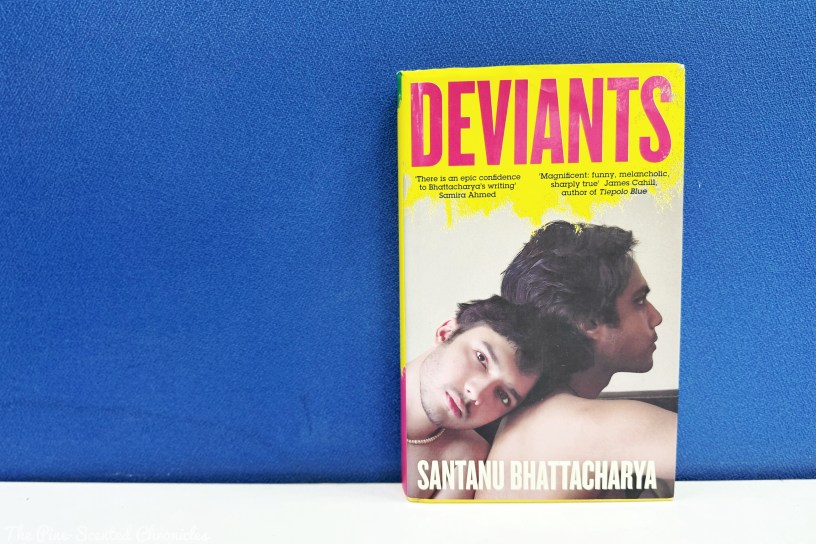
The shift in contemporary India’s attitude toward homosexuality lies at the heart of Santanu Bhattacharya’s sophomore novel, Deviants. Bhattacharya made his literary debut in 2023 with One Small Voice and builds upon it with this second novel. Deviants weaves together the stories of three generations of gay men from the same family in modern India. Alternating across half a century, the story begins in the 21st century with the introduction of the first among the trio, seventeen-year-old Vivaan. Living in India’s Silicon Plateau—the tech hub of Bengaluru—Vivaan is discreet about his sexuality, though his parents recognize and support his homosexuality. However, despite their support, Vivaan still struggles with isolation. His parents are also unaware of the complexities of his online life.
Maybe that is what love is; we feel it, in moments, for short spans of time, that indomitable potency to imagine beauty with inexplicably intense ferocity, like when the little bird gathers up all the oxygen it can muster and sings a tune.
Santanu Bhattacharya, Deviants
Through a dating app, Vivaan meets Zee, and their relationship triggers a shift in Vivaan’s world. Zee introduces Vivaan to the complicated world of love and desire. At first, Vivaan is thrilled by the experience—an opportunity to explore new boundaries. But the relationship begins to evolve in ways he is unprepared for. Vivaan’s story reflects the monumental changes sweeping through India, both in technology and attitudes toward homosexuality. His parents’ progressive views contrast with the traditional mindset still prevailing in institutions. For example, when Vivaan decides to attend a school dance with his boyfriend, the principal is shocked. During a meeting, Vivaan’s mother remarks, “Homosexuality is legal in India. How much time would you need before your school can catch up?” Despite such moments of progress, the struggles faced by gay men in contemporary society remain.
Vivaan’s struggles were recognized by Vivaan’s uncle, Mambro, who tried to lend a helping hand. Recognizing himself in his nephew, Mambro prompted Vivaan to record his thoughts and experiences; Vivaan’s story came in the form of notes. However, Mambro himself is unsure how to navigate the experience of being a gay man in modern India. Mambro came of age in an era starkly different from his nephew’s. In the mid-1990s, Mambro met and fell in love with his classmate, Y. However, they cannot openly pursue their relationship. The Victorian law, Section 377 metes out punishment for those who engage in homosexual acts and relationships. This prompted Mambro and Y to keep their relationship a secret. Their paths ultimately diverged when their studies made them pursue different paths.
But secrets rarely stay hidden. When Mambro’s diary—documenting his sexual encounter with Y—was discovered by his peers, he suffered brutal homophobic attacks. With Section 377 looming, the discovery placed him in legal danger, facing possible imprisonment of up to seven years. The stories of Mambro and Vivaan trace back further to Sukumar, Mambro’s uncle and Vivaan’s great-uncle (or grand-mamu). In 1977, Sukumar too was forced to hide his identity. With the ever-present threat of the colonial law, he had no choice but to conceal who he was. At twenty-five, Sukumar fell in love with X but suppressed his feelings due to societal taboos and the law. He knew his life would be “a long legacy littered with broken hearts, quashed dreams, and duplicitous lives.”
When the relationship ended, Sukumar found himself being embraced by a sense of loneliness, estranged from the rest of the world. He had no one to talk to and was never allowed to live the life he yearned for. Without the liberty to express himself, he lived like a bird trapped in a cage. Believing that having a child would assuage his loneliness, he got married shortly before he turned forty. This is also to appease his mother. Unfortunately, his marriage was ill-fated, bringing only unhappiness. His personal misery manifested in his health and work. Sukumar’s desire is simple. He only wanted to find a space for himself where he would be accepted and without hurting the people he loves. He wanted to live a life like everyone else, free from judgment and prejudices.
But what if same-sex love is not an act of resistance, what if that’s just how it is for some people? And what about men fucking men? You have so many questions, but no one to ask; so much to say, but no one you can trust.
Santanu Bhattacharya, Deviants
Through these three characters, Bhattacharya’s novel explores how India’s attitudes toward homosexuality have shifted over the past fifty years. Vivaan, Mambro, and Sukumar each navigate different worlds. For Mambro and Sukumar, Section 377 cast a long shadow, adding a political dimension to the story and serving as a painful reminder of India’s colonial past. Both were forced to hide their identities, forbidden from expressing themselves for fear of punishment. Their lives, perceived by society as deviant, underscore the deep-seated fear and misunderstanding surrounding queerness. Society, after all, often fears what it does not understand. The consequences of Section 377 are far-reaching. It was a catalyst for the increase in STD cases; men with sexually transmitted diseases are not able to get tested. Men who were raped also refused to report it for fear of being incarcerated.
The anonymity of Mambro and Sukumar’s lovers emphasizes the secrecy of their relationships. Fear of persecution and ostracism pushed them into isolation. Everything had to be kept hidden. Sukumar channeled his isolation through sculpting. Still, both he and Mambro longed for recognition and acceptance—a desire shared by many. Over time, recognition has become possible, but the journey has been slow and arduous, especially in conservative environments. Even today, several countries still criminalize homosexuality. Several members of the community still experience acts of violence and discrimination. In India, it took decades of activism before the Supreme Court finally struck down Section 377 in 2018. The movement began as early as 1991 with the AIDS Bhedbhav Virodhi Andolan.
Even as the call for acceptance gathers steam, the movement has faced obstacles, the biggest of which came from the members of the community itself. Years of muted advocacy have left them dispirited. As Bhattacharya describes: You’re done inviting more hatred. What has desiring men got you? It took away your love, your body, your writing, your dignity. No, there is nothing left in you to give to this movement. Even after its repeal, the legacy of Section 377 persists. Many in the community remain hesitant to come out. Indian society’s perception of homosexuality is still influenced by law, religion, and deep-rooted prejudice. Homosexuality and same-sex relationships are still considered taboo in many circles. The novel illustrates how the impact of unjust laws lingers long after their removal. For instance, Vivaan’s school principal refuses to let him attend the dance with Zee. Yet, allies emerge in surprising places. Vivaan’s parents, for example, become beacons of hope. While unaware of their son’s internal turmoil, they remain steadfast advocates for LGBTQIA+ acceptance.
His life felt like a sailor perpetually in a storm, knowingly voyaging into its eye, clinging to the mast, trimming the sail, holding the boat down against the towering tides, rowing the oars on the high waters. Yes, this was a deranged enterprise, it wasn’t that he couldn’t see what everyone was seeing. But what was the way out? How high was the price of living this fantasy?
Santanu Bhattacharya, Deviants
Beyond the drastic changes that swept modern India, the novel also exposes the underbelly of digital technology. With its exponential growth over the past few decades, digital technology has reshaped every aspect of life, including dating, which has become digital with the popularity of dating applications. For queer individuals who seek anonymity, the digital space offers the level of privacy they need. It is a channel for meeting new people; this applies to heterosexual individuals as well. Technology has also provided convenience. However, it comes with its own caveats, as Vivaan would later realize. Can authentic connections be formed online? Therein also lies the paradox vis-à-vis technology. Originally designed to bridge distances, technology has, ironically, increased disconnections. The growing reliance on technology has made us feel more isolated.
Bhattacharya deftly steers Deviants. While the three protagonists are connected—primarily by shared struggles and secondarily by blood—their stories are distinct. Their experiences and desires are deeply human and universal. Yet, contrasts abound, revealing the cultural, legal, and social shifts across generations. Still, some things remain unchanged: discrimination, prejudice, and the struggle for self-acceptance. Bhattacharya also creates three compelling characters with rich, individual voices. The novel’s structure reinforces their generational differences: Vivaan’s story is told through confessional voice notes, reflecting his generation’s reliance on technology; Mambro’s is told in the second person; Sukumar’s in the third.
In his second novel, Bhattacharya vividly portrays the lives of gay men in modern India. Through three unforgettable characters, he offers a poignant look into their struggles and triumphs amid societal change. He weaves these stories into a rich, emotional tapestry. Deviants is a story about queerness—and the loneliness, shame, and injustice often attached to it. While the novel paints a broad picture of Indian gay men’s experiences, Vivaan, Mambro, and Sukumar emerge as fully realized individuals whose journeys resonate deeply and universally. Despite the remnants of Section 377 and enduring cruelty, there is hope in their stories—and in the people who continue to fight for love, dignity, and freedom.
Beyond the sex though, you’re not gay, you’re not anything; your public life is inert, no love interest, no partner, no children, no cause. You don’t protest, don’t demand the law be changed, don’t make an example of yourself, don’t expose yourself, don’t go to the underground parties, don’t dress up provocatively, don’t march in parades.
Santanu Bhattacharya, Deviants
Book Specs
Author: Santanu Bhattacharya
Publisher: Fig Tree
Publishing Date: 2025
Number of Pages: 285
Genre: Literary, Historical
Synopsis
Vivaan, a teenager in India’s silicon plateau, has discovered love on his smartphone. Intoxicating, boundary-breaking love. His parents know he is gay, and their support is something Vivaan can count on, but they don’t know what exactly their son gets up to in the online world.
For his uncle, born thirty years earlier, things were very different. Mambro’s life changed forever when he fell for a male classmate at a time, and in a country, where the persecution of gay people was rife under a colonial-era law criminalizing homosexuality.
And before that was Mambro’s uncle Sukumar, a young man hopelessly in love with another young man, but forced by social taboos to keep their relationship a secret at all costs. Sukumar would never live the life he yearned for, but his story would ignite and inspire his nephew and grand-nephew after him.
Bold and bracing, intimate and heartbreaking, Deviants is a story of the histories we inherit and the legacies we leave behind.
About the Author
Santanu Bhattacharya was born and raised in India. He earned a degree in Electronics and Communications from Sikkim Manipal University of Health, Medical and Technological Sciences. He then moved to England to pursue a Master’s in Public Policy at the University of Oxford. He also earned a Master’s in Engineering from the National University of Singapore.
Bhattacharya’s foray into writing started with short stories. In 2012, he won the Chapter One Promotions Short Story Prize. In 2021, he won the London Writers Award and was selected for the Tin House Writers’ Workshop in Portland, USA. His work-in-progress novel was longlisted for the BPA First Novel Award 2020. In 2023, he finally made a breakthrough in full-length prose with the publication of One Small Voice. It was shortlisted for the Authors’ Club Best First Novel Award and the Society of Authors’ Gordon Bowker Volcano Prize. In 2025, he published his sophomore novel, Deviants. His non-fiction essays have appeared in The Oxford Student, Feminism in India, and the book Revealing Indian Philanthropy (published by the London School of Economics). He won the Desmond Elliott Prize Residency in 2023 and the Mo Siewcharran and Life Writing Prizes in 2021.
He is currently residing in London.
 The Pine-Scented Chronicles