
Happy Wednesday, everyone! Wednesdays also mean WWW Wednesday updates. WWW Wednesday is a bookish meme hosted originally by SAM@TAKING ON A WORLD OF WORDS.
The mechanics for WWW Wednesday are quite simple: you just have to answer three questions:
- What are you currently reading?
- What have you finished reading?
- What will you read next?

What are you currently reading?

It is already the middle of the week; technically, it is already Thursday. Anyway, how has your week been so far? I hope it’s going well and heading in your desired direction. The weekend is just over the horizon. I hope you hang tough for the rest of the week. Today is also the last day of July. How time flies! Tomorrow, we will be greeting the eighth month of the year. With time taking its natural course, I hope everything is going well for everyone. I hope you’re being showered with blessings and good news. May the rest of the year be prosperous, brimming with prosperity, but more importantly, with good physical and mental health. I hope everyone is already making progress on their goals. But if the year is going otherwise, I hope the rest of the year will be kinder and gentler to you. In terms of reading, I am well ahead of my goal, but I’ve been lagging behind in my reading challenges. As such, my focus in the second half of the year will be on catching up with those.
Currently, my venture into the works of European writers is in full swing. My current read is by an author I am unfamiliar with until I came across his book during a random foray into the bookstore. Austrian writer Heimito von Doderer’s The Strudlhof Steps immediately caught my attention because of its length; at over 800 pages, it is the epitome of thick. Further, the book was published by New York Review Books, making me more curious about what it holds. I even included the book on my 2025 Top 25 Reading List. Originally published in German in 1951 as Die Strudlhofstiege oder Melzer und die Tiefe der Jahre), the novel charts the fortune of a diverse cast of characters who were living within the proximity of Vienna’s Strudlhofstiege, a famed outdoor staircase. In 1920s Vienna, this interesting cast of characters converged, with Melzer among the most prominent; the novel is alternatively published as Melzer and the Depth of the Years. Melzer served as a lieutenant for the Austro-Hungarian Army in the Balkans.
The vast cast of characters reminds me of the works of Charles Dickens. However, most of the characters are born into well-off families, including the families of military officers, businessmen, government officials and lawyers, but their concerns slowly unfold as the story progresses. Actually, there are a lot of plotlines which can be quite challenging to track. But I do enjoy this kind of challenge. At times. Anyway, the life stories of the different characters bring different textures to the story. It does remind me of Georges Perec’s Life: A User’s Manual in how the stories and characters are connected to a place and a time. I am already halfway through the book and although it seems I have read quite a lot, it still feels like I have quite a lot more to read. I am looking forward to how all these various threads pan out in the end. I will be sharing more of my impressions of the book in this week’s First Impression Friday update.
What have you finished reading?
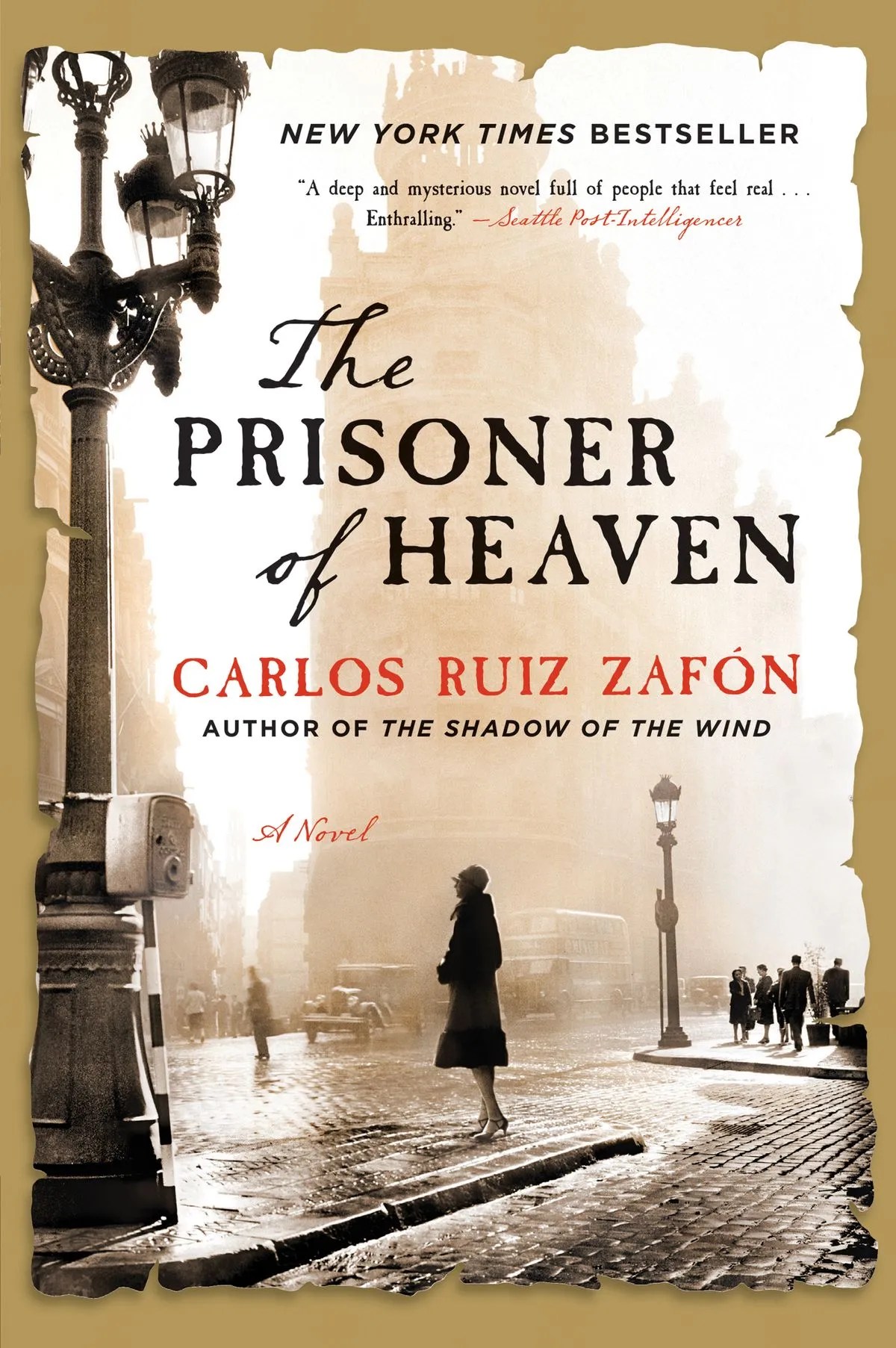
Before I traveled – in terms of literature that is – to Austria, I took a quick escapade in Spain by reading two works of Spanish writers back-to-back. The first of the two books is Carlos Ruiz Zafón’s The Prisoner of Heaven. The Spanish writer first caught my interest with The Shadow of the Wind. However, because of the hype surrounding the book, I took my time reading it. It was only during the pandemic that I read it which I ultimately lamented because of the length of time it took me to finally read it. The book is easily one of my favorite all-time reads. A couple of years later, I finished the third book in his popular The Cemetery of Forgotten Books quartet.
Originally published in 2011 as El prisionero del cielo, The Prisoner of Heaven once again transports readers to Barcelona. Two years have passed since Daniel Sempere and Beatriz Aguilar got married; for the uninitiated, Daniel is the hero of the first book. The couple now lives in the apartment above the family bookshop, Sempere & Sons, along with their baby son, Julián. This installment, however, centers on Fermín Romero de Torres, who is preparing for his own wedding. Though business has declined in recent years, Fermín still finds a place at the bookshop and continues sourcing rare books. The crux of the story is the sudden appearance of a mysterious visitor one day while Fermín is out. This visitor asks for Fermín and purchases a rare and expensive copy of The Count of Monte Cristo. He then leaves the book behind, inscribed with a cryptic message that piques Daniel’s curiosity. As his suspicions mount, Daniel confronts his friend, prompting Fermín to reveal secrets from his past. The narrative then flashes back to 1939. Fermín is incarcerated as the nation teeters on the edge of socio-political upheaval with the rise of the Caudillo. We discover that the mysterious man was once imprisoned alongside Fermín in Castillo Montjuïc. But it’s another inmate, David Martín – the protagonist of Zafón’s second novel, The Angel’s Game – who becomes the focus of this retrospective.
Martín holds secrets the prison governor is desperate to extract – secrets tied to the Cemetery of Forgotten Books. Martín is tortured, and Fermín is bribed to spy on him. As the story progresses, it becomes increasingly engaging, in stark contrast to The Angel’s Game, which I found somewhat disappointing. However, The Prisoner of Heaven begins to weave a clear connection between the first two books. I had always felt The Angel’s Game was somewhat disconnected from The Shadow of the Wind, so I’m eager to see how the threads come together. Moreover, The Prisoner of Heaven paints a more vivid picture of Martín. Overall, The Prisoner of Heaven is essential to the quartet because it provides clarity – not only in connecting the two previous books, but also in enhancing the overall flow of the story.

From one familiar writer to another. It was through must-read lists that I first came across Javier Marías. Some of his works are featured in such lists, among them A Heart So White. The book was also recommended to me by a fellow book reader who sang praises for the book. It made me look forward to reading it. However, acquiring a copy of the book posed a challenge. As such, my foray into the oeuvre of the highly-heralded Spanish writer commenced with a different work, Berta Isla. The book, nevertheless, impressed me, providing me glimpses into Marías’ storytelling skills. A couple of years later, I finally got the opportunity to read A Heart So White which is also part of my 2025 Top 25 Reading List.
Originally published in 1992 as Corazón tan blanco, A Heart So White is one of the 1,001 Books You Must Read Before You Die. The story is narrated by a seemingly anonymous voice, whose identity is gradually revealed as the narrative unfolds. The narrator works as a translator for various international organizations, most notably the United Nations. He has recently married Luisa, a fellow interpreter he met while they were assigned to the same job. However, the focus of his inquiry becomes his father Ranz’s past marriages. The narrator – later revealed to be named Juan- finds his curiosity sparked by Luisa’s growing relationship with his father. Father and son have never shared a close bond, a reality that even Juan finds baffling. While Juan is away for work, Luisa forms connections with people from his life, particularly Ranz and Custardoy, the son of Ranz’s best friend. Ranz, now seventy years old, is an art dealer who still retains much of his charm and charisma. He is a magnetic figure, one that even Luisa finds hard to resist. It is through her that Juan begins to uncover details about his father’s complex marital history. The novel opens with Juan recounting the dramatic death of Ranz’s second wife, Teresa. During a family dinner shortly after their honeymoon, Teresa abruptly leaves the table and takes her own life in the bathroom.
Eventually, Juan learns about Ranz’s first marriage, which had been concealed from him since childhood. Adding to the complexity, Teresa was the older sister of Juan’s mother, Juana. This creates a tangled web of relationships that Juan must slowly unravel. As the story progresses, a second narrative thread emerges. While in New York, Juan is drawn into a strange situation, reluctantly acting as a kind of private detective for his friend Berta, who has become involved with a bizarre man she met through a personal ad. At the same time, Juan is confronting the realities of his own marriage. He is plagued by doubts, particularly about the lack of passion between him and Luisa, and tormented by the suspicion that she may be seeking it elsewhere. What makes the novel feel especially intimate is its distinctive writing style. Marías employs a stream-of-consciousness technique, allowing thoughts and ideas to flow into one another, sometimes blending together. While this can be disorienting, it is also what allows the novel to explore deep philosophical questions. Despite its complexities, A Heart So White is a compelling and thought-provoking read.
What will you read next?


 The Pine-Scented Chronicles