
And just like that, we have finally waved goodbye to the seventh month of the year. It is inevitable that time flows and takes its natural course, regardless of anyone’s regard. Still, I hope that 2025 is going your way, treating you with the kindness you deserve. I hope it is granting you favors. I also hope you are making headway into your goals. I wish you well in your individual journeys. I hope the remaining months of the year will be great. I hope it will be brimming with joy, healing, goals achieved, and prayers answered. For those whose year is not going as planned, I hope that you will experience a reversal of fortune in the remaining months of the year. For those whose goal is just to make it from one point to another, do know that it is okay. With the turmoil enveloping us, muting the noise can be challenging. More importantly, I hope everyone stays healthy, in mind, body, and spirit.
Thankfully, I am on track with my reading goals; I do have some lofty ones. Barring any obstacles, I will be finishing the year with at least 100 books, the fourth year in a row that I will be crossing the three-digit mark. After spending the first half of the year reading exclusively the works of Asian writers – mainly East Asian writers – I finally made a pivot toward the works of European writers in July. Both of these reading journeys underline my goal of reading more translated books than books originally written in English. In a way, the pivot toward works of European literature is to get me on track toward my reading challenges. I have noted how much I have been lagging behind in most of them, including my 2025 Top 25 Reading List. As such, July was yet another memorable journey. I get to explore new worlds while revisiting old ones. So, before I move on to the next month of the year, let me share my foray into works of European literature. Happy reading!

Abigail by Magda Szabó
My foray into European literature commenced with a familiar writer in Magda Szabó, whom I first encountered through online booksellers. It was during the time when I came across New York Review Books for the first time, back in 2019. I then acquired a copy of her novel The Door, which was a memorable read, making me look forward to reading more of her works. Over six years since my first Szabó novel, I finally made good on the promise to explore her oeuvre further with Abigail. Originally published in Hungarian in 1970, the novel charts the adventures of Georgina “Gina” Vitay, the daughter of a general living and working in Budapest; her mother had already passed away. The crux of the story was when Gina was forced to move to the fictional town of Árkod in the easternmost part of Hungary, to attend the Matula Institute, a traditionally Calvinist school. The Institute adheres to a stringent set of rules, leaving the liberated Gina disoriented. She easily earned the ire of her fellow students. Resented by her classmates and far from the comforts of home, Gina found herself alone. She tried to escape, but it was foiled, prompting Gina to finally embrace her fate. Gina soon learned about the legends proliferating in the school, prominently about the titular Abigail, the name given to the statue of a woman located in the school grounds. Legends have it that the statue helps resolve the girl’s concern if they write to Abigail. Initially apprehensive about the legends, Gina soon received a letter from Abigail, naturally piquing her curiosity. Gina tried to find out who Abigail really is. Coming-of-age merges with mystery in Abigail, with remnants of the war reverberating in the background. It also tackles identity and the yearning for belonging while exploring the complexities of human nature. The book is an iteration of the magic of Szabó’s writing and storytelling.
Goodreads Rating:


Flesh by David Szalay
From one Hungarian writer to another, at least one who is of Hungarian origins. Before this year, I had never heard of Hungarian-English writer David Szalay until I came across him while researching books to include in my 2025 Books I Look Forward To List. His latest novel, Flesh, was a recurring presence in similar lists, piquing my interest. I included the book in my own list, making it the third book from my 2025 Books I Look Forward To List that I read. At the heart of Flesh is István. When we first met him, István was a shy and awkward adolescent living in a Hungarian housing project with his mother. On days his mother was away, Istvan passively entered into his first sexual relationship with his neighbor, a married and older woman. When the woman’s husband passed away, his death was pinned on the fifteen-year-old István, commencing an eventful life that saw him serve time in juvenile detention and alongside Norwegian soldiers in Iraq. Fate smiled on him when he was invited into security work, working as a chauffeur in London for an affluent family. Without design, he managed to penetrate the family’s inner circle and became one of them. In a nutshell, Flesh is the quintessential rags-to-riches story, but as the story unfolds, there is more to it than meets the eye. Flesh is an in-depth examination of an individual. While István is irresistible to women, he grew up to be psychologically and socially isolated and taciturn. There was nothing impressive about him, yet life’s forces made him the man he is today. He does come across as a drifter surrounded by a bevy of characters who are as morally gray and as emotionally detached as István. Exploring subjects pertaining to identity, masculinity, trauma, and the impact of historical events on individuals, the Booker Prize longlisted novel is an interesting deviation from my typical read.
Goodreads Rating:


The Fish Can Sing by Halldór Laxness
The pandemic, ironically, was crucial in introducing me to writers whose oeuvres I had not explored before. Among them was Halldór Laxness, whom I first encountered through online booksellers. A couple of years later, I read The Fish Can Sing, the third novel by the Icelandic writer I had read. The book was originally published in 1957 as Brekkukotsannáll (Annals of Brekkukot) and was his first major work after receiving the Nobel Prize in Literature. Set in a humble cottage named Brekkukot in Reykjavík, the novel follows the fortunes of Álfgrímur, an orphaned boy raised by his adoptive grandparents. His mother left for the United States shortly after giving birth to him. Álfgrímur’s grandfather, Jón, is a fisherman. He sells his catch from a wheelbarrow he pushes through town. The future seems already cast in stone for the young Álfgrímur; it was already predetermined that he would become a fisherman. However, as he ventures across the city, Álfgrímur meets a colorful cast of characters, from businessmen to social climbers, each of whom prompts him to question the path laid out before him. One figure in particular captures his imagination: the enigmatic opera singer Garðar Hólm. Garðar travels the world and returns home only sporadically. The Fish Can Sing is, at its core, a coming-of-age story in a society on the brink of major socio-political transformation. It is a poignant homage to a vanishing way of life. Set in early 20th-century Iceland, the novel reflects on the quiet dissolution of traditional ways in the face of modern progress. The novel also explores shifting perspectives on life and destiny while underscoring the allure and illusion of celebrity, the importance of authenticity, and the search for one’s true voice. The shortest Laxness novel I’ve read so far, The Fish Can Sing, only deepens my admiration for Laxness’s prose. Like his earlier works, it offered valuable insights into Iceland—its people, culture, and changing identity.
Goodreads Rating:

Foucault’s Pendulum by Umberto Eco
From one highly heralded writer to another, my literary journey next took me to Italy. It has been almost a decade since I first came across Umberto Eco, who was a familiar presence in must-read lists. I loved his debut novel, The Name of the Rose, which I read in 2017. Fast forward to 2025, I have completed yet another Eco novel, my fifth. Originally published in 1988 as Il pendolo di Foucault, Foucault’s Pendulum commences with Casaubon, the narrator, hiding in Paris’ Musée des Arts et Métiers after it closed; the museum is home to the famous pendulum of Léon Foucault, hence the book’s title. His friend, Jacopo Belbo, the senior editor at a publishing house in Milan, Italy, has gone missing. Casaubon believes his friend was kidnapped by a shadowy group of occultists who he believes are now after him. As time ticks and the pendulum swings, the novel flashes back to 1970s Italy when Casaubon was working on his thesis about the Knights Templar. His study made him encounter Belbo and his colleague Diotallevi; Belbo invited him to review a manuscript about the Templars written by Colonel Ardenti. Ardenti also claims to have discovered a secret plan by the Templars to take over the world, but he mysteriously disappeared after meeting with Belbo and Casaubon. The trio then found themselves immersed in occult manuscripts and conspiracy theories. Foucault’s Pendulum takes the readers on a literary roller coaster. Compared to Eco’s debut novel, it is way more complicated, with its several layers and confounding turns. Nevertheless, it reminded me of his other books. The references to the Knights Templar and the Holy Grail reminded me of Baudolino, while the characters’ vocation reminded me of Numero Zero. Eco, a semiotician, riddled the book with symbols and images that tickle the imagination. History and conspiracies were also woven into the lush tapestry. Foucault’s Pendulum is certainly no easy read, but it is a worthwhile one.
Goodreads Rating:

Panorama by Dušan Šarotar
My foray into European literature also introduced me to new names, among them Dušan Šarotar, whom I first discovered through online booksellers, making Panorama the first book by a Slovene author I’ve read. Looking forward to a new literary experience, I included the book in my 2025 Top 25 Reading List. Originally published in 2014, Panorama is Šarotar’s fourth novel but his first to be translated into English. At the heart of the story is an anonymous narrator, who is widely regarded as the author’s alter ego. In his mid-forties, the narrator charts his travels, starting in Ireland. He was searching for peace and inspiration to finally complete the manuscript he had been working on. In a way, the narrator is a drifter. During his journey, he encounters a diverse cast of characters, among them Gjini, an Albanian who emigrated to Ireland eleven years prior. Gjini initially serves as his guide and driver in Galway before he meets him again, this time as a journalist in Ghent. As the narrator travels around, details of history and places enrich the narrative. They provide a lush backdrop for the narrator’s ruminations. His sharp sense of observation was one of the backbones of the novel. This allowed him to vividly describe everything he sees, from structures and surroundings that echo stories through his reflections. Adding nuance to the story are photographs, which also blur the line between fiction and reality. As such, it comes off as a blend of travelogue and journalistic meditation that also delves into history and memory. While Panorama lacks a robust plot, it delights in nostalgia and thought-provoking insight. A layer of enigma surrounds the narrator, adding mystery to his character. His subdued tone invites readers to examine his experiences closely. A solemn grace to the book that makes it deeply engaging.
Goodreads Rating:
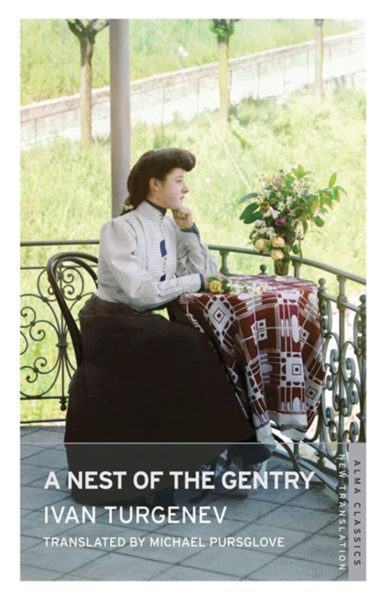
A Nest of the Gentry by Ivan Turgenev
From Slovenia, my literary journey next took me to Russia. Russian literature has certainly been growing on me, largely thanks to Leo Tolstoy and Fyodor Dostoevsky. However, other Russian writers have also caught my interest, among them Ivan Turgenev. My curiosity piqued, I read Fathers and Sons in 2019—the first Turgenev novel I read. However, it would take time before I managed to acquire a copy of his other works. A Nest of the Gentry is the first Turgenev novel I read in over six years. Originally published in 1859 as Дворянское гнездо, A Nest of the Gentry was Turgenev’s sophomore novel and has also been translated as A House of Gentlefolk, Liza, and Home of the Gentry. At the heart of the story is Fyodor Ivanych Lavretsky, a nobleman born to a distant, Anglophile father and a serf mother who died when he was young. He was then raised on the family’s country estate by a stern maiden aunt before pursuing his education in Moscow, where he met his wife, Varvara Pavlovna. The couple moved to Paris, but after an act of betrayal, Lavretsky returned to his native Russia. In the countryside, near the estate he inherited at Vasilyevskoye, while visiting his widowed cousin, Marya Dmitrievna Kalitina, he fell in love with Elizaveta Mikhaylovna (Liza), one of his cousin’s two daughters. Liza, serious and religious in her disposition, is the antithesis of Varvara. Liza and Lavretsky eventually fell in love, but their budding romance was threatened by complications from the past. But there is more to the story than just complicated entanglements. For one, Turgenev pits two symbolic female figures against each other, one representing Russian traditions and the other representing European values. Lavretsky’s return, then, is also a spiritual one, a reconnection with the values of his homeland. A Nest of the Gentry is a compelling read from a gifted Russian storyteller.
Goodreads Rating:

Fontamara by Ignazio Silone
Capping my three-book stretch is another title from my 2025 Top 25 Reading List, which takes me to Italy. Like Russian literature, Italian literature is steadily growing on me. This is primarily due to Umberto Eco and Italo Calvino, whose masterpieces The Name of the Rose and If on a Winter’s Night a Traveler captivated me. Another Italian writer who recently caught my attention—discovered through online booksellers—is Ignazio Silone, the pseudonym of Secondo Tranquilli. My introduction to his work came through his debut novel, Fontamara. Fontamara was originally published in 1930 and was written during his exile in Switzerland. The titular Fontamara is a fictional hillside town where the cafoni—a term commonly used to describe southern Italian peasants—are struggling against a system that exploits them. The story begins with a writer visiting Berardo Viola and his lover, Elvira. Berardo and Elvira recount the history of the village to the writer, and their narrative essentially unfolds into the novel. One day, Pelino, a Cavaliere (Italian knight), gathers the villagers and has them sign a blank sheet of paper, which they sign without hesitation despite having no iota on what it was about. The following day, a crew of road workers arrives to divert the stream that irrigates their fields. It sets into motion the villagers’ plight. At the capitol, they were deceived by the mayor, who was aligned with the fascists. Both the fascists and opportunists suppress the villagers’ attempts to reclaim their rights. The villagers are surrounded by proverbial wolves, some even disguising themselves as allies, but have no qualms about exploiting them. Fontamara is deceptively slender, but within its modest length lies a rich depiction of how fascism reshaped the Italian landscape in the years leading up to the Second World War. The town becomes a microcosm of a nation gripped by corruption, fear, and betrayal.
Goodreads Rating:
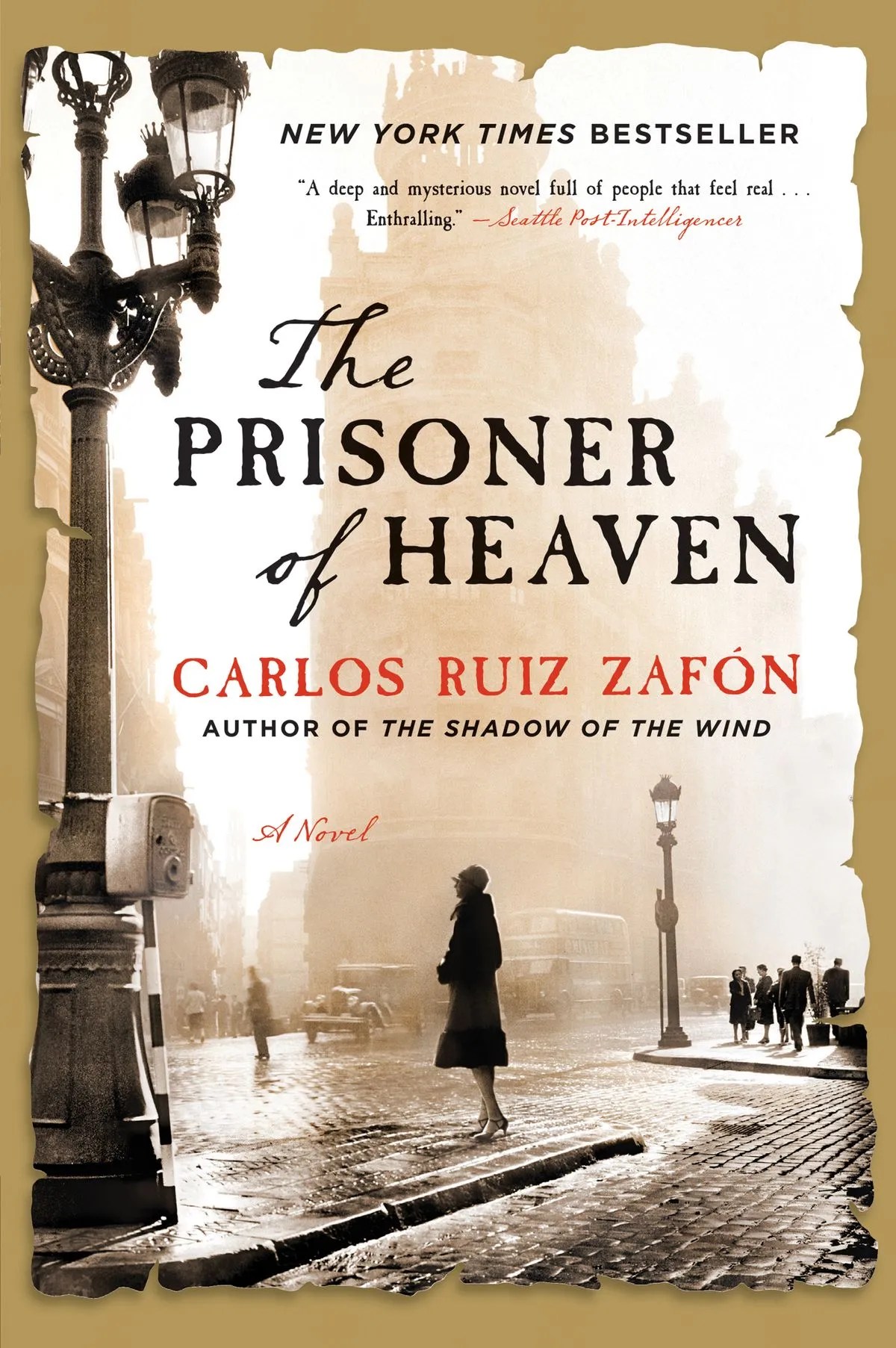
The Prisoner of Heaven by Carlos Ruiz Zafón
Carlos Ruiz Zafón first caught my interest with The Shadow of the Wind. However, it was only during the pandemic that I got to read it; the hype surrounding the book made me initially apprehensive about it. The book is easily one of my favorite all-time reads. A couple of years later, I finished the third book in his popular The Cemetery of Forgotten Books quartet. Originally published in 2011 as El prisionero del cielo, The Prisoner of Heaven transports readers to Barcelona. Two years have passed since Daniel Sempere and Beatriz Aguilar got married and are now living in the apartment above the family bookshop, Sempere & Sons, along with their baby son, Julián. This installment, however, centers on Fermín Romero de Torres, who is preparing for his own wedding. Fermín continues sourcing rare books for the bookshop despite declining sales. One day, a mysterious visitor appeared while Fermín was out. This visitor purchased a rare copy of The Count of Monte Cristo, which he leaves behind, inscribed with a cryptic message that piques Daniel’s curiosity. When confronted by Daniel, Fermín revealed secrets from his past. In 1939, Fermín was incarcerated in Castillo Montjuïc alongside the mysterious man. But it’s another inmate, David Martín – the protagonist of Zafón’s second novel, The Angel’s Game – who becomes the focus of this retrospective. Martín holds secrets the prison governor is desperate to extract. He is tortured, and Fermín is bribed even to spy on him. Details of history provide nuance to the story. The Prisoner of Heaven weaves a clear connection between the first two books; I always found The Angel’s Game a bit of a disconnect from the first book. This made me eager to see how the threads come together. Overall, The Prisoner of Heaven is essential to the quartet because it provides clarity while enhancing the overall flow of the series.
Goodreads Rating:

A Heart So White by Javier Marías
It was through must-read lists that I first came across Javier Marías. Some of his works are featured in such lists, among them A Heart So White, which was also recommended to me by a fellow book reader. However, acquiring a copy of the book posed a challenge. It was only recently that I was able to acquire a copy of A Heart So White, which I also included in my 2025 Top 25 Reading List. Originally published in 1992 as Corazón tan blanco, A Heart So White is narrated by an initially anonymous voice; he was eventually revealed as Juan. Juan works as a translator for various international organizations. Through one of his engagements, he met Luisa, a fellow interpreter whom he would eventually marry. The novel’s inquiry, however, focuses on Juan’s father Ranz’s past marriages. Juan’s curiosity was sparked by Luisa’s growing relationship with his father; Juan never had a close bond with his father. While Juan is away for work, Luisa forms connections with people from his life, particularly Ranz and Custardoy, the son of Ranz’s best friend. Ranz, now seventy years old, is an art dealer with a magnetic charm. Through Luisa, Juan begins to uncover details about his father’s complex marital history, with the novel opening with Juan recounting the dramatic death of Ranz’s second wife, Teresa, and the older sister of Juan’s mother, Juana. Eventually, Juan learns about Ranz’s first marriage, which had been concealed from him since childhood. While he unravels this tangled web of relationships, Juan is confronting the realities of his own marriage. He is plagued with doubts, particularly about the lack of passion between him and Luisa. Making the novel more intimate was Marías’s stream-of-consciousness, which allowed thoughts and ideas to flow into one another, sometimes blending together. While this can be disorienting, it is also what allows the novel to explore deep philosophical questions. Despite its complexities, A Heart So White is a compelling and thought-provoking read.
Goodreads Rating:

The Strudlhof Steps by Heimito Von Doderer
Concluding my first month in European literature is a writer I recently discovered. Heimito Von Doderer is a prominent name in Austrian literary circles and was even nominated for the Nobel Prize in Literature at least four times (1959, 1960, 1962, 1964). On a random trip to the bookstore, I came across his novel, The Strudlhof Steps. The book’s heft immediately caught my interest. When I acquired a copy of the book, I made it part of my 2025 Top 25 Reading List. Originally published in German in 1951 as Die Strudlhofstiege oder Melzer und die Tiefe der Jahre, the titular Strudlhof Steps pertain to a famed elaborate outdoor staircase in Vienna opened in 1910. Primarily set in the 1920s, the novel weaves in and out of the past and the present as some memories take the readers between 1908 to 1911 – the novel chronicles the lives and fortunes of a diverse cast of characters who were residing within the proximity of the staircase. The most prominent character is Melzer; the novel is alternatively published as Melzer and the Depth of the Years. Melzer served as a lieutenant for the Austro-Hungarian Army in the Balkans and is one of the main threads binding the characters together. The concerns of the characters slowly unfold as the story progresses. Minutiae of their lives are intertwined with the opinions and views of the narrator, providing nuance to the story. The plenitude of storylines reminded me of Georges Perec’s Life: A User’s Manual, including the characters’ connection to a place and time. In a way, the stairs are an allegory. Socio-economic themes are subtly woven into the story. The upper section is occupied by members of the upper middle class, while the lower section is occupied by lower-level employees. Melzer himself was born into a lower-middle-class background. Overall, The Strudlhof Steps is an insightful story about a place and time. The diverse cast of characters makes the novel come alive.
Goodreads Rating:
Reading Challenge Recaps
- 2025 Top 25 Reading List: 12/25
- 2025 Beat The Backlist: 8/20; 64/60
- 2025 Books I Look Forward To List: 3/10
- Goodreads 2025 Reading Challenge: 70/100
- 1,001 Books You Must Read Before You Die: 3/20
- New Books Challenge: 5/15
- Translated Literature: 55/50
Book Reviews Published in July
- Book Review # 595: Life: A User’s Manual
- Book Review # 596: Deviants
- Book Review # 597: The South
- Book Review # 598: Water Moon
- Book Review # 599: Violets
After months of lagging behind my writing targets, I am slowly gaining momentum. In the past three months, I was able to publish at least five book reviews. This is in stark contrast to the sluggish start I had this year. I have been trying to pick up the pen, but I was not expecting that the opening third of the year was going to be this hectic. Nevertheless, I am glad that I am slowly picking up pace. In July, I managed to complete five book reviews, a measly number compared to the eight I published in June, but it is still a decent number because the month has also been hectic. I am hoping I get to build more momentum as the year progresses. Unfortunately, I have failed to make a dent on my June 2023 pending book reviews, which are all works of Asian writers. Instead, in July, I focused on recently published novels.
Because of the recent slowdown, I find myself ever swamped in pending book reviews from 2023 until the present. This August, I hope to build more momentum. I will try to double my effort to reduce the number of my pending reviews. And yes, I am currently working on my 600th book review. What a milestone! I can’t believe that I am about to breach the 600 threshold. I am beyond excited and proud, of course. From humble beginnings, I am on the brink of yet another milestone. In August, I will be striking a balance between my pending June 2023 book reviews and recently published novels. After my 600th book review, I will work on my review of Ocean Vuong’s The Emperor of Gladness, Sayaka Murata’s Vanishing World, and Hiro Arikawa’s The Passengers on Hankyu Line. These are all works of Asian writers.
In August, I will be continuing my foray into the world of European literature. I just realized that my reading challenges are brimming with works of European writers. After all, I promised to focus on my reading challenges in the second half of the year. I am about to start Guido Morselli’s The Communist, one of the books on my 2025 Beat the Backlist Challenge List. On deck are Bernardo Atxaga’s Seven Houses in France, Hilary Mantel’s Wolf Hall, William Golding’s Rites of Passage, and Thomas Mann’s Death in Venice. This is quite a lofty list, to think that these are just the books on my 2025 Beat The Backlist Challenge List. Meanwhile, the books from my 2025 Top 25 Reading List are José Saramago’s Blindness, Heinrich Böll’s The Silent Angel, Ian McEwan’s Amsterdam, and Vasily Grossman’s Life and Fate. These are on top of other works of European writers I want to read, such as Fredrik Backman’s My Friends, Fyodor Dostoevsky’s The Idiot, and Saramago’s The History of the Siege of Lisbon. August is certainly going to be a hectic but interesting reading month.
How about you, fellow reader? How is your own reading journey going? I hope you enjoyed the books you have read. For now, have a great day. As always, do keep safe, and happy reading, everyone!
 The Pine-Scented Chronicles