
Happy Wednesday, everyone! Wednesdays also mean WWW Wednesday updates. WWW Wednesday is a bookish meme hosted originally by SAM@TAKING ON A WORLD OF WORDS.
The mechanics for WWW Wednesday are quite simple: you just have to answer three questions:
- What are you currently reading?
- What have you finished reading?
- What will you read next?

What are you currently reading?

It’s already the middle of the week. Technically, it’s Thursday—the last one for August. How time flies! In just a couple of days, we’ll be welcoming the final third of the year. As time takes its natural course, I hope everything is going well for everyone. I hope you’re being showered with blessings and good news. May the rest of the year be filled with answered prayers, more blessings, and healing. I hope everyone is doing well, both physically and mentally. I also hope you’re making steady progress toward your goals. With the year approaching its inevitable close, I sincerely wish you’re making great strides toward those goals. I hope the remaining months of the year are kinder and gentler to you. Reading-wise, I’ve been lagging behind on my reading challenges. To catch up, I’ve shifted my focus to my reading lists, immersing myself in European literature—many of the books on my challenge are written by European authors.
Among the books I included in my 2025 Top 25 Reading List is my current read: Blindness by José Saramago. Blindness is the fourth novel by the Portuguese Nobel Laureate in Literature that I’ve read. Interestingly, it’s one of Saramago’s works I’ve been looking forward to for the longest time. Once I acquired a copy, it became imperative for me to include it on my 2025 list. The novel opens with a traffic jam caused by a man who suddenly goes blind. A Good Samaritan drives him home. When the blind man’s wife learns of this, she schedules an appointment with an ophthalmologist. After examining him, the doctor says his eyes are biologically fine. Meanwhile, it’s revealed that the Good Samaritan is actually a car thief who stole the couple’s car. However, shortly after the visit, the car thief also suddenly goes blind. Then the doctor goes blind too.
From one blind man, the condition spreads rapidly. The doctor realizes – and tells his wife – that the blindness is highly contagious. He notifies the Ministry of Health, and a quarantine zone is set up in an abandoned psychiatric hospital. The doctor, along with his wife – who, although still able to see, pretends to be blind in order to stay by his side – is taken to the facility. Everyone exhibiting symptoms of blindness, or deemed “infected,” is brought to the quarantine zone. To prevent further spread of the mysterious disease, the hospital is guarded by armed soldiers, and those tasked with caring for the patients are ordered by the government to enforce a draconian set of rules. In some ways, the swift action and rapid spread of infection are reminiscent of the recent pandemic. The novel, originally published in 1995 as Ensaio sobre a cegueira, seems chillingly relevant.
I’m already midway through the book. I can begin to discern some of the messages Saramago wove into his lush narrative – and his signature lack of quotation marks. Existentialism is a recurring theme, but through the experiences of the infected, we witness a society on the brink of collapse. The growing blindness is symbolic of a deeper, moral blindness within society. But I believe that’s just the tip of the iceberg ; after all, this is Saramago’s universe. By the way, Blindness feels like a departure from the other Saramago novels I’ve read, which are deeply rooted in history. Still, I’m looking forward to how this “new” literary experience will pan out.
What have you finished reading?

The previous week was quite a busy reading week—at least in comparison to the preceding ones. I managed to complete three novels. The first, Vasily Grossman’s Life and Fate, was actually a carryover from the prior week. It was also one of the reasons—along with Fyodor Dostoyevsky’s The Idiot—why my reading momentum had slowed down. Both are hefty tomes, and if memory serves me right, Life and Fate is my longest read of the year so far, or at least one of them. Interestingly, Life and Fate marked my second consecutive dive into Russian literature, although I initially assumed Grossman was German. It was only during the pandemic that I first learned about him.
Originally published in 1980 as Жизнь и судьба (Zhizn’ i sud’ba), Life and Fate is the third and final book in Grossman’s Stalingrad Trilogy. The novel takes readers into the Second World War, specifically during the Battle of Stalingrad. It opens with the German army’s advance and the Soviet Union’s desperate defense. Amidst the chaos, we are introduced to the Shaposhnikov family, many of whom are involved in the war effort in one way or another. One of the central figures in the Stalingrad section is Yevgenia (Zhenya) Nikolaevna Shaposhnikova, a dedicated Communist Party member who reconnects with her lover, Colonel Pyotr Pavlovich Novikov. As the war escalates, they retreat to Kuibyshev, where Zhenya struggles to obtain a residence permit due to bureaucratic red tape. In Kuibyshev, she stays with Jenny Genrikovna, an elderly German woman who had once served as the Shaposhnikov family’s governess. Zhenya’s older sister, Lyudmila (Lyuda) Nikolaevna Shaposhnikova, is married to Viktor Pavlovich Shtrum, a renowned nuclear physicist and member of the Academy of Sciences. The couple has a daughter, Nadya, while Lyuda also has a son, Tolya, from her previous marriage to Abarchuk. As the German army approaches Kazan, the Shtrums are relocated to Moscow.
Viktor is deeply absorbed in his work, and much of his storyline focuses on his scientific research. After a significant mathematical breakthrough, he faces harsh criticism from Party authorities. His experience highlights the oppressive political climate that often stifled scientific advancement. Meanwhile, Grossman shifts the focus to the frontlines, exploring the gritty realities of the battlefield and the ideological battle between Soviet and German forces. Politics is a dominant theme in Life and Fate, which is often compared to Leo Tolstoy’s War and Peace and is even considered its 20th-century counterpart. With its vast scope and immersive historical detail, the novel is a challenging but ultimately rewarding read.
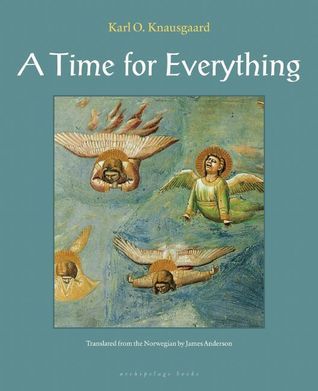
From the former Soviet Union, my literary journey next brought me to Norway. I can’t quite recall when I first came across Karl Ove Knausgård, although it was during the pandemic that I began noticing how prevalent his works were. Naturally, this piqued my interest. Last year, The Wolves of Eternity was part of my 2024 Top 24 Reading List, and it served as my introduction to his oeuvre. Now, amid my European literary exploration, I picked up A Time for Everything. Interestingly, it wasn’t part of any of my reading lists or challenges; curiosity simply got the better of me.
Originally published in 2004 as En tid for alt, and also known in English as A Time to Every Purpose Under Heaven, this is Knausgård’s second novel. I wasn’t prepared for its premise. The novel opens in the 16th century and introduces Antinous Bellori, an eccentric theologian who wrote On the Nature of Angels (1584). Bellori is portrayed as a melancholic scholar who devotes his life to studying angels, and his work forms the novel’s framing device. From this starting point, the narrative delves deep into history, reimagining various Biblical and folkloric encounters with angels. Among the reinterpreted stories are that of Cain and Abel, The Flood, and Lot and Ezekiel. Knausgård exercises poetic license to fill in the silences of scripture, offering fresh, literary takes on these iconic tales. In one section, for example, the focus shifts to Noah’s sister, while Noah himself is portrayed as a recluse. Cain and Abel’s relationship was also extensively explored in the story, exploring the divides between good and evil while providing a different perspective upon which to examine stories and folklore as we know them.
As the novel progresses, it begins to resemble a theological essay more than a traditional narrative. Yet, Knausgård’s philosophical depth remains consistent. He treats his subjects with intellectual rigor, immersing readers in reflections on the divine, on angels, and on humanity’s evolving perception of them. He even explores how angels have been depicted in art history – and how these representations reflect broader religious and cultural shifts. What makes this even more compelling is that Knausgård identifies as an atheist. Despite this, A Time for Everything is a thought-provoking, allegorical examination of the divine, God’s presence (or absence), and our changing relationship with religion. It’s a fascinating and intellectually rich work from one of contemporary literature’s most original voices.

The three-book stretch concluded with a work from a writer previously unknown to me. Had it not been for the Nobel Prize in Literature—and, by extension, various must-read lists—I likely wouldn’t have encountered German author Heinrich Böll. Awarded the Nobel Prize in Literature in 1972, Böll was the first German laureate since Thomas Mann in 1929. Curious about his work and eager to expand my literary horizon, I added The Silent Angel to my 2025 Top 25 Reading List.
Interestingly, Böll wrote The Silent Angel in 1950, and it was meant to be his first novel. However, he couldn’t find a publisher. It was published posthumously in 1992, seven years after his death, as Der Engel schwieg. Set during the final days of World War II, the novel follows Hans Schnitzler, a German soldier attempting to desert. Even before he can follow through, he’s mistaken for a deserter. In a twist of fate, Willy Gompertz, a stenographer, switches jackets with him and is executed in his place. Assuming Gompertz’s identity, Schnitzler travels to Cologne – the author’s city of birth – to deliver the coat to Elisabeth Gompertz, Willy’s widow. Things got interesting when, in the coat lining, he discovers a will. It was no ordinary will as it exposes corruption and greed. This then gradually propels the novel toward a different direction. The will becomes the center of a quiet mystery, as Herr Doktor Professor Fischer, a relative of the deceased, seeks to retrieve it.
Meanwhile, Hans meets Regina, a grieving woman whose child was killed by a German machine gun. Around them is a broken city, physically and spiritually devastated by war. Böll vividly captures the despair, the numbness, and the emotional inertia that pervade the ruined city. People spend their days in bed, staring at the walls, weighed down by hopelessness. Yet, the novel is not merely about despair. Beneath the rubble of Cologne and the trauma of war, The Silent Angel explores resilience—the courage to live on, to seek meaning, and to rediscover connection in a fractured world. It’s a haunting and beautifully written reflection on post-war life.
What will you read next?

 The Pine-Scented Chronicles