
First Impression Friday will be a meme where you talk about a book that you JUST STARTED! Maybe you’re only a chapter or two in, maybe a little farther. Based on this sampling of your current read, give a few impressions and predict what you’ll think by the end.
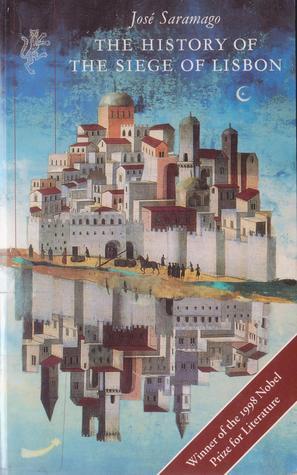
Synopsis:
A humble proof-reader for a Lisbon publishing house takes it upon himself to insert a negative into the sentence of a history book, thus effectively leaving that history entirely rewritten: whatever the experts have hitherto chosen to say, the visiting crusaders did not help the King of Portugal to recapture Lisbon from the Saracens in the twelfth century. This act of gross insubordination, which might have ended Raimundo Silva’s career, has instead the unexpected result of making his superior, the fetching Maria Sara, fall in love with him, and in his middle age romance blossoms. Under her impetus the humble proof-reader rewrites the history of the siege of Lisbon in a style graphic enough to satisfy the most exigent reader of historical romances.
As in The Stone Raft, so in this new novel José Saramago challenges, and indeed teases, his readers into discarding all their preconceptions, and by a slight refocusing of the microscope, brings them to observe human relationships and motivations, past and present, in a radically different light.
Happy Friday, everyone! Technically, it is already Saturday, but I am still grateful that we were all able to make it through the workweek! I hope everyone was able to end the workweek on a high note. I hope everyone was able to complete all their tasks and is jumping into the weekend without much worry. Outside, a storm is brewing. The thunderclap is strong. It has been like this for the past few days. Nevertheless, I hope everyone will have a restful weekend. It is time to let our hair down, wear comfortable clothes, and slow down. I hope we spend the weekend wisely, whether in completing our chores or spending time with our loved ones. I wish you well as you pursue your passions. I hope the weekend is providing everyone a timely respite from the tediousness of life. I hope everyone will find peace amid this pandemonium. More importantly, I hope everyone is doing well, in body, mind, and spirit.
With the workweek coming to an end, it is time for a fresh, albeit late, First Impression Friday update. While I have been posting late, I just cannot pass up the opportunity of publishing one because this has become an essential component of my weekly book blogging. It allows me space to take a breather and process the book I am currently reading. In August, I continued my exploration of European writers’ works, a literary journey I had begun in July. This pivot comes after spending the first half of the year reading the works of Asian writers, primarily those from East Asia. This literary journey is also critical in my 2025 reading journey because I have several books written by European writers in my reading challenges. I realized that I have been lagging behind in my reading challenges. However, my current read, José Saramago’s The History of the Siege of Lisbon, does not belong to any although it ticks off one book in the 1,001 Books You Must Read Before You Die List.
Like most of the writers I am reading in the past ten years, it was must-read lists that first introduced me to José Saramago, who I later learned was awarded the Nobel Prize in Literature. This naturally piqued my interest, making me acquire some of his works. In 2019, I read The Double, the first novel by Saramago I read. Six years later, I am reading my fifth Saramago novel; I actually just finished Blindness, his work I have long wanted to read but never quite got the opportunity until now. He then joins a select group of Nobel Laureates in Literature – and the first Portuguese writer – of whom I have read at least five books. To be honest, I was not planning on reading The History of the Siege of Lisbon because Blindness was already listed in my 2025 Top 25 Reading List. However, my curiosity got the best of me because of the novel’s premise. Actually, what reeled me into the novel is the exploration of alternative history.
Originally published in 1989 as História do Cerco de Lisboa, the novel structurally chronicles two plotlines occurring between two different periods. In the twentieth century, we meet Raimundo Silva, a fifty-year-old unmarried proofreader who works primarily for a small publisher. The crux of the story was when his services were enlisted for the proofreading of the manuscript of The History of the Siege of Lisbon. The titular siege of Lisbon took place from July 1 to October 25, 1147. Before the siege, the Portuguese capital was under the leadership of Moslems (borrowing the term as used in the book), particularly the Almoravid dynasty; the second prominent plotline transports the readers to this historical event as Saramago reimagines it. Historically, the siege was critical in the expansion of Christian monarchies. It was one of the few definitive victories of the Second Crusade. With this victory, the Kingdom of Portugal was established.
I am just about to cross the one-hundred-page mark, so I can’t share much about the historical details as Saramago rewrites, rather reimagines them. The first few chapters take place in the present as Silva is pressured by his publisher to finish proofreading the book. They have a deadline they wanted to keep, even if it meant there were some crucial errors in the text. Silva, you see, is considered a connoisseur on the subject. However, he deliberately decided to alter a crucial sentence by inserting the word “not” in the text. He was contemplating it because it would adversely impact the book, although I have yet to understand the impact on the overall story. Nevertheless, this provides me with glimpses into what the story is about. The synopsis is also more than enough to give me an iota of what the book is about.
As I mentioned, the premise of an alternate history is one of the reasons why I resolved to read the book despite it not being part of my original lineup. After all, in the contemporary era, alternate versions of history have become prevalent, even subject to prominent online discourses. It reminds me of an old but timeless adage of how the victor gets to write history. This then puts the proverbial question mark on the objectivity of how historical events are depicted. When scrutinized, different versions of history come out. This is, personally, a very interesting point, and I want to read how Saramago will challenge our perception of history. On top of this, Saramago has been renowned for exploring the history of his country; Raised from the Ground is a fine example of this.
On the other hand, the book places the microscope on the profession of proofreading, which, I fear, is going to be adversely impacted by the ascent of artificial intelligence. Still, I am looking forward to how Saramago writes about the art and intricacies of proofreading. Meanwhile, I am also looking forward to how Saramago reimagines the siege of Lisbon. Yes, the book is going to be a bit of a challenge to read. Saramago has the reputation of not using quotation marks. This results in overlapping sentences and conversations. Paragraphs can be tedious. But this is also one of the charms of his writing. Regardless, there is so much to look forward to in the novel. How about you, fellow reader? What book or books have you read over the weekend? I hope you get to enjoy whatever you are reading right now. Happy weekend!
 The Pine-Scented Chronicles