
And just like that, we are again turning in on a new leaf. We’ve completed the first two-thirds of the year, and now we enter its final third. How time flies! It continues on its natural course, with no regard for anyone. As the year slowly winds down, I hope the past eight months have treated you well. I hope they’ve brought you blessings, progress, and fulfillment. I also hope you’re making headway toward your goals. I wish you well on your individual journeys. May the remaining months of the year be filled with joy, healing, achievements, and answered prayers. If the year has been challenging so far, I hope the final stretch brings a reversal of fortune. I hope everyone’s hard work pays off. For those whose goal is simply to get from one point to another, know that that’s okay too. In times like these, with turmoil all around us, silencing the noise can be a challenge. More importantly, I hope everyone stays healthy—in mind, body, and spirit.
As for reading, the year is going smoothly. For the fourth year in a row, I’m on track to finish the year having read at least 100 books. I’m currently at 79, and with four more months to go, I have plenty of time to hit the mark. However, I can’t say the same for my other reading goals. After spending the first half of the year exploring works by Asian writers, I realized I’ve fallen behind on many of them. With that in mind, I shifted my focus to European literature—many of the books on my reading challenges are written by European authors. As always, the literary journey has been both memorable and enriching. I’ve explored new worlds while revisiting old ones. So, before diving into September, let me share how the second month of my venture into European literature shaped up. Happy reading!

King, Queen Knave by Vladimir Nabokov
Like Japanese literature, Russian literature has grown on me, although my exploration of it is not as extensive as my journey through Japanese works. Still, I always look forward to expanding my foray into this part of the literary world—one that introduced me to Vladimir Nabokov. I was fairly impressed with his globally renowned novel Lolita, which made me eager to read more of his work. This year, I included King, Queen, Knave in my 2025 Beat the Backlist Challenge list. Interestingly, King, Queen, Knave was Nabokov’s second published novel and also the second of his books I’ve read. It originally appeared in 1928 as Король, дама, валет (Korol’, dama, valet) under the pseudonym Sirin, and was translated into English by his son, Dmitri, four decades later. The novel chronicles the story of Franz Bubendorf, a hopelessly nearsighted and rather bland young man from a small provincial town. He is on his way to Berlin to seek employment at his uncle’s clothing store. Unbeknownst to him, Franz is sharing the train compartment with his uncle, Kurt Beyer, and Kurt’s young wife, Martha; Franz has met neither of them before. Franz is immediately captivated by Martha, whom he sees as sensual and passionate. Shortly after Franz begins working in his uncle’s store, he becomes enamored with Martha’s beauty, which leads to a secret love affair. As the story progresses, it becomes increasingly clear that Martha is a discontented woman, and her distaste for her husband grows more pronounced. This emotional strain begins to take a toll on Franz, whose health begins to deteriorate. In a way, King, Queen, Knave is Nabokov’s attempt to play with the love triangle trope. The encounters between Franz and Kurt often parody familiar scenes from such narratives. For his part, Kurt still cherishes his wife, even as she grows cold and distant. Franz, in turn, slowly transforms into a shadow of his lover, leading the story into darker territory. King, Queen, Knave is markedly different from Lolita, but it remains a compelling satire of middle-class adultery and the clichéd love triangle dynamic.
Goodreads Rating:


The Communist by Guido Morselli
From Russia, my literary journey next took me to Italy. It was through online booksellers that I first came across Italian writer Guido Morselli and his novel The Communist. I bought the book despite having no idea what it was about—and without having ever heard of Morselli before. That was way back in 2019. After letting it gather dust on my bookshelf for years, I finally resolved to include it in my 2025 Beat the Backlist Challenge. Originally published in 1976 as Il comunista, the titular communist is Walter Ferranini, a man born and bred for the political left. He grew up in abject poverty, was orphaned at twelve, and experienced the harsh realities of physical labor from a young age—an experience that exposed him to the ideals of Communism. In the 1930s, he left Mussolini’s Italy to fight Franco in Spain and later went into exile in the United States, where he got married. As Walter’s life takes us across continents, we are regaled with his reflections. In the United States, he feels he has betrayed the ideals of Communism by becoming entangled in the capitalist system. After his marriage falls apart, he returns to Italy and devotes his life and career to the Italian Communist Party, eventually being elected to represent his hometown, Reggio Emilia, in the Italian Parliament. It is at this juncture that Walter’s life begins to unravel. His advocacy for workplace safety reforms goes unsupported by his party, which has other priorities. Meanwhile, Walter becomes involved with Nuccia Cors, a younger woman working in publishing, who begins to challenge his long-held Communist beliefs. The novel gradually transforms into a story of ideological and existential crisis, as Walter begins to question his commitments and his place in the world. A palpably political novel, it references Stalin, The Communist Manifesto, and the broader history of socialism. Overall, The Communist is a compelling portrait of a man forced to confront who he is and what he truly stands for.
Goodreads Rating:

Seven Houses in France by Bernardo Atxaga
Before 2023, I had never heard of Bernardo Atxaga, whom I discovered through an online bookseller. Curious about what his writing had to offer, I acquired two of his books, including Seven Houses in France, which I included in my 2025 Beat the Backlist Challenge. Apparently, Bernardo Atxaga is the pseudonym of Joseba Irazu Garmendia, a Spanish Basque writer and self-translator who is a prominent figure in Spanish literary circles. Seven Houses in France was originally published in 2009 under the Basque title Zazpi etxe Frantzian. The novel opens in 1903 with Chrysostome Liège, who signs a contract to serve in King Léopold’s Force Publique. He travels to the Congo, then a Belgian colony deep in the rainforests of Africa—specifically to the remote outpost of Yangambi, which is under the command of Captain Lalande Biran. In the garrison, Chrysostome proves himself the best marksman and builds a reputation as the most stoic and morally upright soldier in the Empire. The novel details his interactions with both his fellow soldiers and the local population. However, the central focus of the story is Captain Biran, who agrees to serve in the Congo for five years as part of a plan orchestrated by his wife, Christine. While Biran commands the garrison, Christine works toward purchasing seven houses in France within that five-year span. As Christine prepares to close on the final house, the pressure on Captain Biran to send more money intensifies. This demand translates into a forced increase in the output of mahogany and rubber—resources extracted through the exploitation of Congolese laborers. The houses, then, become a powerful symbol: Christine’s desire for wealth and social status comes at a devastating human cost. The novel explores the legacy of colonialism while exposing the self-serving ambitions of colonial officers. With its graphic imagery and unflinching portrayal of violence and oppression, Seven Houses in France can be deeply discomfiting at times. Nevertheless, it is a powerful and worthy read.
Goodreads Rating:

The Idiot by Fyodor Dostoyevsky
One of the reasons I fell in love with Russian literature is Fyodor Dostoyevsky (also spelled Dostoevsky), whom I first encountered through various must-read lists. I began exploring his oeuvre with The Brothers Karamazov, which I read back in 2016. Nearly a decade later, I’ve now completed my fifth Dostoyevsky novel—though, interestingly, it wasn’t part of any of my ongoing reading challenges. I simply couldn’t resist reading The Idiot. Originally published serially in The Russian Messenger between 1868 and 1869, The Idiot is considered one of Dostoyevsky’s four most defining works. The titular “idiot” is Prince Lev Nikolayevich Myshkin, a young man in his mid-twenties. After spending four years in a Swiss asylum for severe epilepsy, the Prince travels to St. Petersburg on a cold November morning. His first stop is the household of General Yepanchin, whose wife, Lizaveta Prokofyevna Yepanchin, is a distant relative he wishes to become acquainted with. During his journey, the Prince meets Parfyon Semyonovich Rogozhin, whose obsessive devotion to Nastasya Filippovna Barashkova captures the Prince’s interest. At the General’s household, he also meets Gavril Ardalyonovich Ivolgin (Ganya), the general’s assistant, who is set to marry Nastasya. As if things couldn’t be more complicated, Nastasya is the former mistress of the aristocrat Afanásy Ivánovich Tótsky, while Ganya secretly yearns for Aglaya, the General’s youngest and most beautiful daughter. After saving Nastasya from a potentially humiliating situation, the Prince finds himself drawn to her, creating a love triangle with Rogozhin. While this entanglement adds dramatic tension, the novel remains centered on the Prince himself. Against the sophistication of the Yepanchins and the moral decay of the society surrounding him, the Prince stands out. His naiveté and honesty make him an object of both admiration and bewilderment. Dostoyevsky uses the Prince to portray a truly beautiful and innocent soul in a world steeped in materialism, cynicism, and spiritual emptiness—a world where people have no qualms about exploiting such innocence. The Idiot is yet another compelling and thought-provoking work from one of the true masters of Russian literature.
Goodreads Rating:


Life and Fate by Vasily Grossman
It was during the pandemic, through an online bookseller, that I first came across Vasily Grossman and his novel Life and Fate. I was surprised to learn that he was Russian—I had assumed he was German. Nevertheless, Life and Fate is one of the books on my 2025 Top 25 Reading List and, if memory serves me right, it’s my longest read of the year so far. Originally published in 1980 as Жизнь и судьба (Zhizn’ i sud’ba), Life and Fate is the third and final book in Grossman’s Stalingrad Trilogy. The novel takes readers across the vast landscape of the Battle of Stalingrad during the Second World War. As the German army advances, the Soviet Union’s defenses are pushed to their limits. Amidst the chaos, we are introduced to the Shaposhnikov family. In the Stalingrad section of the novel, we meet Yevgenia (Zhenya) Nikolaevna Shaposhnikova, a dedicated Communist Party member who reconnects with her lover, Colonel Pyotr Pavlovich Novikov. As the war escalates, they retreat to Kuibyshev, but Zhenya struggles to obtain a residence permit due to bureaucratic red tape. Meanwhile, Zhenya’s older sister, Lyudmila (Lyuda) Nikolaevna Shaposhnikova, is married to Viktor Pavlovich Shtrum, a renowned nuclear physicist. The couple has a daughter, Nadya, while Lyuda also has a son, Tolya, from a previous marriage. As the German army approaches Kazan, the Shtrum family is relocated to Moscow. Much of Viktor’s storyline centers on his scientific work. After making a significant mathematical breakthrough, he faces harsh criticism from Party authorities—an illustration of the oppressive political climate that often stifled intellectual and scientific progress. A third major storyline captures the brutal realities of life on the battlefield. Politics is a dominant theme in Life and Fate, a novel often compared to Leo Tolstoy’s War and Peace, and widely regarded as its 20th-century counterpart. With its sweeping scope, immersive historical detail, and complex interweaving narratives, the novel is a challenging but ultimately rewarding read.
Goodreads Rating:
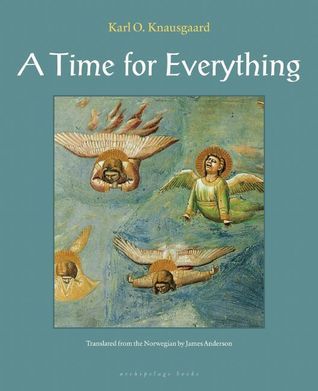
A Time for Everything by Karl Ove Knausgård
I can’t quite recall when I first came across Norwegian writer Karl Ove Knausgård, although it was during the pandemic that I began noticing the growing presence of his works. This piqued my interest, and last year, The Wolves of Eternity became part of my 2024 Top 24 Reading List, serving as my introduction to his oeuvre. Now, amid my ongoing exploration of European literature, I picked up A Time for Everything. It wasn’t part of any of my reading lists or challenges, but curiosity got the better of me. Originally published in 2004 as En tid for alt (and also known in English as A Time to Every Purpose Under Heaven), this is Knausgård’s second novel. The book opens in the 16th century with Antinous Bellori, an eccentric and melancholic theologian, who pens On the Nature of Angels (1584). Bellori devotes his life to the study of angels, and his treatise forms the novel’s framing device. From there, the narrative dives deep into history, reimagining various biblical and folkloric encounters with angels. Among the reinterpreted stories are those of Cain and Abel, the Great Flood, and Lot and Ezekiel. Knausgård takes poetic license to fill in the silences of scripture, offering fresh, literary perspectives on these iconic tales. The relationship between Cain and Abel is particularly well-developed, as Knausgård explores the complexities of good and evil while challenging our assumptions about biblical narratives and folklore. As the novel progresses, it begins to resemble a theological essay more than a traditional narrative. Yet Knausgård’s philosophical depth remains consistent. He treats his subjects with intellectual rigor, immersing readers in meditations on the divine, on angels, and on humanity’s evolving understanding of both. The novel also explores how angels have been depicted in art history, illustrating how these representations reflect broader religious and cultural transformations. Despite its density and complexity, A Time for Everything is a thought-provoking, allegorical examination of divinity, God’s presence (or absence), and our shifting relationship with religion.
Goodreads Rating:

The Silent Angel by Heinrich Böll
My venture into works of European literature next took me to Germany, the birthplace of several Nobel Laureates in Literature and many distinguished writers. Had it not been for the Nobel Prize in Literature, I likely wouldn’t have encountered Heinrich Böll. Awarded the prize in 1972, Böll was the first German laureate since Thomas Mann in 1929. Curious about his work and eager to expand my literary horizons, I added The Silent Angel to my 2025 Top 25 Reading List. Interestingly, Böll wrote The Silent Angel in 1950, intending it to be his debut novel. However, he couldn’t find a publisher at the time. It was only published posthumously in 1992 under the title Der Engel schwieg. Set during the final days of the Second World War, the novel follows Hans Schnitzler, a German soldier attempting to desert his unit. Before he can follow through, however, he is mistaken for a deserter. In a twist of fate, Willy Gompertz, a stenographer, switches jackets with him and is executed in his place. Assuming Gompertz’s identity, Schnitzler travels to Cologne to deliver the coat to Elisabeth Gompertz, Willy’s widow. Things take an unexpected turn when he discovers a will hidden in the coat lining—one that reveals corruption and greed. This quietly shifts the novel’s trajectory, turning the will into the center of a subtle yet significant mystery. Herr Doktor Professor Fischer, a relative of the deceased, seeks to retrieve the will and keep its contents buried. Meanwhile, Hans meets Regina, a grieving woman whose child was killed by a German machine gun. They are surrounded by a city both physically and spiritually devastated by war. Böll vividly captures the despair, numbness, and emotional inertia that pervade the ruins of Cologne. Yet The Silent Angel is not merely about despair. Beneath the rubble and trauma, the novel explores resilience—the quiet courage to go on living, to search for meaning, and to rediscover human connection in a fractured world. It is a haunting and poignant reflection on post-war life.
Goodreads Rating:

Blindness by José Saramago
From one Nobel Laureate in Literature to another. Unlike Böll, I’ve already had several opportunities to explore the oeuvre of Portuguese writer José Saramago. I first read his work in 2019, and for the first time ever, I read two of his books back-to-back. The first of the two was Blindness, a novel I had long been looking forward to. From the moment I first encountered it, I knew I had to read it. Obtaining a copy, however, was another matter entirely. When I finally managed to secure one, I immediately included it in my 2025 Top 25 Reading List. Originally published in 1995 in Portuguese as Ensaio sobre a cegueira (literally Essay on Blindness), the novel opens in an unnamed city with a traffic jam caused by a man who suddenly goes blind. When his wife learns of his strange and sudden affliction, she schedules an appointment with an ophthalmologist, who finds nothing physically wrong with the man’s eyes. That should have been the end of it—but of course, it isn’t. The Good Samaritan who helps the man home also goes blind. Then the ophthalmologist himself goes blind, followed by several of his patients. The doctor concludes that this strange blindness is highly contagious. Upon notifying the Ministry of Health, a quarantine zone is hastily established in an abandoned psychiatric hospital. Everyone infected is forcibly taken to the facility, guarded by armed soldiers. Those assigned to care for the quarantined are instructed to enforce a strict and draconian set of rules. With no cure in sight, conditions rapidly deteriorate. Food becomes scarce, and what little is available is distributed unfairly. Morale plummets. But this is only the surface. As one delves deeper into the novel, it becomes clear that the blindness is symbolic—representing a much deeper moral and spiritual blindness that permeates modern society. Set in a dystopian future, Blindness is Saramago’s grim and unsettling prognosis of the human condition. The absence of names—for both characters and places—underscores the universality of the story’s themes and its relevance across time and geography. Blindness is a deeply philosophical and thought-provoking read—bleak, yes, but profoundly insightful.
Goodreads Rating:
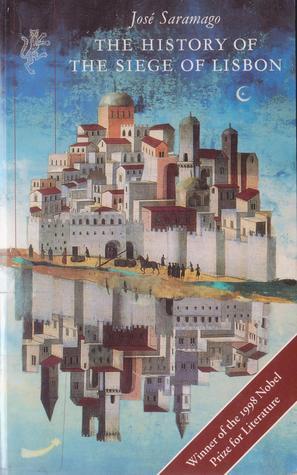
The History of the Siege of Lisbon by José Saramago
Unlike Blindness, The History of the Siege of Lisbon is not part of any of my current reading challenges. I hadn’t even planned to read it anytime soon, especially since I had only recently acquired my copy. But when I learned that it was listed among the 1,001 Books You Must Read Before You Die, I reconsidered my initial plan. Originally published in 1989 as História do Cerco de Lisboa, the novel weaves together two plotlines set in different periods. In the twentieth century, we meet Raimundo Silva, a fifty-year-old unmarried proofreader who works primarily for a small publishing house. He is also regarded as an expert on the titular Siege of Lisbon. This historical siege began on July 1 and ended on October 25, 1147, when Lisbon was seized from the Almoravid Muslims by the Second Crusade. It marked a pivotal turning point in Portuguese history: Portugal transformed from a vassal state into an independent Christian kingdom. Silva is assigned to edit a manuscript entitled The History of the Siege of Lisbon. However, he finds the text unoriginal and predictable, so he deliberately alters it by inserting a single but significant word: “not.” This change reverses the meaning to suggest that the Crusaders did not assist the Portuguese during the siege. Running parallel to Silva’s modern storyline is Saramago’s reimagined version of the siege, a work of alternate history. I find this facet especially interesting, as alternate versions of history have become increasingly relevant in today’s discourse. Since history is often written by the victors, the objectivity of historical documentation is questioned. Essentially, the novel challenges our understanding of history while offering intriguing insight into the world of proofreading. Another narrative thread explores Silva’s evolving relationship with Dr. Maria Sara, who is brought in by the publisher to supervise the proofreaders. The History of the Siege of Lisbon reveals a different dimension of Saramago’s literary range. Like Blindness, it tackles themes that transcend time and place. It examines not only the past but also interrogates the stories we tell, and the ones we choose to believe.
Goodreads Rating:
Reading Challenge Recaps
- 2025 Top 25 Reading List: 16/25
- 2025 Beat The Backlist: 12/20; 74/60
- 2025 Books I Look Forward To List: 3/10
- Goodreads 2025 Reading Challenge: 79/100
- 1,001 Books You Must Read Before You Die: 5/20
- New Books Challenge: 5/15
- Translated Literature: 64/50
Book Reviews Published in August
- Book Review # 600: The Water Margin
- Book Review # 601: The Emperor of Gladness
- Book Review # 602: Snow Country
- Book Review # 603: The Passengers on the Hankyu Line
Admittedly, I’m still in a bit of a writing rut. I can’t seem to build the momentum I want, and my output has been below my own expectations. Over the past four months, I managed to publish at least four book reviews each month, but even that feels like it’s falling short. I know I’m capable of writing at least eight, sometimes even more than ten, in a month. I just feel sluggish lately, struggling to find the motivation to keep going. That said, I’m glad I’ve been able to pick up the pen and tick off some of my pending reviews. In August, I completed four book reviews—a decent number overall, but still less than what I know I can do. I’m hoping to build more momentum as the year progresses. I also didn’t make any progress on my June 2023 backlog, which mostly consists of works by Asian writers. August turned out to be a mixed bag—I even reviewed a book I read nearly a decade ago: Yasunari Kawabata’s Snow Country. I suppose that’s a positive sign because there are many earlier reads I’ve been meaning to revisit and write about.
The recent slowdown means I’m still swamped with pending book reviews from 2023 to the present. Nevertheless, I’m proud to say I published my 600th book review in August—a milestone that feels like a real achievement. For September, I’m aiming to build more momentum—or perhaps reignite that creative fire. I just published my review of Sayaka Murata’s latest novel, Vanishing World, and I plan to double my efforts to reduce my backlog. My primary focus will be on those pending June 2023 reviews, but I’ll also work on some from 2024 and 2025. Occasionally, I might also publish reviews of books I read before I began publishing reviews—such as Haruki Murakami’s Norwegian Wood and Kafka on the Shore, Kazuo Ishiguro’s An Artist of the Floating World, Orhan Pamuk’s Snow, Salman Rushdie’s The Ground Beneath Her Feet, Ian McEwan’s Atonement, and Naguib Mahfouz’s Miramar. Many of these hold special significance for me as they were the first works I read by these authors.
September will also continue my journey through European literature. I have quite a few books in my reading challenges lined up, including Hilary Mantel’s Wolf Hall, Ian McEwan’s Amsterdam, and William Golding’s Rites of Passage—all originally written in English. Interestingly, the last English-language book I read was in early July. Alongside these, I have Thomas Mann’s Death in Venice and Hermann Hesse’s Peter Camenzind on my reading list, both German Nobel Laureates. And, of course, I might pick up a book or two outside my challenges as the month progresses. How about you, fellow reader? How is your own reading journey going? I hope you enjoyed the books you have read. For now, have a great day. As always, do keep safe, and happy reading, everyone!
 The Pine-Scented Chronicles