
First Impression Friday will be a meme where you talk about a book that you JUST STARTED! Maybe you’re only a chapter or two in, maybe a little farther. Based on this sampling of your current read, give a few impressions and predict what you’ll think by the end.
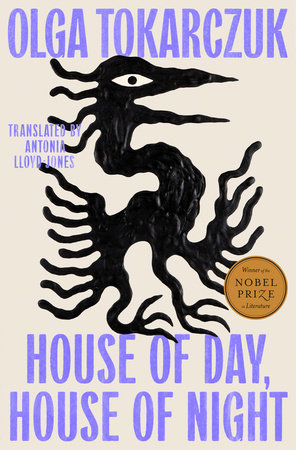
Synopsis:
A woman settles in a remote Polish village. It has few inhabitants now, but it teems with the stories of the living and the dead. There’s the drunk Marek Marek, who discovers that he shares his body with a bird, and Franz Frost, whose nightmares come to him from a newly discovered planet. There’s the man whose death – with one leg on the Polish side, one on the Czech – was an international accident. And there are the Germans who still haunt a region that not long ago they called their own. From the founding of the town to the lives of its saints, these shards piece together not only a history but a cosmology.
Another brilliant “constellation novel” in the ode of her International Booker Prize-winning Flights, House of Day, House of Night reminds us that the story of any place, no matter how humble, is boundless.
Happy Friday, everyone! Technically, it is already Saturday. So, happy Saturday, everyone! Thankfully, we were able to make it through another workweek. I hope you ended the workweek on a high note and were able to accomplish everything you wanted to. I hope you are jumping into the weekend without much worry. Here in the Philippines, the skies remain overcast, although the weather from the previous week has been a mix of hot and cold. No wonder many are feeling under the weather. With this, I hope everyone is doing well. I wish everyone a restful weekend. It is time to let your hair down and wear comfortable clothes. Slow down and take a rest. I hope everyone will have a great weekend. I hope everyone will find peace amid this pandemonium. More importantly, I hope everyone is doing well, in body, mind, and spirit.
With the workweek coming to an end, it is time for a fresh, albeit (as usual) late, First Impression Friday update. Despite the late updates, I couldn’t pass up the opportunity to publish one update, as this has become an essential component of my weekly book blogging routine. It is a space that allows me to process the book I am currently reading. In September, I am still pursuing works of European writers, although I will conclude this literary journey this month. This pivot comes after spending the first half of the year reading the works of Asian writers. This pivot is also critical in my 2025 reading journey because I have several books written by European writers in my reading challenges. I realized that I have been lagging behind in my reading challenges. My current read, Olga Tokarczuk’s House of Day, House of Night, however, is not part of any of these reading lists.
It was just recently that I learned about the re-release of one of the Nobel Laureate in Literature’s earlier works; it was during the lead-up to the announcement of the 2018/2019 Nobel Prize in Literature that I first came across the Polish writer. Originally published in 1998 as Dom dzienny, dom nocny, House of Day, House of Night was first translated into English in 2002. This makes the novel the first book by Tokarczuk to be translated into English; it was translated by Antonia Lloyd-Jones. This year, Fitzcarraldo Editions will republish this translation in their signature minimalistic blue book cover. I am surprised I was able to find a copy of the book (although not the Fitzcarraldo Editions version) because I am expecting it to be rereleased in December. Regardless, it was a no-brainer for me to read the book shortly after I acquired a copy of it; after all, I am still in the midst of a venture into works of European literature.
House of Day, House of Night transports the readers to a small, remote village in southwestern Poland, near the border with Czechia. At the heart of the novel is an unnamed woman who is also the novel’s narrator. She and her partner R moved to Nowa Ruda, which used to be part of the German Reich until 1945. The setting immediately reminded me of Drive Your Plow Over the Bones of the Dead, the first novel by Tokarczuk I read. However, the structure reminded me of another Tokarczuk novel, Flights. When I researched more about my current read, many refer to it and Flights as constellation novels. Essentially, both books lack a straightforward plot. Instead, Tokarczuk wove a lush tapestry of loosely connected, disparate stories, sketches, and essays.
It is because of this structure that many refer to House of Day, House of Night as Tokarczuk’s most difficult novel. Or at least I assume that it is the reason why they consider it her most difficult novel. This was also among the drivers why I wanted to read the book: how much more challenging is it compared to Flights? Anyway, these fragments slowly paint a portrait of the sparsely populated village. Tokarczuk fuses folklore and some local stories, such as that of Kummernis of Schönau, a bearded female folk saint crucified by her father, and Paschalis, the monk who longed to be a woman and chronicled her life. I understand why many find the novel a challenging read, particularly literary purists. The digressions and the meandering tale are rather mind-boggling.
But I guess the focus of the novel is the village; it seems to be the main character. The narrator is a mere crucible through which these stories flow. The history of the village and its prominent residents explores memory as well. At the same time, the novel seemingly explores transformation and the meaning of home. I am already halfway through the book. Like the Tokarczuk novels I previously read, House of Day, House of Night is quite an experience. Rather than expecting anything, I am just letting the book guide me. There is a lot to look forward to and to understand. How about you, fellow reader? What book or books have you read over the weekend? I hope you get to enjoy whatever you are reading right now. Happy weekend!
 The Pine-Scented Chronicles