A Turkish Literary Epic
Life has an interesting way of leading us toward fulfilling our true calling. As we grow up, our dreams begin to take shape. We set goals and work diligently toward achieving them. However, along the way, we often encounter detours. As we continue on our journey, we come to realize that the path to our destination is not always straightforward. This is true even for some of the world’s most successful writers. Take, for example, Turkish writer Ferit Orhan Pamuk. Born to an affluent but declining family, Pamuk was raised in the city’s westernized and prosperous district of Nişantaşı. He dreamed of becoming a painter, although his family disapproved of his ambition. He then pursued an alternative path, earning a degree in architecture at Istanbul Technical University. Eventually, Pamuk realized that neither architecture nor painting was his true calling.
He then took another detour and pursued a degree in journalism at Istanbul University. Ironically, he never worked as a journalist, but this academic pursuit laid the groundwork for what would become his literary career. In his early twenties, Pamuk decided to pursue writing seriously. In 1982, he published his debut novel, Cevdet Bey ve Oğulları (Cevdet Bey and His Sons, also translated as Darkness and Light). An immediate critical success, the novel earned him the Orhan Kemal and Milliyet Literary Prizes. It marked the beginning of a literary career that would transcend national boundaries, especially after the publication of his third novel, Beyaz Kale (1985; The White Castle). As the saying goes, the rest is history. Pamuk is Turkey’s best-selling author, and in 2006, he received one of the world’s highest literary honors when the Swedish Academy awarded him the Nobel Prize in Literature.
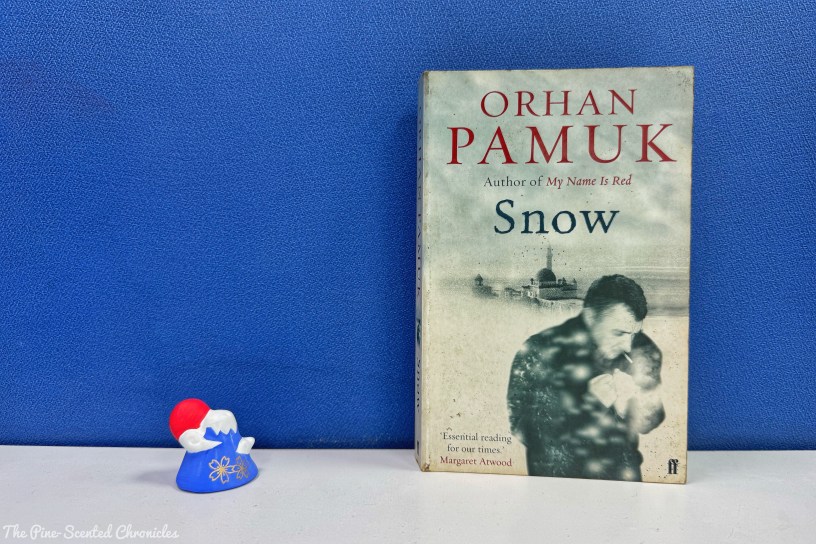
Among his most acclaimed works is Snow. Originally published in 2002 as Kar, it was his first novel following the success of Benim Adım Kırmızı (1998; My Name is Red). Snow is set primarily in the early 1990s. At the center of the story is Ka, a forty-two-year-old poet from Istanbul who fled Turkey as a political exile twelve years earlier and moved to Frankfurt, Germany. He returns to his homeland following the death of his mother and becomes captivated by a disturbing suicide epidemic affecting young Muslim women in the town of Kars, near the country’s eastern border. Posing as a journalist writing for a friend’s newspaper, Ka travels to the remote town. As he journeys there, snow falls heavily. Shortly after Ka’s arrival, Kars becomes isolated from the rest of the world due to a snowstorm.
There are two kind of men. The first kind does not fall in love until he’s seen how the girls eats a sandwich, how she combs her hair, what sort of nonsense she cares about, why she’s angry at her father, and what sort of stories people tell about her. The second type of man—and I am in this category—can fall in love with a woman only if he knows next to nothing about her.
Orhan Pamuk, Snow
Upon arriving in town, Ka visits the families of the deceased girls, going door to door. As he probes deeper into their deaths, he becomes increasingly disturbed, caught in a web of confusion and ambiguity. Conflicting narratives emerge, further obscuring the truth. Although his investigation into the suicides begins as a pretense, Ka becomes deeply invested. This pretense conceals his real motivation: a woman named İpek Hanım, with whom he once shared romantic feelings. Ka devises a plan to win İpek’s affection. She had previously been married to Muhtar Bey, their mutual friend from college, but they divorced three years earlier. Muhtar is now a local political candidate. Ka hopes to persuade İpek to move to Germany with him and become his wife.
With Kars cut off from the outside world, Ka checks into the hotel owned by İpek’s father, where he sees her again for the first time in years. Overcome by her beauty, he begins to pursue her relentlessly, setting his original plan into motion. Their reunion was awkward at first as they tried to find a common ground. Tthey gradually reconnected through shared memories and experiences. As Ka’s affection for İpek intensifies, so does the turmoil around them. During a conversation in a café, they witness the murder of the local director of the Institute of Education by a radical seeking revenge for the suicides of the young girls. This is an ominous prelude to the chaos that would soon engulf the town.
The shocking event, however, did not hinder Ka from pursuing his investigation into the suicide of young women. As he delved deeper into these cases, he met a diverse and interesting cast of characters from all walks of life. He managed to gain an audience with Muhtar, the assistant police chief, and even some religious high school students, such as Necip. A sensitive but charming Islamist youth, Necip introduced Ka to Blue, an enigmatic and elusive character. Blue is a charismatic Islamic radical who warned Ka against reporting on the tragic suicides. Turning their deaths into a political statement could do more harm than good. Meanwhile, Kadife is İpek’s younger sister. She is a schoolgirl who is embroiled in the political intrigue that swept the town. She is also the leader of the “head-scarf girls,” and is romantically involved with Blue.
Despite the upheaval, Ka continues investigating the suicides and encounters a wide range of characters. Each had their point-of-view of the events, adding interesting layers to the story. Soon. Ka meets with Muhtar, the assistant police chief, and even some religious high school students. Among the students he met, one that stood out was Necip. He is a sensitive, devout, and charismatic youth who introduces Ka to Blue, an enigmatic Islamic radical. Blue issued a warning to Ka not to politicize the suicides, insisting that doing so could be harmful. Meanwhile, İpek’s younger sister, Kadife, emerges as a central figure. She is a schoolgirl caught in the political turmoil, leader of the “headscarf girls,” and romantically involved with Blue.
Elsewhere in Kars, Sunay Zaim—an actor turned politician—leads a coup. In the 1970s, Sunay was known for his impassioned performances in leftist political theater. However, his fall from grace was marked by controversial statements and failed attempts to be cast as Atatürk. Now, under the guise of a play titled My Fatherland or My Headscarf, Sunay stages a violent coup with the help of Z Demirkol. Under the pretense of promoting “enlightenment,” they arrest, interrogate, and even kill Islamist youths and suspected fundamentalists. The chaos that ensues is hidden from the outside world, as both the Kars television station and the Border City Gazette, a local newspaper run by the eccentric Serdar Bey, fall under Sunay’s control.
The sight of snow made her think how beautiful and short life is and how, in spite of all their enmities, people have so very much in common; measured against eternity and the greatness of creation, the world in which they lived was narrow. That’s why snow drew people together. It was as if snow cast a veil over hatreds, greed, and wrath and made everyone feel close to one another.
Orhan Pamuk, Snow
What began as a personal mission to rekindle an old love gradually evolves into a dark and complex narrative about cultural conflict in rural Turkey. The catalyst is the suicide epidemic among young Muslim women—a fictionalized account based on actual events in Batman, Turkey. Ka—whose full name is Kerim Alakuşoğlu—encounters divergent perspectives on the crisis. The deputy governor dismisses the suicides as unrelated to emotional distress, remarking, “If unhappiness were a genuine reason for suicide, half the women in Turkey would be killing themselves.” Others were dismissive and consider the phenomenon mere rumor. In contrast, religious figures such as Sheikh Saadettin Efendi interpret the suicides as acts of dignity and defiance. These young women saw their headscarves as integral to their identities.
When the government imposed a ban on headscarves in public institutions, some young women responded by taking their own lives. This was compounded by the murder of the Institute’s director, who had strictly enforced the policy. Blue and Kadife share Sheikh Saadettin’s interpretation, viewing the suicides as symbolic resistance. This moment marks a narrative shift: what initially appears to be a cultural dilemma expands into political, economic, and religious commentary. From the outset, Ka observes the town’s bleak socioeconomic conditions—poverty and despair are widespread. These realities intersect with the broader ideological divide between secularism and religious fundamentalism.
As Kars remains isolated, ideological tensions escalate. Sunay, championing secularism, seeks to purge Islamist views and indoctrinate the public with his own beliefs. Meanwhile, Blue and his followers resist. The headscarf then becomes an emblem of political Islam, a symbol of the values they are defending. It also represents a cultural marker closely associated with Turkish women’s identity. Yet the line between devout faith and fanaticism is thin. In one unsettling scene, a girl named Hande suggests suicide to another, shocking Ka. This incident exposes the fragile line between personal agency and ideological coercion, reflecting the broader tension between tradition and modernity in Turkish society. Modernization, paradoxically, serves as both a response to and a cause of the despair Ka observes in the town.
Kars then serves as a vivid microcosm of Turkey, with its characters navigating the country’s shifting social, political, and religious landscapes. The narrative also reveals gender-based disparities, particularly in how religious identity affects men and women differently. Early in the story, İpek offers a poignant observation: “The men give themselves to religion, and the women kill themselves.” This comment encapsulates the gendered impact of religious and political discourse. The novel further explores the tension between individual identity and societal expectations. Muhtar, for example, grapples with faith and politics, while Ka is forced to confront his own spiritual beliefs.
In twenty years’ time—in other words, when you’re thirty-seven years old—you will have understood at last that all the evil in the world—I mean the poverty and ignorance of the poor and the cunning and lavishness of the rich—and all the vulgarity in the world, and all the violence, and all the brutality—I mean all the things that make you feel guilty and think of suicide—by the time you’re thirty-seven you’ll know that all these things are the result of everyone’s thinking alike.
Orhan Pamuk, Snow
Ka’s education and Western ideals initially render him skeptical of religion. Raised in a liberal household that encouraged reading. This then exposed him to Western culture, including films and literature. As an adult, he now faces an internal crisis of identity as he struggles to strike a balance between his Turkish roots and his Westernized upbringing. Though he returns to Turkey intending to remain neutral, the extremity of the views he encounters makes neutrality impossible. Without his design, he was slowly becoming an unwilling participant into these political and religious discourses. A conversation with Kadife underscores the central philosophical conflict: she claims that only those who have suffered can truly question faith.
Love emerges as a recurring theme in the novel—whether in Ka’s romantic pursuit of İpek, his appreciation for Western culture, or his reverence for the beauty of snow. He associates beauty with love, and this idealization complicates his emotional state in Kars. To navigate the turmoil, Ka turns to poetry. He composes twenty poems inspired by the symmetrical elegance of snowflakes. His reunion with İpek rekindles his artistic sensibilities, which he struggled with during his exile due to the silence surrounding him. Nineteen of these poems are documented; the twentieth is believed to have been performed live during the town’s first televised program. The theater, too, becomes a medium for political messaging and activism.
Through Ka’s experiences, Pamuk offers international readers a nuanced portrait of modern Turkey. The events in Kars reflect a nation in conflict with itself. The suicide crisis among young women masks deeper, systemic issues. Secularism and religious fundamentalism collide, and the tension between tradition and progress shapes the characters’ lives. The novel weaves themes of love, betrayal, identity, and faith into a rich tapestry. Culture, politics, history, activism, and religion intersect in Kars, as individuals confront their ideals and inner selves. Ultimately, Snow is a complex, multilayered exploration of personal and collective identity in a nation undergoing profound transformation. The novel cements Pamuk’s legacy as a masterful storyteller.
Even if you did believe in God, it would make no sense to believe alone. You’d have to believe in Him as the poor do; you’d have to become one of them. It’s only by eating what they eat, living where they live, laughing at the same jokes and getting angry whenever they do that you can believe in their God. If you’re leading an utterly different life, you can’t be worshipping the same God they are. God is just enough to know that it’s not a question of reason or logic but how you live your life.
Orhan Pamuk, Snow
Book Specs
Author: Orhan Pamuk
Translator (from Turkish): Maureen Freely
Publisher: Faber and Faber Limited
Publishing Date: 2005 (2002)
Number of Pages: 436
Genre: Historical, Literary
Synopsis
As snow begins to fall, a journalist arrives in the remote city of Kars on the Turkish border. Kars is a troubled place – there’s suicide epidemic among its young women, Islamists are poised to win the local elections, and the head of the intelligence service is viciously effective. When the growing blizzard cuts off the outside world, the stage is set for a terrible and desperate act…
Orhan Pamuk’s magnificent and bestselling new novel evokes the spiritual fragility of the non-Western world, its ambivalence about the godless West, and its fury.
About the Author
To learn more about the 2006 Nobel Prize in Literature awardee and esteemed Turkish writer, click here.
 The Pine-Scented Chronicles