
Happy Wednesday, everyone! Wednesdays also mean WWW Wednesday updates. WWW Wednesday is a bookish meme hosted originally by SAM@TAKING ON A WORLD OF WORDS.
The mechanics for WWW Wednesday are quite simple: you just have to answer three questions:
- What are you currently reading?
- What have you finished reading?
- What will you read next?

What are you currently reading?
It’s already the middle of the week — how time flies! Technically, it is already Thursday, but hey, I hope everyone’s week is going well. We’re already in the tenth month of the year. Before we know it, we’ll be welcoming a new one. As the year approaches its inevitable close, I hope everything is going well for everyone. I hope blessings and good news are showering upon you. May the last quarter of the year be filled with answered prayers and healing. More importantly, I hope everyone is doing well — both physically and mentally. I sincerely hope you’re making great strides toward your goals. May the remaining months of the year be kinder to you and repay you for all your hard work. Reading-wise, I’ve been lagging behind on my reading challenges. As I’ve done in previous years, I’ll be spending the rest of the year catching up.
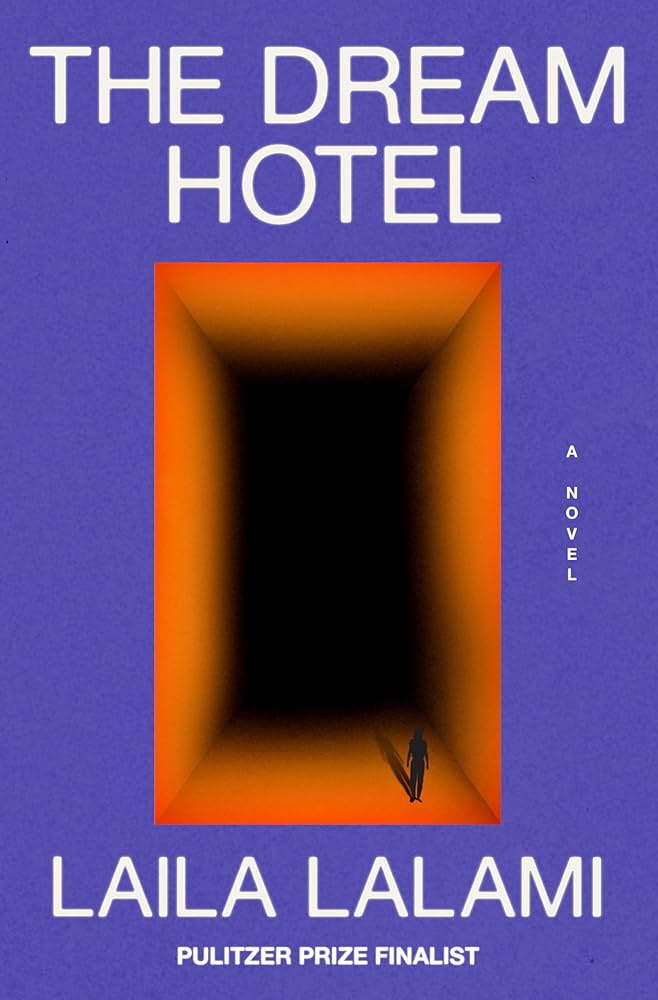
Before this year, I had never encountered Laila Lalami. However, while searching for books to include in my 2025 Books I Look Forward To list, I came across her latest novel, The Dream Hotel. The book’s premise — and its promise to explore a new world — compelled me to add it to my list. Thankfully, I was able to obtain a copy, making it the fourth book from the list I’ve read. The novel is set in the near future and charts the fortunes of Sara Hussein, a Moroccan-American woman. At the start of the novel, we find her detained by a government agency in Madison, a former elementary school repurposed by the contractor Safe-X. She has been in detention for 10 months — far exceeding the standard 21 days — and was not even granted the basic right to a hearing. This sets the stage for exploring the circumstances of her arrest.
The story then rewinds to the moment she was taken. Sara is a 38-year-old historical archivist. She is married and has twin children. On a return flight to Los Angeles from an international conference, she was stopped by law enforcement. She had no idea what she had done to prompt such a response. The interrogation began with an innocuous question: What happened during the flight? From there, more inquiries followed. You see, before the conference, Sara was considered “Low Risk.” Yes — in this world, people are assessed individually based on their perceived threat level. For example, even having a distant relative with a criminal record could raise your score. Upon her return, Sara’s risk score had spiked to 518, exceeding the 500-threshold. What fate awaits her in Madison? The premise is quite compelling and carries echoes of dystopian classics such as George Orwell’s 1984. It has now captured my full attention. I can’t wait to see what this Pulitzer Prize–nominated book has in store.
What have you finished reading?

Toward the end of my venture into European literature, I seem to have gathered a semblance of reading momentum. After completing four books the week before, I was able to finish three more this past week. The first of the three is by a familiar writer. It was various must-read lists that introduced me to Neil Gaiman, whose oeuvre I first explored through his popular American Gods, followed by Neverwhere. However, it has been quite some time since I last read a book by the British author. For this reason, I picked up Coraline — even though it wasn’t part of any of my ongoing reading challenges.
I’ve been meaning to read Coraline, which I first heard about as a movie. I haven’t seen the film, but I’ve always been curious about the book — and now it’s the third work by Gaiman that I’ve read. At the heart of the novella is the titular Coraline Jones, a young girl who moves with her parents, Charlie and Mel, into a large, old house in a new town. The house has been structurally divided into individual units, each occupied by eccentric tenants from different walks of life. Despite working from home and clearly loving their daughter, Coraline’s parents rarely have time to play with her. Curious, adventurous, and perceptive, Coraline begins exploring beyond the confines of her flat and becomes acquainted with the other tenants. April Spink and Miriam Forcible, retired actresses, live in the unit below. Meanwhile, Mr. Bobo — commonly referred to as the “Crazy Old Man Upstairs” — claims to be training a mouse circus. This cast of quirky characters adds charm and intrigue to the story.
But, of course, as in many Gothic tales, the house itself becomes a major character — reminiscent of Manderley in Rebecca. One day, Coraline discovers a locked door in the living room, which sets into motion a strange and unsettling series of events. Misses Spink and Forcible read her fortune in tea leaves, while Mr. Bobo warns her of a message from the mice: “Don’t go through the door.” Despite the warning, Coraline opens it. On the other side, she finds a flat identical to her own, inhabited by eerie doppelgängers of her parents — her “Other Mother” and “Other Father.” Even younger versions of Misses Spink and Forcible reside there. Though the premise may seem simple, Coraline explores a wide range of themes. It’s a story about the meaning of home, the nuances of family relationships, and, more than anything, Coraline’s coming-of-age. The novella blends horror, fantasy, and emotional depth — making it a quintessential Gaiman tale.

From a British writer to a Russian one. From a familiar voice to an unfamiliar one. My venture into European literature next led me to a part of the literary world that has grown on me over the years. While my appreciation for Russian literature is largely shaped by the works of Fyodor Dostoevsky and Leo Tolstoy, I’ve always sought opportunities to expand my understanding of it. Interestingly, 2025 is turning out to be my most prolific year yet for Russian literature, with Yevgeny Zamyatin’s We becoming the fifth work by a Russian author I’ve read this year.
Ironically, We is not part of any of my ongoing reading challenges. However, it appears on the 1,001 Books You Must Read Before You Die list, making it technically a part of my broader reading goals. Originally written between 1920 and 1921, We has a fascinating publication history. Its English translation was published in 1924, well before the full Russian text (Мы, My) appeared in 1952. Set in a dystopian future, the novel is presented as a series of 40 “Records” written by the primary narrator, D-503. The story takes place in the One State, a hyper-rational society built almost entirely of glass and ruled by an authoritarian regime led by a figure known as the Benefactor. D-503 is a mathematician and spacecraft engineer, and the lead designer of the INTEGRAL—a rocket ship commissioned by the One State to invade extraterrestrial planets. The mission? To spread the ideology of the One State: complete subservience to the government and absolute faith in logic, mathematics, and rationality. The Benefactor believes that individual freedom is a threat to collective welfare.
Through D-503’s journals, we are taken through the rigid, transparent, and surveilled world of the One State. Its citizens—called “ciphers”—live in glass apartment buildings and are constantly monitored by the Bureau of Guardians, the regime’s secret police. D-503 is assigned a regular sexual partner, O-90. During a walk with her, he encounters I-330, a bold and unconventional woman who shamelessly flirts with him—an act that violates state norms. Though disturbed, D-503 is drawn to her. I-330 invites him to the mysterious Ancient House, and as his obsession with her deepens (even experiencing dreams, which are considered signs of mental illness), she reveals her ties to a rebel group known as the Mephi, which seeks to overthrow the One State. Will the Mephi succeed? Like the novel it inspired—George Orwell’s 1984—We is a vivid and haunting portrait of a future in which individuality is sacrificed for the supposed greater good. It’s not just a dystopia—it’s a diagnosis and a warning. Overall, We is a compelling and thought-provoking read.
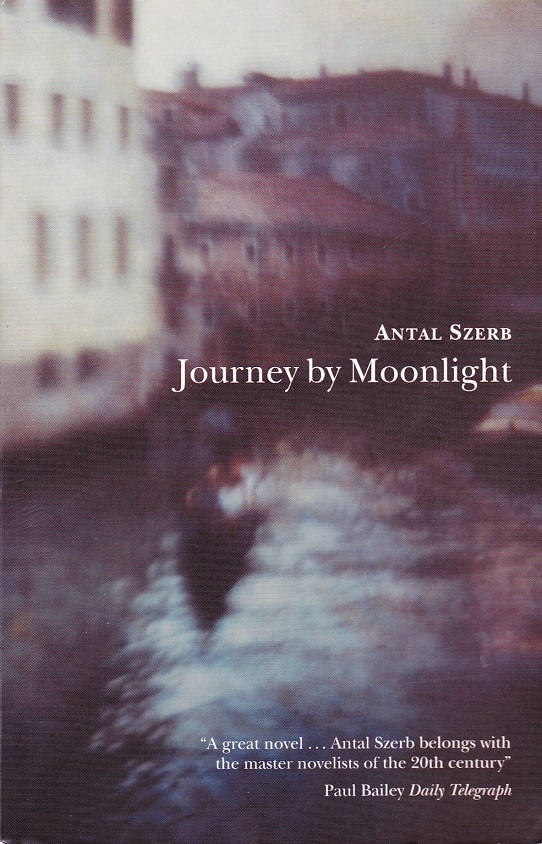
I originally planned to conclude my venture into European literature with We. However, since I had time, I decided to squeeze in one more book. Besides, my to-be-read list is a long one. Hungarian writer Antal Szerb is one of several authors I discovered through online booksellers. I had barely any idea who he was, but the curious cat in me simply couldn’t resist the allure of exploring a new literary world. Hungarian literature has also been growing on me, thanks to the literary trio of Magda Szabó, László Krasznahorkai, and Péter Nádas. As it turns out, Szerb is considered one of the most important Hungarian writers of the 20th century. These are the reasons I picked up a copy of Journey by Moonlight.
Originally published in 1937 as Utas és holdvilág, Journey by Moonlight is Szerb’s second novel—and his best-known work. At the heart of the story is Mihály, a Budapest native in his thirties, born into a bourgeois family. Everything in life was handed to him: he was pushed into a job at the family firm and pressured into marrying the beautiful and wealthy Erzsi. When we first meet him, Mihály is on his honeymoon in Venice, Italy—his first time visiting the country. It should have been a happy and memorable trip for the couple, but things quickly begin to unravel. A chance encounter with an old friend, János Szepetneki, sets off a chain of events that sends Mihály spiraling into memories of his youth. Nostalgia grips him as he recalls the friends who once defined his adolescent years—chief among them the mysterious siblings Tamás and Éva Ulpius, in whose home Mihály found a sense of refuge and comfort. Ervin and János later joined their circle. They were intellectuals, dreamers, and romantics, obsessed with history and prone to theatrical playacting—all while competing, subtly or otherwise, for Éva’s attention.
But good times rarely last. Tamás’s suicide shattered the group and scattered its members in different directions. They lost contact and drifted apart. In the present, a mishap causes Mihály to board a different train than Erzsi. Whether by accident or subconscious intention, this separation marks the start of Mihály’s personal odyssey across Italy. The country becomes a rich, dreamlike backdrop for a novel populated by wonderfully eccentric but deeply human characters. We learn more about Erzsi too—she had previously divorced Zoltán, and while she knew the risks of marrying Mihály, she went ahead anyway. Mihály, for his part, is dreamy and romantic, struggling to break free from the rigid expectations of bourgeois life. Though aware that he’s been separated from Erzsi, he nonetheless follows the pull of something deeper—an inner calling to explore his own identity and desires. Journey by Moonlight is, at its core, a novel about marriage and friendship. Alternately eccentric and nostalgic, it’s a delightful and thought-provoking exploration of selfhood, memory, and the quiet rebellion against conformity.
What will you read next?

 The Pine-Scented Chronicles