
First Impression Friday will be a meme where you talk about a book that you JUST STARTED! Maybe you’re only a chapter or two in, maybe a little farther. Based on this sampling of your current read, give a few impressions and predict what you’ll think by the end.
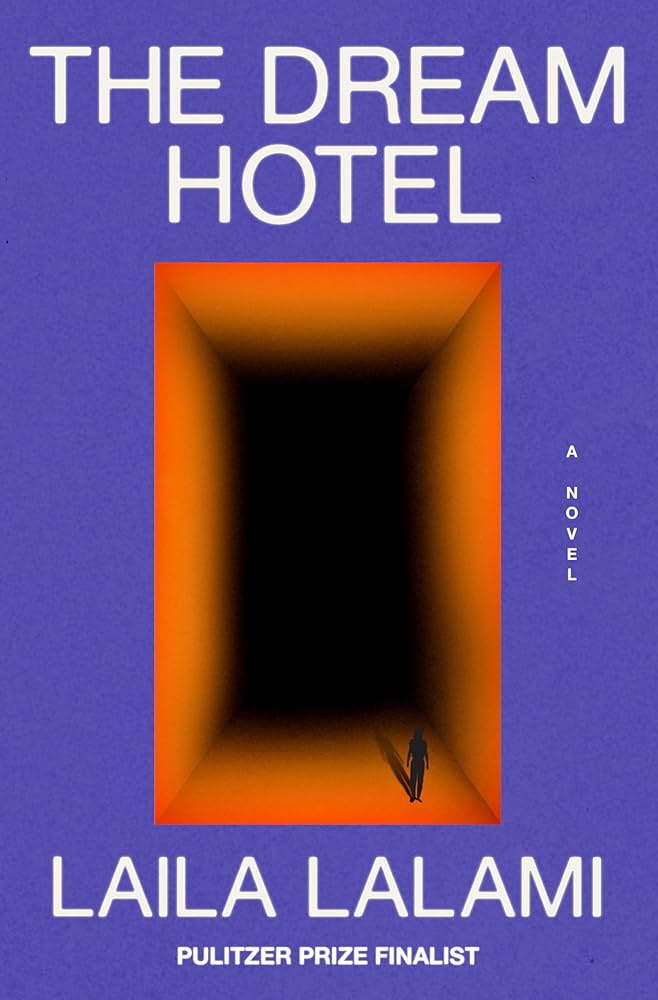
Synopsis:
Sara has just landed at LAX, returning home from a conference abroad, when agents from the Risk Assessment Administration pull her aside and inform her that she will soon commit a crime. Using data from her dreams, the RAA’s algorithm has determined that she is at imminent risk of harming the person she loves most: her husband. For his safety, she must be kept under observation for twenty-one days.
The agents transfer Sara to a retention center, where she is held with other dreamers, all of them women trying to prove their innocence from different crimes. With every deviation from the strict and ever-shifting rules of the facility, their stay is extended. Months pass and Sara seems no closer to release. Then one day, a new resident arrives, disrupting the order of the facility and leading Sara on a collision course with the very companies that have deprived her of her freedom.
Eerie, urgent, and ceaselessly clear-eyed, The Dream Hotel artfully explores the seductive nature of technology, which puts us in shackles even as it makes our lives easier. Lalami asks how much of ourselves must remain private if we are to remain free, and whether even the most invasive forms of surveillance can ever capture who we really are.
It’s the end of the workweek—yay! Finally, the weekend is here. I’m glad that we were all able to make it through another week. I do hope that, despite the challenges, you were able to end the week on a high note. The past week has been quite eventful here in the Philippines. A powerful earthquake struck the northern part of Cebu province, causing massive damage and resulting in some casualties. Meanwhile, the northern region of the country is being ravaged by yet another typhoon, just a week after being battered by a supertyphoon. Here in the capital, it looks like we’re in for another damp weekend, although the weather has been alternating between hot and cold. It’s no surprise that several people are feeling under the weather. As such, I hope everyone is doing well—physically, mentally, and emotionally. Wishing you all a great weekend ahead.
With the workweek coming to a close, it’s time for a fresh First Impression Friday update. It’s been a while since I made a timely one. This blogging meme is a great opportunity to process my current read, and as such, it has become an essential part of my weekly book blogging routine. In September, I finally concluded my quarter-long foray into the works of European literature. It was a memorable literary journey that introduced me to new names whose works I hadn’t explored before, while also reacquainting me with familiar ones. The journey was filled with amazing reads. Interestingly, I both started and ended it with works by Hungarian writers. I began with Magda Szabó’s Abigail and concluded with Antal Szerb’s Journey by Moonlight. It’s just a bit sad to bring it to a close—but then again, there are just too many good books out there waiting to be read.
With one chapter ending, another begins. Following the conclusion of my European literature venture, I’m now shifting my focus to the other books in my ongoing reading challenges and goals—mainly works by American writers (from both North and South America). Among these books is Laila Lalami’s The Dream Hotel. Before this year, I hadn’t encountered the Moroccan-American writer. I discovered her latest novel while searching for books to include in my 2025 Books I Look Forward To list. It was a familiar presence in similar lists, so it was a no-brainer to include it in mine. Thankfully, I was able to get a copy without much delay. Since the book didn’t align with my previous reading motifs, I had to put it off—until now, when I finally found time to read it.
The Dream Hotel is the fourth book I’ve read from my 2025 list. Set in the not-so-distant future, the novel follows Sara Hussein, a 38-year-old Moroccan-American woman working as a historical archivist. She is married to Elias, and they have twin children, Mohsin and Mona. We first meet Sara waking up on her birthday in detention at Madison, a former elementary school in the Californian desert repurposed by the contractor Safe-X. She has been detained for ten months—far exceeding the standard 21 days—and has not even been granted the basic right to a hearing due to repeated delays, despite asserting her innocence. This sets the stage for uncovering the circumstances behind her arrest.
The story then rewinds to the moment she was taken into custody by government forces. On a return flight to Los Angeles from an international conference, she was stopped by law enforcement. She had no idea what she had done to warrant such action. Despite her repeated pleas of innocence and requests for an explanation, she was detained. The interrogation began with an innocuous question: What happened during the flight? A fellow passenger—seated next to her—experienced discomfort just as the plane was about to depart. Sara called the attention of the flight crew, leading to the passenger’s removal from the flight. Before being offboarded, the passenger accused Sara of harassment. But that was just scratching the surface.
Before the conference, Sara was considered “Low Risk.” In this futuristic world, individuals are assigned risk scores based on their perceived threat level. Even having a distant relative with a criminal record can raise one’s score. Upon her return, Sara’s risk score had inexplicably spiked to 518—above the critical threshold of 500. But how are these risk scores determined? Enter the Risk Assessment Administration (RAA). After a deadly shooting aired live during a Super Bowl game, the RAA began employing devices like the Dreamsaver, a wearable technology that records and analyzes people’s dreams. Data from these devices is fed into an AI algorithm that assesses an individual’s risk level. Yes, even your dreams now contribute to your social risk score.
The premise is both fascinating and chilling. Dreams—those fleeting fragments of the subconscious—are weaponized. Imagine having a dream where you harm a loved one, and that becomes admissible as evidence. You’re labeled a murderer, even though no actual crime was committed. The novel explores the dark side of our growing reliance on artificial intelligence. While AI can be a powerful tool when used properly, it can also become a means to police thought and surveil the deepest corners of one’s mind. And that’s terrifying. The Dream Hotel offers a futuristic echo of Yevgeny Zamyatin’s We and George Orwell’s 1984. In all three stories, citizens are subservient to the state. Autonomy is restricted. What’s worse, in The Dream Hotel, even dreams—our last refuge of freedom—are used against us.
The Dream Hotel is a thought-provoking novel that offers a grim prognosis of the future. It also poses an unsettling question: How far are we willing to go in maximizing the potential of artificial intelligence? Like most tools, AI brings both benefits and dangers—and Lalami’s fictional world feels uncomfortably plausible. It also raises another troubling question: To what extent are we willing to let our personal autonomy be compromised in the name of collective safety? I can’t wait to see how Sara’s story unfolds. Will she be proven guilty? Will her risk score drop below the threshold? There are so many questions—both within the story and beyond—that linger in my mind. How about you, fellow reader? What book (or books) have you been reading over the weekend? I hope you’re enjoying your current read. Happy weekend!
 The Pine-Scented Chronicles