
Hello, readers! It is Monday again! As it is Monday, welcome to another #5OnMyTBR update. The rule is relatively simple. I must pick five books from my to-be-read piles that fit the week’s theme.
This week’s theme: No Prompt
Since there is still no prompt this week, I will be featuring works of Hungarian literature. This is in light of the recent awarding of the Nobel Prize in Literature to László Krasznahorkai, making him the second Hungarian writer to be recognized by the Swedish Academy with the world’s most prestigious literary prize. Interestingly, it was during the lead-up to the announcement of the 2018 Nobel Laureate in Literature. He was among the top prospects. It was also what piqued my interest. I guess it was delayed gratification for him, as he would earn it a couple of years later. Furthermore, he is among a handful of Hungarian writers who led me into this part of the literary world. Here are some other works of Hungarian literature I am looking forward to.

5OnMyTBR is a bookish meme hosted by E. @ Local Bee Hunter’s Nook where you choose five books from your to-be-read pile that fit that week’s theme. If you’d like more info, head over to the announcement post!

Title: Embers
Author: Andrés Neuman
Translator (from Hungarian): Carol Brown Janeway
Publisher: Penguin Books
Publishing Date: 2003 (1942)
No. of Pages: 249
Synopsis:
As darkness settlers on a forgotten castle at the foot of the Carpathian mountains, two men sit down to a final dinner together. They have not seen one another in forty-one years. At their last meeting, in the company of a beautiful woman, an unspoken act of betrayal left all three lives shattered – and each of them alone. Tonight, as wine stirs the blood, it is time to talk of old passions and that last, fateful meeting.
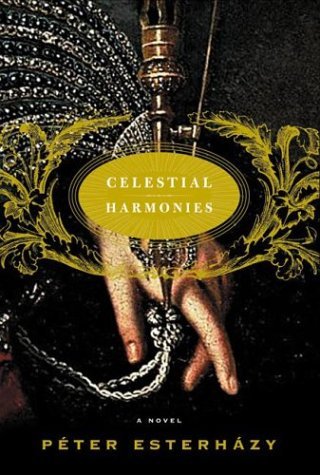
Title: Celestial Harmonies
Author: Péter Esterházy
Synopsis:
The Esterházys, one of Europe’s most prominent aristocratic families, are closely linked to the rise and fall of the Hapsburg Empire. Princes, counts, commanders, diplomats, bishops, and patrons of the arts, revered, respected, and occasionally feared by their contemporaries, their story is as complex as the history of Hungary itself. Celestial Harmonies is the intricate chronicle of this remarkable family, a saga spanning seven centuries of epic conquest, tragedy, triumph, and near annihilation. Told by Péter Esterházy, a scion of this populous clan, Celestial Harmonies is dazzling in scope and profound in implication. It is fiction at its most awe-inspiring. This P.S. edition features an extra 16 pages of insights into the book, including author interviews, recommended reading, and more. (Source: Goodreads)
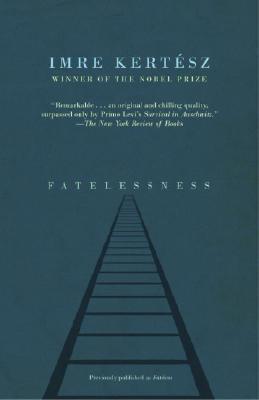
Title: Fatelessness
Author: Imre Kertész
Synopsis:
At the age of 14 Georg Koves is plucked from his home in a Jewish section of Budapest and without any particular malice, placed on a train to Auschwitz. He does not understand the reason for his fate. He doesn’t particularly think of himself as Jewish. And his fellow prisoners, who decry his lack of Yiddish, keep telling him, “You are no Jew.” In the lowest circle of the Holocaust, Georg remains an outsider.
The genius of Imre Kertesz’s unblinking novel lies in its refusal to mitigate the strangeness of its events, not least of which is Georg’s dogmatic insistence on making sense of what he witnesses–or pretending that what he witnesses makes sense. Haunting, evocative, and all the more horrifying for its rigorous avoidance of sentiment, Fatelessness is a masterpiece in the traditions of Primo Levi, Elie Wiesel, and Tadeusz Borowski. (Source: Goodreads)

Title: The Melancholy of Resistance
Author: László Krasznahorkai
Synopsis:
A powerful, surreal novel, in the tradition of Gogol, about the chaotic events surrounding the arrival of a circus in a small Hungarian town. The Melancholy of Resistance, László Krasznahorkai’s magisterial novel, depicts a chain of mysterious events in a small Hungarian town. A circus, promising to display the stuffed body of the largest whale in the world, arrives in the dead of winter, prompting bizarre rumours. Word spreads that the circus folk have a sinister purpose in mind, and the frightened citizens cling to any manifestation of order they can find – music, cosmology, fascism. The novel’s characters are unforgettable: the evil Mrs. Eszter, plotting her takeover of the town; her weakling husband; and Valuska, our hapless hero with his head in the clouds, who is the tender center of the book, the only pure and noble soul to be found. Compact, powerful and intense, The Melancholy of Resistance, as its enormously gifted translator George Szirtes puts it, “is a slow lava flow of narrative, a vast black river of type.” And yet, miraculously, the novel, in the words of The Guardian, “lifts the reader along in lunar leaps and bounds.” (Source: Goodreads)

Title: Anna Édes
Author: Dezső Kosztolányi
Synopsis:
This long out-of-print novel by Hungarian writer Kosztolanyi (1885-1936) takes place in Budapest just after the end of WW I. The city is occupied by Romanian troops after having undergone two brief social revolutions. The novel focuses on the plight of a young peasant woman who comes to work as a maid for the Vizys, a pathologically self-absorbed middle-class couple who are struggling to maintain their social standing amidst the ever-changing political climate. Pleased with Anna’s almost robotic work ethic, Mrs. Vizy becomes obsessed with maintaining her servant’s loyalty through psychological manipulation. A metaphor for the inhumanity of Hungary’s precarious bourgeoisie, the novel follows Anna’s victimization by her employers, her fellow servants and the Vizys’ dissolute nephew as she struggles to achieve even the slightest emotional connection. Kosztolanyi’s characters are ironic to the point of caricature, except Anna, whose inexplicable simple-mindedness limits the reader’s sympathy for her. The novel nevetheless provides fascinating insight into a volatile period in Europe’s history, laying bare the barbarism and hypocrisy inherent in all strata of society. (Source: Goodreads)
 The Pine-Scented Chronicles
It’s currently Hungarian Lit Month at Stu’s. Check it out here.
LikeLiked by 1 person