
First Impression Friday will be a meme where you talk about a book that you JUST STARTED! Maybe you’re only a chapter or two in, maybe a little farther. Based on this sampling of your current read, give a few impressions and predict what you’ll think by the end.
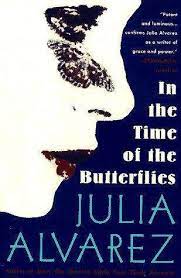
Synopsis:
They were the four Mirabal sisters – symbols of defiant hope in a country shadowed by dictatorship and despair. They sacrificed their safe and comfortable lives in the name of freedom. They were Las Mariposas, “The Butterflies,” and in this extraordinary novel Patria, Minerva, Maria Teresa, and Dedé speak across the decades to tell their own stories – from tales of hair ribbons and secret crushes to gunrunning and prison torture – and describe the everyday horrors of life under the Dominican dictator Trujillo. Now through the art and magic of Julia Alvarez’s imagination, the martyred Butterflies live again in a warm, brilliant, and heartbreaking novel that makes a haunting statement about the human cost of political oppression.
It’s the end of the workweek—yay! Finally, the weekend is here. I’m glad that we were all able to make it through another week. I do hope that, despite the challenges, you were able to end it on a high note. The Philippines has recently been rocked by a series of earthquakes. Every major island group has been shaken, prompting some to say that “the Philippines is shaking.” It’s literal, with some of the earthquakes being very powerful and causing several aftershocks. As such, I hope everyone is safe. Meanwhile, here in the capital, the weather has been unpredictable. The days have been marked by alternating hot and cold spells. Mornings often start with overcast skies before the sun breaks through and the stifling heat negates the morning breeze. It’s no surprise that several people are feeling under the weather. With that, I hope everyone is doing well—physically, mentally, and emotionally. Wishing you all a great weekend ahead.
With the workweek coming to a close, it’s time for a fresh First Impression Friday update. Over the years, this blogging meme has become an essential part of my weekly book blogging routine. It provides a great opportunity to take a breather while reflecting on my current read. These updates also serve as springboards for my eventual book reviews. This month, I’ve been focusing on books that are part of my reading challenges. Following ventures into Asian and European literatures, I have now turned my attention to books written by American—both North and South—and African writers. After starting the reading month with consecutive works by North American authors, I’ve now traveled to the Caribbean, with Julia Alvarez’s In the Time of the Butterflies.
At the start of the year, I came up with a list of at least 20 books I wanted to read. This year, I made it 25, in line with the last two digits of the year. Among the books I listed on my 2025 Top 25 Reading List is the Dominican-American writer’s In the Time of the Butterflies, a book I first encountered through must-read lists. My venture into Alvarez’s oeuvre actually started with her debut novel, How the García Girls Lost Their Accents. I wasn’t as impressed as I expected, but that didn’t stop me from wanting to read her second novel. Besides, her debut already provided glimpses into what Butterflies is about. Basically, the novel tells the story of the Mirabal sisters. I’m not sure where I first read about them; if memory serves me right, Dominican-American writer Junot Díaz also mentioned them in his novel The Brief Wondrous Life of Oscar Wao.
So anyway, I already had some background on the Mirabal sisters. They are four sisters—Patria, Adela “Dedé”, Minerva, and María Teresa—born to Enrique Mirabal Fernández and Mercedes Reyes Camilo. Their parents were landowners in the central Cibao region. The family had a farm in the village of Ojo de Agua, near the town of Salcedo, where they received their primary education. They later attended a Catholic boarding school, El Colegio de la Inmaculada, for their secondary education in the city of La Vega. The period in which they were born and raised was precarious. Rafael Leónidas Trujillo had been in power since August 1930, after skillfully orchestrating the overthrow of the president and any opposition. He installed himself as the country’s lifelong leader. Yes, it was through The Brief Wondrous Life of Oscar Wao that I first encountered Trujillo and learned about his atrocities.
In the Time of the Butterflies charts the story of the four sisters; it is Alvarez’s attempt to capture their heroism. The novel provides a brief look into their childhood. When we first meet them, the three younger sisters are already attending boarding school, while Patria is married and a mother. It doesn’t take long before the sisters become involved in political discourse. This is despite the heavy presence of patriarchy, which predetermined their futures: marry young and take care of their husbands and children, as in Patria’s case. These expectations were instilled in them at a young age. Minerva, however, resisted. Unlike her older sister, she wanted to attend university.
Trujillo’s regime, however, demonized universities and schools, which he believed fostered radical ideologies. It was at Inmaculada Concepción that Minerva first became involved in anti-dictatorship movements. Minerva’s eureka moment came after meeting fellow student Sinita, who told her about El Jefe’s corruption and brutality. Meanwhile, another student, Lina Lovatón, was one of Trujillo’s many girlfriends. Trujillo even built Lina her own house, but when she became pregnant and Trujillo’s wife found out, Lina was sent to Miami to live in exile. It comes as no surprise that Minerva would become the most politically involved of the sisters.
The story maps the sister’s deepening involvement in anti-dictatorship activities. They helped create and organize the 14th of June Revolutionary Movement. Within the group, they were known as Las Mariposas (The Butterflies), hence the book’s title. Because of their activism, Minerva and María Teresa were frequently imprisoned in both La Victoria and La 40 prisons. They, along with their husbands, were subjected to torture. The tortures they endured didn’t stop Minerva and María Teresa—and, to a moderate degree, Patria and Dedé—from continuing the fight against the dictatorship. They remained resolute, despite the presence of the SIM (secret police) and spies who infiltrated their organization.
Stylistically, Alvarez used different narrative devices to tell each sister’s story. Dedé’s story is narrated by an omniscient narrator. As the only sister who survived the dictatorship, her story begins with an interview in 1994, before shifting into the past. The other sisters narrate their own stories. Patria and Minerva’s chapters are straightforward narratives, while María Teresa’s is presented in an epistolary form (through diary entries). These varying narrative techniques help distinguish the sisters’ voices. The use of first-person perspectives also captures their inner anxieties and psychological states, while Dedé’s perspective offers a more reflective, nuanced view. This is the same technique Alvarez used in her debut novel. While I wasn’t fully convinced by its execution in How the García Girls Lost Their Accents, I feel it worked better in In the Time of the Butterflies. Yes, some sections of the story are left to the reader’s imagination, and some details are withheld. Nevertheless, the action flows seamlessly.
I’m now approaching the fateful day—November 25. Since I already have an idea of what’s going to happen, what I’ve been looking forward to most is the vicarious experience of living in such a precarious time. And I must say, Alvarez was able to deliver. She masterfully set the stage for the grand event that became a turning point in the Dominican Republic’s fight to overthrow the dictatorship. How about you, fellow reader? What book (or books) are you reading this weekend? I hope you’re enjoying your current read. Happy weekend!
 The Pine-Scented Chronicles