
Happy Wednesday, everyone! Wednesdays also mean WWW Wednesday updates. WWW Wednesday is a bookish meme hosted originally by SAM@TAKING ON A WORLD OF WORDS.
The mechanics for WWW Wednesday are quite simple: you just have to answer three questions:
- What are you currently reading?
- What have you finished reading?
- What will you read next?

What are you currently reading?

It’s already the middle of the week — how time flies! I hope everyone’s week is going well. The good news is, we only have two more days to go before the weekend. Hopefully, we can all make it through. By the way, I can’t believe the year is already drawing to a close; it still feels like yesterday when we welcomed 2025. A new year is just over the horizon. With the year approaching its inevitable end, I hope everything is going well for everyone. May blessings and good news shower upon you. I hope the remaining months of the year are filled with answered prayers and healing. I hope everyone is doing well — both physically and mentally. I sincerely hope you’re making great strides toward your goals. May the rest of the year be kinder to you and reward you for all your hard work.
As has become customary, I’ve spent the past few months ticking off books on my reading challenges. It’s now a tradition for me to spend the latter part of the year catching up on these goals. My current read, however, is not part of any specific challenge — although, being a new book, it technically still qualifies. It was through various must-read lists that I first encountered American writer Thomas Pynchon. Several of his works are featured on those lists. Recently, I learned about his latest release, Shadow Ticket. Including it on my reading list was a no-brainer. I had already included one of his earlier books, The Crying of Lot 49, in my 2025 Beat the Backlist Challenge. Thankfully, I was able to get a copy of Shadow Ticket, and interestingly, I’m now reading it ahead of The Crying of Lot 49. Shadow Ticket is the third Pynchon novel I’ve read.
The reclusive writer’s first book in over a decade, Shadow Ticket shares similarities with Inherent Vice, which I read earlier this month. The novel transports readers to 1930s Milwaukee. At the heart of the story is Hicks McTaggart, a gorilla-sized former strikebreaker now working for a detective agency. At the start of the novel, Hicks is assigned to trace the whereabouts of Daphne Airmont, the daughter of a mobbed-up Wisconsin dairy kingpin, dubbed “the Al Capone of Cheese.” Daphne is about to marry a wealthy man, but instead disappears with a Jewish swing clarinetist. This sets the tone for the story — though I haven’t gotten too far yet. That said, I find the pace of this book a bit quicker compared to Inherent Vice — or perhaps I was just still adjusting to Inherent Vice’s style at the time. Either way, I’m looking forward to how the story develops, as capers are the last thing I expect from Pynchon. If I don’t finish the book by Friday, I’ll be sharing more of my thoughts in this week’s First Impression Friday update.
What have you finished reading?
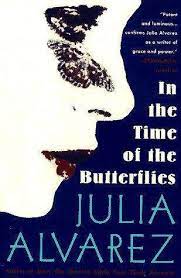
My venture into the vast world of American literature is in full swing. From the North, my literary journey next took me to the Caribbean. Technically, Julia Alvarez is Dominican American, as she was raised in the United States. Like with Pynchon, it was through must-read lists that I first encountered Alvarez. I have since read her debut novel, How the García Girls Lost Their Accents, which I found a little underwhelming. However, the novel made me curious about Alvarez’s sophomore effort, In the Time of the Butterflies. It came to my attention around the same time I was becoming more interested in the history of the Dominican Republic, so I eagerly added it to my 2025 Top 25 Reading List.
As mentioned, Alvarez’s debut novel gave me glimpses into what Butterflies might be about. The novel tells the story of the Mirabal sisters: Patria, Adela “Dedé,” Minerva, and María Teresa. They were born to Enrique Mirabal Fernández and Mercedes Reyes Camilo, landowners in the central Cibao region. The family had a farm in the village of Ojo de Agua, near the town of Salcedo, where the sisters received their primary education. They later attended a Catholic boarding school, El Colegio de la Inmaculada, for their secondary studies in the city of La Vega. These are just the preliminaries. The sisters were born and raised during a precarious period in Dominican history. Rafael Leónidas Trujillo had been in power since August 1930. After orchestrating the overthrow of the president and eliminating opposition, he installed himself as the country’s lifelong leader. The novel is Alvarez’s attempt to recount the stories of the sisters within this oppressive regime. When the three younger sisters were attending school — Patria was already married — they experienced a political awakening. Trujillo had demonized universities and schools, which he believed were breeding grounds for radical ideologies. It was at Inmaculada Concepción that Minerva first became involved in anti-dictatorship movements; she would become the most politically active of the sisters.
Through the story of the four sisters, Alvarez paints a vivid portrait of Trujillo’s regime. He gained a reputation for preying on young women, censored the media, and aggressively suppressed insurgent groups. State-sponsored violence carried out by the SIM — the military intelligence unit — was widespread. The novel traces the sisters’ deepening involvement in anti-dictatorship activities. They helped create and organize the 14th of June Revolutionary Movement, where they were known as Las Mariposas (The Butterflies). Because of their activism, Minerva and María Teresa were frequently imprisoned in both La Victoria and La 40 prisons, where they, along with their husbands, were subjected to torture. Despite this, they remained steadfast in their resistance. Even though violence eventually silenced them, their voices echoed across the world. The day of their assassination, November 25, is now commemorated globally as the International Day for the Elimination of Violence against Women.
With Alvarez’s narrative technique — blending first-person and third-person points of view — I was given multiple perspectives: both intimate glimpses into the characters’ psychological states and more detached, reflective insights. Overall, In the Time of the Butterflies is a compelling read — a testament to the indomitable strength of women and a sobering exploration of the evils of dictatorship.

Another American writer who piqued my attention is Amor Towles, whom I first encountered way back in 2019. I came across a copy of his sophomore novel, A Gentleman in Moscow, during one of my random ventures to the bookstore. I was fairly impressed by the book and its details. The book was also my window, not only to Towles’ oeuvre, but also to his journey as a writer. You see, while he showed interest in writing when he was younger, his dream of becoming a writer had to take the backseat as he had to earn a stable salary in order to support himself and his family. I would eventually read his latest novel, The Lincoln Highway, and this year, I read the book where it all started.
After a decade of working in the corporate world, Towles realized that the desire to write still burned within him. In 2011, he finally published his first novel, Rules of Civility. Set at the end of the 1930s during The Great Depression, the novel charts the fortunes of spunky roommates Katey Kontent and Evelyn Ross as they navigate their way up the social ladder in New York society. The narrator is Katey, real name Katya, who is the daughter of a Russian immigrant. The story started when the two friends visited a jazz bar on New Year’s Eve in 1937. They were both struggling with their budget, and before long, their measly budget was spent on drinks. It was at this juncture that Tinker Grey entered the bar. Tinker is a wealthy and handsome bachelor. Over the course of the night, the three got acquainted, which eventually deepened into a friendship. However, it was palpable from the onset that their friendship was not one to last. The dynamics of their friendship changed when Even was disfigured following an accident caused by Tinker while driving his car. Eve saw it as an opportunity for Tinker to woo him. As Tinker and Eve waltz into the French Riviera, Katey fills her night with parties, hoping for unlikely encounters that would help her move forward in both life and career.
Katey’s toiling – and well, social climbing – eventually paid off when Nathaniel Parish, a senior editor at a publishing house, offered her a position at a hot new magazine, Gotham. This changed the trajectory of her life as it opened doors to a world of literature and intellectual engagement. Her new job also made her orbit vibrant and affluent social circles. All the while, she was also tuning into the grapevines as she waited for bits and pieces about what was happening to Eve and Tinker. Her adventures in high society were juxtaposed with stories of her humble beginnings. The novel takes place over a year and follows seasonal changes, and tackles a plethora of subjects and themes. Identity, class struggle, and friendship were at the core of the story. On the sly, it also has overtones of love, betrayal, and the follies of our wants and needs. As he has shown in his succeeding works, Towles crafted an atmospheric read. Rules of Civility is a propulsive book that marked the ascent of a new and excitable voice.
What will you read next?


 The Pine-Scented Chronicles