
Happy Wednesday, everyone! Wednesdays also mean WWW Wednesday updates. WWW Wednesday is a bookish meme hosted originally by SAM@TAKING ON A WORLD OF WORDS.
The mechanics for WWW Wednesday are quite simple: you just have to answer three questions:
- What are you currently reading?
- What have you finished reading?
- What will you read next?

What are you currently reading?
It’s already the middle of the week — how time flies! I hope everyone’s week is going well. The good news is, we only have two more days to go before the weekend. Thankfully, this Friday is a holiday here in the Philippines. Still, I hope everyone makes it through the workweek. Also, October is about to draw to a close, which means we are just a couple of weeks away from welcoming a new year. With the year approaching its inevitable end, I hope everything is going well for everyone. May blessings and good news shower upon you. I hope the remaining months of the year are filled with answered prayers and healing. I hope everyone is doing well — both physically and mentally. I sincerely hope you’re making great strides toward your goals. May the rest of the year be kinder to you and reward you for all your hard work.
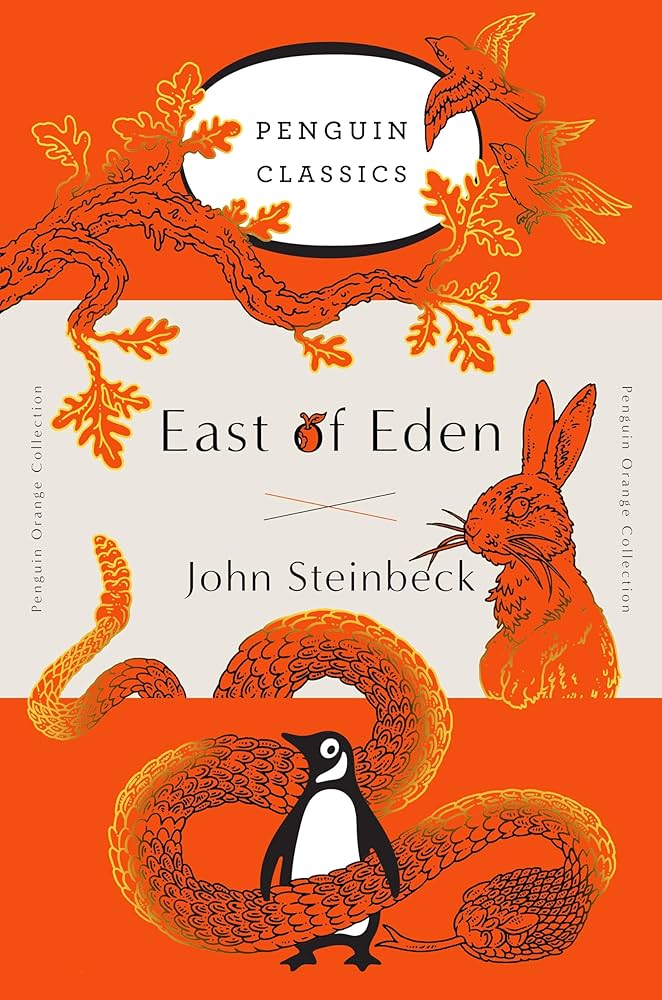
Like in previous years, I have been — and will be — spending the rest of the year ticking off books on my reading challenges. It has now become a tradition for me to spend the latter part of the year catching up on these goals. Among the books I listed on my 2025 Top 25 Reading List is John Steinbeck’s East of Eden. It was through various must-read lists that I first came across the American writer. I began my foray into his oeuvre with The Pearl, which I read nearly a decade ago. Ten years hence, I am reading my fifth novel by the Nobel Laureate in Literature. For the longest time, I have been looking forward to reading East of Eden. Along with The Grapes of Wrath, the book has been cited as one of Steinbeck’s best works. Furthermore, both novels are included in 1,001 Books You Must Read Before You Die; in reading East of Eden, I am hitting two birds with one stone.
Originally published in 1952, the story begins in the late nineteenth century, when Samuel Hamilton settles in the Salinas Valley in northern California. He and his wife, Liza, travel from Ireland. The couple would have nine children and become a prominent family in the valley; however, Samuel never became a wealthy man. Meanwhile, Adam Trask settles in the valley with his wife, Cathy Ames. A brief backstory informs readers of Adam’s provenance: he and his half-brother, Charles, lived on a farm in Connecticut. Charles resented Adam for being favored by their father, Cyrus. Upon their father’s death, Adam took his inheritance and moved to California, where he and Cathy befriended the Hamiltons. This is as far as I’ve gotten in the story. With this, I look forward to seeing how the fates of the two families intertwine. I’ll be sharing more of my impressions of the book in this week’s First Impression Friday update.
What have you finished reading?

My venture into the vast world of American literature is in full swing. Among the several writers I first encountered through must-read lists is Thomas Pynchon. There is, quite literally, very little trace of him out there — except, of course, for his literary works. Most of his novels have been listed as must-reads, with several included among the 1,001 Books You Must Read Before You Die. This naturally piqued my interest. My fascination with him grew when I learned that he was a reclusive writer. In 2021, I finally read my first Pynchon novel, Gravity’s Rainbow. This year, I included The Crying of Lot 49 in my 2025 Beat the Backlist Challenge. I also recently read Inherent Vice.
Then I learned that Pynchon was about to release his first novel in over a decade. When I heard about Shadow Ticket, it was a no-brainer to include it in my ongoing reading list. Thankfully, the book was not as elusive as its author. Pynchon’s ninth novel transports readers to the 1930s. At its heart is Hicks McTaggart, a private detective working for Unamalgamated Ops in Milwaukee. This immediately reminded me of Inherent Vice (2009); apparently, his last three novels, including Bleeding Edge (2013), share similar elements. Furthermore, these books differ significantly from Gravity’s Rainbow — they are noir detective thrillers. Nevertheless, I looked forward to exploring a different dimension of Pynchon’s storytelling and prose. The novel’s main action begins when Hicks is assigned to track down a missing young woman, Daphne Airmont, the daughter of Bruno Airmont. Bruno built his fortune on cheese, earning him the moniker “the Al Capone of Cheese,” while his daughter is fondly called the “Cheese Princess.” Unfortunately, Hicks has very little to go on. Before she disappeared, Daphne was about to marry Hop Wingdale, a jazz clarinetist. Normally, Hicks would have avoided such a case, but a previous encounter with Daphne compels him to accept the assignment — he once helped her escape a mad therapist via motorboat.
As Hicks digs deeper, more people become entangled in the case, including federal agent T.P. O’Grizbee, whose mounting pressure forces Hicks to flee Milwaukee for New York. In New York, he is drugged and shipped aboard the Stupendica, a vessel bound for Europe. Thus commences an adventure across the Eastern European landscape, driven by the search for a missing young woman. What begins as a typical caper eventually transforms into a deep rumination on history. Historical context and politics are gradually woven into the narrative as it progresses; Nazis and Soviet agents enter the scene, heightening the risks Hicks faces. Beyond history, the novel also embraces humor — particularly through the International Cheese Syndicate. Outlandish characters and bizarre situations abound. Complex and dense, Shadow Ticket is quintessential Pynchon. However, I wasn’t as impressed by it as I had initially hoped. Still, it was a compelling read.

It was yet another slow reading week, as my attention was divided throughout. Still, I’m glad I was able to complete two books. The second of these is Tess Gunty’s The Rabbit Hutch, yet another recent acquisition. The book first piqued my interest back in 2022 when it won the National Book Award for Fiction. Literary awards have often been a fruitful way for me to discover new names. Three years after its victory, I finally had the chance to read the book. To be honest, I was a bit apprehensive about picking it up. However, I couldn’t pass up the opportunity to broaden my venture into contemporary literature.
I only recently learned that The Rabbit Hutch is Gunty’s debut novel. The titular “Rabbit Hutch” is a nickname for the La Lapinière Affordable Housing Complex, located in the fictional city of Vacca Vale, Indiana—Gunty herself was born and raised in the Hoosier State. The story opens with an intriguing premise: on a sweltering night in Apartment C4, Blandine Watkins exits her body. This immediately raises questions: Who is Blandine, and what were the circumstances surrounding her “exit”? Born Tiffany Watkins, Blandine once attended St. Philomena’s, the city’s only private school. She now resides in Apartment C4 with three young men—Malik, Jack, and Todd—all just out of their teens and recently released from the foster care system. Though they barely know each other, they are all shaped by the events unfolding around them. Blandine, intellectually gifted, gave up on her college aspirations and her hopes for a future outside the city after becoming disillusioned with formal education. Instead, she channels her energy into sabotaging the planned Vacca Vale development project. Once a post-industrial city, Vacca Vale is undergoing redevelopment, part of which includes the demolition of the Rabbit Hutch—a place that has become home to the novel’s central characters.
In capturing the stories of these four protagonists, Gunty employs a variety of literary devices that reflect each character’s personality. Todd’s perspective, for instance, appears later in the novel through drawings. Gunty also integrates obituary comments and epistolary passages to advance the narrative. Her writing shines in its psychological depth and its vivid, descriptive portrayal of both people and place. The city of Vacca Vale radiates hopelessness—unemployment and crime are rampant, and it has even been ranked first on Newsweek’s “Top Ten Dying American Cities.” Yet it retains its own distinct cultural identity. For many residents, it is the only home they have ever known. The Rabbit Hutch is a complex novel that takes time to find one’s footing in. Despite this, I found myself engrossed in Blandine’s story and her interactions with her co-residents. I was swept up in Gunty’s depiction of a town in decline. The novel functions both as a coming-of-age story and as a social commentary, fully deserving of the accolades it has received.
What will you read next?


 The Pine-Scented Chronicles