Happy Tuesday everyone! As it is Tuesday, it is time for a Top Ten Tuesday update. Top Ten Tuesday is an original blog meme created by The Broke and the Bookish and is currently hosted by That Artsy Reader Girl.
This week’s given topic: Best Books I Read in 2025
However, I have already posted my best reads of 2025. As such, I will be featuring my favorite books in translation that I read in 2025.


Title: The Heike Story
Author: Eiji Yoshikawa
Translated from: Japanese
From one work of historical fiction to another. Another standout during my venture into East Asian literature is Eiji Yoshikawa’s The Heike Story: A Modern Translation of the Classic Tale of Love and War, a book I was not originally planning to read this year. However, when I realized that I was about to read my 1,300th novel, I reconsidered the idea of reading it. At the heart of The Heike Story is the titular Heike clan, a warrior clan that thrived in twelfth-century Kyōtō, back then Japan’s Imperial capital. This was a tumultuous period in Japanese history, when emperor after emperor was abdicating or being deposed – or plotting the overthrow of their successors – pushing Japanese society to the brink of pandemonium. Two houses emerge as the loci of power and influence: the Imperial Palace and the Cloistered Palace, which housed the abdicated Emperors. The latter was emerging as the de facto source of power. The courtiers were also seizing the opportunity to obtain power. Suffering the consequences of these actions are the warrior clans. The head of the Heike clan was Heita Kiyomori, whose provenance was a source of intrigue. Nevertheless, he rebuilt the lost glory of his clan, starting as a lowly warrior, before climbing up the ranks. Not only is he a fierce warrior, but he is also a wise leader. The Heike Story is very eventful, with layers of romance, betrayal, forgiveness, and violence permeating it. Apparently, the novel is the modern prose rendering of a classic Japanese epic. The details of warrior and clan life, juxtaposed with the lack of political will of the emperors, provide glimpses of the Japan of old. It is an epic and compelling historical account.

Title: Foucault’s Pendulum
Author: Umberto Eco
Translated from: Italian
Italian writer Umberto Eco has certainly won me over with his debut novel, The Name of the Rose; this is despite a less-than-favorable experience with Baudolino. In 2025, I listed his sophomore novel, Foucault’s Pendulum, as part of my 2025 Top 25 Reading List. It is my fifth novel by the renowned semiotician. Originally published in 1988 as Il pendolo di Foucault, Foucault’s Pendulum commences with Casaubon, the narrator, hiding in Paris’ Musée des Arts et Métiers after it closed; the museum is home to the famous pendulum of Léon Foucault. His friend, Jacopo Belbo, the senior editor at a publishing house in Milan, Italy, has gone missing. Casaubon believes Belbo was kidnapped by a shadowy group of occultists. As the pendulum swings, the novel flashes back to 1970s Italy when Casaubon was working on his thesis about the Knights Templar. His study made him encounter Belbo and his colleague Diotallevi; Belbo invited him to review a manuscript about the Templars written by Colonel Ardenti. However, Colonel Ardenti mysteriously disappeared after meeting with Belbo and Casaubon. The trio then found themselves immersed in occult manuscripts and conspiracy theories, essentially the novel’s heart and soul. Foucault’s Pendulum takes the readers on a literary roller coaster. With its several layers and confounding turns, the novel explores the dangers of conspiracy theories and humanity’s compulsion to keep finding connections and meanings where none exist. We have this need to rationalize everything. Riddled with symbols and images — hallmarks of Eco’s oeuvre — that tickle the imagination, Eco weaves a lush tapestry. While Foucault’s Pendulum is no easy read, it is a worthwhile one.

Title: Radiance and Sunrise (Banaag at Sikat)
Author: Lope K. Santos
Translated from: Tagalog
Over the past few years, I have been consciously integrating works of Philippine literature into my reading journeys. It has paid off, as I was able to read some of the classics of Philippine literature, the most recent of which was Lope K. Santos’s Radiance and Sunrise, which I first encountered in high school history classes under the title Banaag at Sikat. Originally published in Tagalog in 1906, the novel is widely considered the first Asian proletarian novel. Banaag at Sikat charts the fortunes of friends Delfin and Felipe, who were the antithesis of each other. Born to a rich family of landowners, Felipe is an anarchist who opposes wealthy landowners. This made him loathe his father, a local leader in fictional Silangan, whom he left behind to move to Manila and live with his ninong, Don Ramon. Meanwhile, his friend Delfin was born into a poor family. Delfin was working for a newspaper and was studying law. He advocated for socialist reforms, fervently believing in the importance of education in freeing a nation from the shackles of poverty and ignorance. Felipe, on the other hand, believes that change will be ushered in by the breaking down of social barriers. While their views are polar opposites, both challenge the Philippine norms and standards of the period. Sharp social and political commentaries captured the condition of the country, including the maladies that hold it back. Despite the setting, the passage of time reveals that these social and political maladies persist in the present-day Philippines. Adding nuance and texture to the story are the characters’ romantic attachment, particularly that of Delfin and Meni, the daughter of a capitalist. Overall, Banaag at Sikat is an intriguing but lush story that examines the Philippine condition.

Title: Life and Fate
Author: Vasily Grossman
Translated from: Russian
It was through an online bookseller that I first came across Vasily Grossman and his novel Life and Fate. I was surprised to learn that he was Russian—I had assumed he was German. Nevertheless, Life and Fate is one of the books on my 2025 Top 25 Reading List. Originally published in 1980 as Жизнь и судьба (Zhizn’ i sud’ba), Life and Fate takes readers across the vast landscape of the Battle of Stalingrad during the Second World War. As the German army’s offensive advances across the Soviet border, the Soviet Union’s defenses are pushed to their limits. Witness to the chaos was the Shaposhnikov family. In Stalingrad, we meet Yevgenia (Zhenya) Nikolaevna Shaposhnikova, a dedicated Communist Party member who reconnected with her lover, Colonel Pyotr Pavlovich Novikov. Meanwhile, Zhenya’s older sister, Lyudmila (Lyuda) Nikolaevna Shaposhnikova, is married to Viktor Pavlovich Shtrum, a renowned nuclear physicist. As the German army approached Kazan, the Shtrum family was forced to relocate to Moscow. Much of Viktor’s storyline centers on his scientific work. Despite making a significant mathematical breakthrough, he faced harsh criticism from Party authorities. This underscored the oppressive political climate that often stifled intellectual and scientific progress. Beyond the family, the novel vividly captured the brutal realities of life on the battlefield. Politics is also a prevalent theme. Often compared to Leo Tolstoy’s War and Peace, Life and Fate is widely regarded as the literary classic’s 20th-century counterpart. With its expansive scope, immersive historical detail, and complex interweaving narratives, Life and Fate is a challenging but ultimately rewarding read.

Title: My Name is Red
Author: Orhan Pamuk
Translated from: Turkish
My reading horizon, in the past few years, has grown leaps and bounds. One major factor is the Nobel Prize, which introduced me to writers whose oeuvres I would not normally explore. Among them is Turkish writer Orhan Pamuk. From my first Pamuk novel, Snow, I have now read six of his works, the latest being My Name is Red, which is also a part of my 2025 Top 25 Reading List. Originally published in 1998 as Benim Adım Kırmızı, My Name is Red was among Pamuk’s works cited by the Swedish Academy when they awarded him the Nobel Prize in Literature in 2006. The winner of the International Dublin Literary Award, the novel is set in late sixteenth-century Constantinople and commences with the voice of a recently departed man, Elegant Effendi, an illuminator working for a workshop of miniaturists in Murad III’s Ottoman Empire. The ghost of Elegant speculated about the reasons for his murder, but never mentioned the perpetrator. From a dead body, the narrative voice was taken over by objects and even paintings. However, two characters loom above the story: Black, who returned to Istanbul shortly after Elegant’s murder, and his lover, Shekure, the daughter of his uncle Enishte. Black has been banished to the outskirts of the Empire, where he stayed for over a decade. While the rekindling of their romance seems like a deflection, the story still corresponds to the mystery surrounding Elegant’s death; Black was commissioned to get to the bottom of it. As Black solves the case, the real story unfolds. Growing Western influences have made Ottoman artists fear the disintegration of their art. These changes were also reflected in the city’s transformation. Death, art, and life converge in My Name is Red, a textured and multilayered tale from a master storyteller.
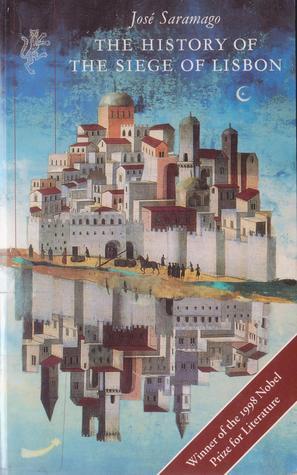
Title: The History of the Siege of Lisbon
Author: José Saramago
Translated from: Portuguese
As I have mentioned, the Nobel Prize in Literature introduced me to names I would have ignored. Another name it introduced me to is Portuguese writer José Saramago. In 2019, I read my first Saramago novel. In six years, I was able to expand my venture into his oeuvre, with The History of the Siege of Lisbon, his fifth novel that I read. Originally published in 1989 as História do Cerco de Lisboa, the novel weaves together two plotlines set in different periods. The heart of the story is fifty-year-old Raimundo Silva, an unmarried proofreader working primarily for a small publishing house. He is regarded as an expert on the titular Siege of Lisbon, a historical siege that began on July 1 and ended on October 25, 1147, when Lisbon was seized from the Almoravid Muslims by the Second Crusade. It was a pivotal period in transforming Portugal from a vassal state into an independent Christian kingdom. Silva, assigned to edit a manuscript entitled The History of the Siege of Lisbon, deliberately alters the text by inserting a single word, “not,” that alters the text, suggesting that the Crusaders did not assist the Portuguese during the siege. Saramago’s reimagined version of the siege runs parallel to Silva’s story. The novel finds its significance in its exploration of alternate histories; alternate versions of history have become increasingly relevant in today’s discourse. Since history is often written by the victors, the objectivity of historical documentation is often questioned. The novel then challenges our understanding of history while offering intriguing insight into the world of proofreading. The History of the Siege of Lisbon reveals a different dimension of Saramago’s literary range.

Title: We Do Not Part
Author: Han Kang
Translated from: Korean
Interestingly, I was not a fan of Han Kang’s The Vegetarian. My subsequent immersion into Korean culture made me understand the novel and even appreciate it. In 2024, Kang was announced as the awardee of the Nobel Prize in Literature, the first female Asian writer to earn the highest distinction. With this recognition came the news of one of her older works being translated into English. I made sure I got to read We Do Not Part. The novel was originally published in 2021 and is narrated by Kyungha, a woman living alone in Seoul. On the brink of depression, Kyungha’s torpor was disrupted by a call from her friend Inseon, who was recuperating in a hospital following a work accident. Because of her injury, Inseon asked her friend to travel to Jeju and feed her pet bird, Ama. Upon Kyungha’s arrival in Jeju, the island was carpeted in snow as a snowstorm swept through it. Nevertheless, she was able to make her way to her friend’s house, where Kyungha learned about her friend’s family’s troubled history. Inseon’s family history is intertwined with the island’s tragic contemporary history, particularly the Jeju Massacre. Starting in 1948, state-sponsored killings rocked the island to purge it of communists. It was estimated that at least 30,000 people, including 1,500 children, were killed by authorities and by extreme-right militant groups. Kang’s latest novel reminds me of two of Kang’s previous works: Human Acts in its exploration of Korea’s ruptured history and White Book in the novel’s pensive tone. While it is not as intense as Human Acts, the novel is a compelling read about the frailties of humanity. The novel further underlines Han’s status as a premier chronicler of ruptured histories.

Title: My Name is Adam
Author: Elias Khoury
Translated from: Arabic
Admittedly, my foray into Middle Eastern and Arab literature is quite sparse. Thankfully, online booksellers introduced me to some of the renowned writers of the region, including Elias Khoury. He is the first Lebanese writer whose oeuvre I have explored. My Name is Adam immediately piqued my interest when I came across it. I even made it part of my ongoing reading journey and I am glad I did. Originally published in 2016 as أولاد الغيتو- اسمي آدم, My Name is Adam introduces Adam Dannoun, a melancholic self-exiled man working in a Middle Eastern restaurant in New York City. Through Sarang Lee, one of Khoury’s students, he was introduced to the writer; this is how the novel was framed, with Khoury being part of the story. Their friendship was cut short when a film based on Khoury’s book Gate of the Sun was shown. The next time Khoury heard of Adam, he had passed away from an accidental fire. However, some of Adam’s notebooks survived the fire, and Sarang gave these notebooks to her mentor, who decided to publish them. Essentially, the notebooks contain Adam’s notes for two books he planned to write: one is a novel, and the other is an autobiography. Both books provide glimpses into Adam’s family history and the history of the Palestinian cause, starting with the Nakba. The novel reminded me how I know very little about the Nakba. Palestinians were abused, forcibly removed from their homeland, placed in ghettos, and even tortured. These details are the reasons why I appreciate this book, as heartbreaking as it can be at times. The recent events in Palestine make the book a timely and relevant read. My Name is Adam, the first volume in Children of the Ghetto, makes me look forward to the rest of the series.

Title: The Idiot
Author: Fyodor Dostoyevsky
Translated from: Russian
Like Japanese literature, Russian literature has become one of my favorite literary quarters. One of the reasons for this is Fyodor Dostoyevsky (also spelled Dostoevsky). I began exploring his oeuvre with The Brothers Karamazov, which I read back in 2016. Nearly a decade later, I’ve now completed my fifth Dostoyevsky novel, The Idiot. Originally published serially in The Russian Messenger between 1868 and 1869, The Idiot is considered one of Dostoyevsky’s four most defining works. The titular “idiot” is Prince Lev Nikolayevich Myshkin, a man in his mid-twenties. After spending four years in a Swiss asylum for severe epilepsy, the Prince travels to St. Petersburg on a cold November morning. His first stop is the household of General Yepanchin, who was married to Lizaveta Prokofyevna Yepanchin, the Prince’s distant relative. During his journey, the Prince meets Parfyon Semyonovich Rogozhin, whose devotion to Nastasya Filippovna Barashkova captures the Prince’s interest. At the General’s household, the Prince meets Gavril Ardalyonovich Ivolgin (Ganya), the general’s assistant, who is betrothed to Nastasya. Interestingly, Nastasya is the former mistress of the aristocrat Afanásy Ivánovich Tótsky, while Ganya yearns for Aglaya, the General’s youngest daughter. The Prince would also find himself drawn to Nastasya, creating a love triangle with Rogozhin. This entanglement adds dramatic tension, but the novel’s focus is still the Prince, who stands out due to his naivete and honesty. The Prince was the depiction of a truly beautiful and innocent soul in a world steeped in materialism, cynicism, and spiritual emptiness. The Idiot is yet another thought-provoking work from one of the true masters of Russian literature.

Title: A Heart So White
Author: Javier Marías
Translated from: Spanish
Another writer who was introduced to me by must-read lists is the Spanish writer Javier Marías. While some of his works are featured in such lists, A Heart So White has long held my interest after it was recommended to me by a fellow book reader. However, it took time before I acquired a copy of the book. Once I did, I made it part of my 2025 Top 25 Reading List. Originally published in 1992 as Corazón tan blanco, A Heart So White is narrated by an initially anonymous voice; he was eventually revealed as Juan. Juan works as a translator for various international organizations, and through one of his engagements, he met Luisa, his wife. When Juan was away for work, Luisa formed connections with people from his life, particularly Ranz, Juan’s father, and Custardoy, the son of Ranz’s best friend. While he is an aging art dealer, Ranz’s charm remains magnetic. Through his wife, Juan begins to uncover details about his father’s complex marital history; Juan was not fond of his father. Interestingly, the novel opens with Juan recounting the dramatic death of Ranz’s second wife, Teresa, and the older sister of Juan’s mother, Juana. Ranz’s first marriage had been concealed from Juan since childhood. However, the past was a catalyst for Juan to confront the realities of his own marital life. He is plagued with doubts, particularly about the lack of passion between him and Luisa. Making the novel more intimate was Marías’s stream-of-consciousness, which allowed thoughts and ideas to flow into one another, sometimes blending together. This can be disorienting, but it also allows the novel to explore deep philosophical questions. A Heart So White is a complex yet compelling and thought-provoking read.
 The Pine-Scented Chronicles