
First Impression Friday will be a meme where you talk about a book that you JUST STARTED! Maybe you’re only a chapter or two in, maybe a little farther. Based on this sampling of your current read, give a few impressions and predict what you’ll think by the end.
Synopsis:
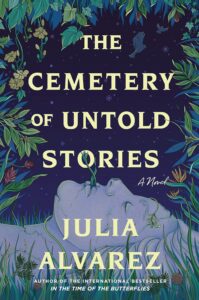
Alma Cruz, the celebrated writer at the heart of The Cemetery of Untold Stories, doesn’t want to end up like her friend, a novelist who fought so long and hard to finish a book that it threatened her sanity. So when Alma inherits a small plot of land in the Dominican Republic, her homeland, she has the beautiful idea of turning it into a place to bury her untold stories – literally. She creates a graveyard for the manuscript drafts and the characters whose lives she tried and failed to bring to life and who still haunt her.
Alma wants her characters to rest in peace. But they have other ideas and soon begin to defy their author: they talk back to her and talk to one another behind her back, rewriting and revising themselves. Filomena, a local woman hired as the groundskeeper, becomes a sympathetic listener to the secret tales unspooled by Alma’s characters. Among them, Bienvenida, dictator Rafael Trujillo’s abandoned wife who was erased from the official history, and Manuel Cruz, a doctor who fought in the Dominican underground and escaped to the United States.
The Cemetery of Untold Stories asks: Whose stories get to be told, and whose buried? Finally, Alma finds the meaning she and her characters yearn for in the everlasting vitality of stories. Julia Alvarez reminds us that the narratives of our lives are never truly finished, even at the end.
It’s the end of the workweek—yay! I hope the week has been kind to everyone and that you’re all ending it on a high note. I hope you were able to regain your pre-holiday mojo, accomplish your tasks—or at least make significant progress—and start building some momentum. It’s now time to dress down and let your hair down to dive into the weekend! Whew. Just like that, it is already the fourth weekend of the first month of the year. In a couple of days, we will be welcoming February. How time flies! Regardless, I hope you spend the weekend wisely, whether by resting from the rigors of a tedious career, pursuing your passions, completing household chores, or spending time with loved ones. I hope you’re all doing well—physically, mentally, and emotionally.
My third full week with my new employer has come and gone. While I am slowly regaining my “accounting brain,” I am still feeling a bit overwhelmed by my new responsibilities. There are certainly several avenues for change. It seems like a tall task, but I am used to handling these kinds of challenges and hope to whip things into shape soon. With the new year comes new reading goals. I decided to commence my 2026 literary journey with the works of Latin American writers. I realized it has been some time since I dedicated a full month to this region—the last time was toward the end of 2023. I am looking forward to dipping my toes into familiar territory while exploring new authors. Among the familiar writers I am excited to revisit is Julia Alvarez.
In early 2024, I learned about this Dominican-American writer’s most recent release, The Cemetery of Untold Stories. There was something about the book that captivated me, but to my dismay, I was unable to obtain a copy before the year ended. I finally secured one recently and immediately made it part of my ongoing venture into Latin American and Caribbean literature. Alvarez, along with Junot Díaz, played a seminal role in introducing me to the history and people of the Dominican Republic. It was through them that I learned about Rafael Trujillo, the brutal dictator who shaped the country’s contemporary history. He has been a prominent subject in Alvarez’s work, so it was not surprising to see him referenced in the opening pages of her latest novel.
Alvarez’s seventh novel follows Alma Cruz, a novelist and professor in her sixties. It is easy to find parallels between the character and the author; in many ways, Alvarez’s writing reflects her own life. Take her debut, How the García Girls Lost Their Accents—the family’s story eerily echoes Alvarez’s own struggles. Alma, like Alvarez, has three sisters. Interestingly, there were also four Mirabal sisters, the subjects of Alvarez’s sophomore novel, In the Time of Butterflies. I sense that the Cruz sisters are Alvarez’s vision of what the Mirabal sisters might have been had they not been assassinated by the Trujillo regime. The day they were murdered, November 25, is now the International Day for the Elimination of Violence Against Women.
Through flashbacks, we learn that Alma’s mother objected to her writing, particularly her portrayal of family life. Consequently, Alma publishes under the pseudonym Scheherazade to avoid upsetting her kin. Following their parents’ death, the sisters learn of their inheritance through the family attorney, Martillo. Their father left them land in the Dominican Republic, but the sisters cannot agree on how to divide it, nor are they willing to live there. Through a random draw, Alma is given the first pick. Going against the consensus, she chooses the largest plot located on the outskirts of Santo Domingo. The land is deemed worthless by her sisters because it sits near a landfill and a slum, but because it is the largest, Alma elects to forgo any further inheritance.
Choosing the piece of land was not Alma’s initial plan. Nevertheless, a plan formed in her mind. Following her retirement from academe, she returns to her homeland seeking a quiet existence; her family has moved to the United States following Trujillo’s ascent to power. On that worthless land, she builds a cemetery—not for people or animals, but for her untold stories and the characters she created but never published. She arrives with boxes of manuscripts she never finished and hires Brava, a local artist, to create markers for each story’s burial plot. Access is limited: one can only enter if they can tell a good story.
The first person to gain entry is Filomena, a middle-aged woman living across from the cemetery gate. She is illiterate and seemingly mute, but Alma eventually hires her as a caretaker. Through flashbacks, we learn Filomena’s story. She and her sister, Perla, were raised in poverty by an abusive father before a series of complications led to their estrangement. Perla moved to “Nueva” York, while Filomena remained behind to care for an elderly woman with dementia. This mirrors the life of Alma’s father, Dr. Manuel Cruz, who also suffered from dementia, underlining the book’s theme of memory.
One manuscript Alma plans to bury is the one she wrote about her father. However, the papers fail to catch fire, along with a box of notes regarding Bienvenida Inocencia Ricardo de Trujillo, the dictator’s second wife. Seeking peace of mind, Alma buries them physically instead. Yet, these characters still want their stories heard—literally. Filomena begins to hear a woman’s voice—Bienvenida—emanating from a grave marker. Even Dr. Manuel Cruz “rises” to tell his story. This is a fascinating premise. While magical realism is a staple of Latin American literature, it’s a surprising and pleasurable new dimension in Alvarez’s storytelling.
The Cemetery of Untold Stories builds on familiar themes but remains an accessible read; I expect to finish it later today. I am eager to see how the past connects to the present and how the lives of Bienvenida, Manuel, and Filomena converge. How about you, fellow reader? What are you reading this weekend? I hope you’re enjoying your current book. Happy weekend!
 The Pine-Scented Chronicles