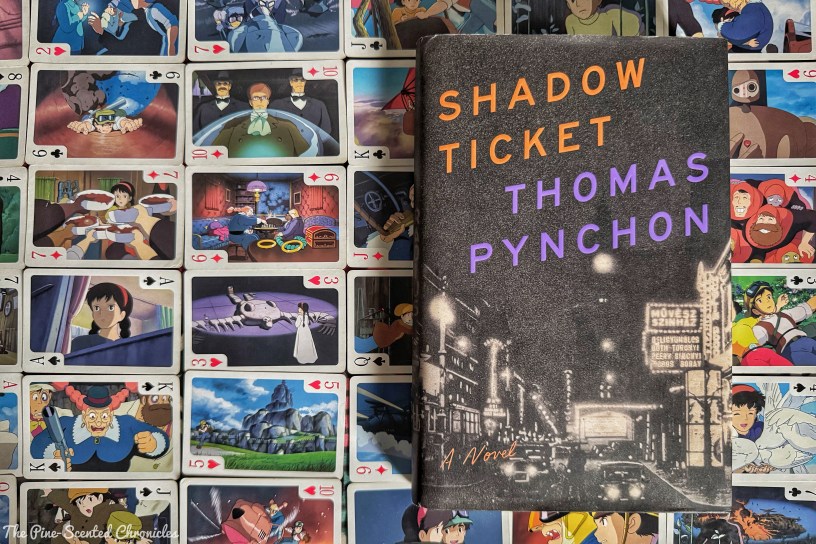
An American Cheese Novel
A venture into contemporary American literature would not be complete without encountering Thomas Pynchon, whether through his work or his persona. Born on May 8, 1937, in Glen Cove, Long Island, New York, Pynchon is undoubtedly one of the most renowned contemporary American novelists. As a young boy, Pynchon was described as a voracious reader and a precocious writer, contributing short stories to his school newspaper. Ironically, he pursued engineering physics at Cornell University. However, after his sophomore year, Pynchon enlisted in the U.S. Navy (1955–57) and served on the destroyer USS Hank in the Mediterranean Sea during the Suez Crisis. Upon his return, he completed his B.A. in English in 1959. Before pursuing a full-time career as a writer, Pynchon was hired as a technical writer for the Boeing Aircraft Corporation in Seattle. Two years later, he decided to leave the company and devote himself fully to writing.
Post-university, Pynchon spent a year in Greenwich Village writing short stories and working on a novel. In 1963, the novel he had been working on was published. V. earned Pynchon the Faulkner Foundation Award and was a finalist for the National Book Award. While his debut novel gained readers’ attention and marked the ascent of a new literary star, it was his third novel, Gravity’s Rainbow (1973), that consolidated his status as a literary titan. His most celebrated work, Gravity’s Rainbow elevated Pynchon to a household name. Set during the twilight days of the Second World War and the weeks immediately following V-Day, Gravity’s Rainbow is often hailed by literary pundits as one of—if not the—greatest American post–World War II novels. It was a massive success and a cornerstone of his oeuvre, widely considered a tour de force of 20th-century literature.
Despite his growing success, Pynchon has remained a notoriously elusive figure. He has established a reputation for reclusiveness, never having granted an interview or participated in literary events. He has such a minimal public and social imprint that among the few published photographs of him is one from his high school yearbook. Yet it is precisely this layer of mystery that reels readers into his oeuvre. Each of his releases is eagerly anticipated, especially given that he often takes years between publications. His releases are events in themselves. When it was announced that he would be releasing a new work in 2025, literary pundits and readers alike were on the lookout. Later that year, Shadow Ticket was published—his first novel, and his ninth overall, in over a decade since Bleeding Edge (2013).
Not to blame the Depression or anything, but there seem to be a considerable number of fish-happy unemployed to be found today out here on the frozen expanse, with sleds, tip-ups, bikes pedal- and motor-driven, shelters more and less elaborate. Small fires going, coffee percolating, kerosene lamps cutting some of the gloom, portable radios at low volume, possibly on some theory that music will hypnotize fish up through the ice.
Thomas Pynchon, Shadow Ticket
Shadow Ticket transports readers to the 1930s. At the heart of the novel is Hicks McTaggart, a private detective working for Unamalgamated Ops in Milwaukee. Muscular and imposing, McTaggart was once a semi-professional dancer before becoming a strikebreaker, busting heads at union strikes. Believing he had nearly killed a man, he eventually decided to become a private investigator. As a detective, Hicks deals with people from all walks of life; his work consists mostly of marital snooping and small-time hoodlum surveillance. However, he soon finds himself caught between a conflict involving the federal government and the mafia, while also dodging attempts on his own life after offending a bootlegger—after all, it was the Prohibition era. Interestingly, the novel opens with a bomb rolling under a booze-smuggling truck and blowing it to smithereens. McTaggart hurriedly reports to his office, believing the investigation of the explosion would fall on him.
To McTaggart’s surprise, he is handed a different assignment. Instead, he is tasked with tracking down a missing woman—Daphne Airmont. Daphne is no ordinary young woman. She is known as the “Cheese Princess,” the daughter of Bruno Airmont, a businessman who built his fortune on cheese, earning him the moniker “the Al Capone of Cheese” throughout the dairy industry. Bruno has since gone into exile, having “packed a trunk full of banknotes and skipped.” Unfortunately, Hicks has very little to go on. Before she disappeared, Daphne was about to marry G. Rodney Flaunch of the Glencoe Flaunches, who was left in tears over the million-and-a-half-dollar dowry that slipped through his fingers. Instead, she absconded with clarinetist Hop Wingdale, a member of the Klezmopolitans, a popular swing band reformatted by electric xylorimba virtuoso Curly Capstock.
Normally, Hicks would have avoided such a case, but a previous encounter with Daphne prompts him to accept the assignment—he once helped her escape a mad therapist via motorboat. As McTaggart digs deeper, more people become entangled in the case. His personal life also unravels when his love affair with songstress April Randazzo comes to the attention of the local ’Ndrangheta kingpin, Don Peppino. Additional pressure mounts from federal agent T. P. O’Grizbee. When the tension becomes overwhelming, McTaggart flees Milwaukee for New York City. Yet the Big Apple offers no reprieve. He is drugged and shipped aboard the Stupendica, a vessel bound for Europe. This concludes the novel’s first part. The second part marks the beginning—perhaps misadventure—of a journey across Eastern Europe.
McTaggart’s quest to locate Daphne eventually leads him to Belgrade, where matters grow even more complicated. What began as a seemingly simple task gradually transforms into an ordeal that pushes McTaggart far outside his comfort zone. As the geographical setting shifts eastward, the novel’s landscape itself begins to morph. There, McTaggart encounters Egon Praedinger, an Interpol officer with a proclivity for cocaine. Praedinger enlists McTaggart’s help in hunting down Ace Lomax, Bruno Airmont’s right-hand man. Over the course of his adventures and misadventures, McTaggart encounters English double agent-assassins, a woman gifted a used gyrocopter by an enamored salesman, a mad scientist capable of making objects disappear and reappear at will, the anti-Semitic biker gang known as the Vladboys, and a Czech golem named Zdenek. He also reunites with Daphne and eventually Bruno himself.
The room by now lit up in some unearthly color process, timed in a faraway film lab so as to present an outward and visible sign of some strange underacknowledged link between Hungary and tropical Brazil, energetic dancers in vivid flashes of carrot colors and fanciful hats gliding elaborately by, camera angles growing dutched and dizzy, as it all goes sweeping down a long depth of focus away toward, and perhaps at last funneling into, an elborate ladies’ lounge or toilet, and who knows what futher vistas of streamlined modernity…
Thomas Pynchon, Shadow Ticket
With the publication of Inherent Vice in 2009, Pynchon appeared to make a palpable shift in his storytelling, delving into the world of private investigation—a departure from the scope of Gravity’s Rainbow. Bleeding Edge (2013) continued this shift, with Shadow Ticket seemingly completing an informal trilogy. Yet, when viewed in the context of Pynchon’s larger body of work, this evolution feels natural. Given his shadowy presence, little comes as a surprise. Shadow Ticket, like much of his work, reads bizarrely. The novel is populated with characters bearing cartoonish and outlandish names, almost as if they were jokes: Dippy Chazz, Glow Tripforth del Vasto, and others. Unsurprisingly, these characters are thrust into equally bizarre situations. The narrative even dips into the supernatural, referencing the apport and asport of objects—such as the world’s most tasteless yet valuable lamp.
The story is riddled with subplots that appear, at times, to have little bearing on the main plot. In one instance, the characters rescue a pig. Pynchon seems to be playing with the human compulsion to rationalize chaos—a tendency that often gives rise to conspiracy theories. Conspiracies are central to Pynchon’s oeuvre, dating back to The Crying of Lot 49. Shadow Ticket is no exception. One particularly humorous layer is the cheese conspiracy. The novel embraces absurdity through the International Cheese Syndicate. Apparently, the 1930s witnessed a boom in the cheese industry, with Bruno at its center—hence his sudden wealth and influence. He eventually goes into exile after allegedly committing “cheese fraud.” The title he earns is well deserved. Humor and bizarre coincidence combine to create a deliberately convoluted narrative.
In Pynchon’s literary universe, complexity and ridiculous detail are intentional. The humor and convoluted plot conceal deeper themes and ideas embedded in the historical context. Prohibition banned the production, importation, transportation, and sale of alcohol in the United States, while nearby Chicago became an epicenter of organized crime. Though Milwaukee is comparatively a backwater, criminal activity inevitably spills over, with Prohibition exacerbating its underworld. On the surface, Bruno’s cheese fraud appears trivial. Yet as McTaggart investigates Daphne’s disappearance, he uncovers deeper, more sinister conspiracies—particularly after crossing the Atlantic. There, he personally witnesses the ascent of fascism. Even the Vladboys biker gang embodies neo-fascist ideology.
Not surprisingly, interested parties can be found, usually after dark, prowling around in little panel trucks with rotating loop antennas on top trying to get a fix on sources of transmission, obsessed by what these kids might find out, who they might be talking to about it. . . bootleggers, lately more and more making use of encrypted radio traffic, being of particular federal concern.
Thomas Pynchon, Shadow Ticket
At one point, Egon pointed out to McTaggart how the Cheese Fraud was allegorical. It was the front for something more geopolitical. The pivot to Europe, while seemingly capricious, was then deliberate. The early 1930s saw the ascent of Adolf Hitler and the Nazi Party to power in Germany. Meanwhile, Spain descended into civil war. This culminated in the dictatorship of Francisco Paulino Hermenegildo Teódulo Franco Bahamonde; toward the end of the 1930s, he installed himself as the Caudillo, a position he held until his death. Shadow Ticket emphasizes the rise of fascism as a warning of how such movements shape history. The characters would find themselves chased by the influences of fascism. They experienced increasing state surveillance and even faced threats. Nazis and Soviet agents enter the scene, heightening the risks McTaggart and the other characters face.
By a slim margin, the characters manage to escape the rapid spread of Nazism, reaching the port city of Fiume as a final refuge. Yet pandemonium is already spreading worldwide, including in the United States, where violent strikes have broken out nationwide. Oppressive systems are a recurring theme in Pynchon’s work, and Shadow Ticket is no different. Early in the novel, Pynchon hints at the growing fascism. During a raid on a beer hall, a federal agent declares that “compliance is the price of liberty.” While ostensibly a reference to Prohibition, the line increasingly resonates as a reflection of contemporary politics. Pynchon designs the novel as a mirror of our own moment, with the world teetering on the brink of upheaval. It is a satire of our times. Steeped in history yet relevant in the present.
With Shadow Ticket, Pynchon once again demonstrates the depth of his storytelling. What begins as a conventional caper slowly transforms into something absurd before peeling back layers to reveal a meditation on history and power. Pynchon’s playfulness remains intact, yet it is this very quality that underscores his brilliance. The novel is steeped in historical context, with politics woven seamlessly into the narrative. As the story gathers momentum, it grapples with urgent and relevant themes. By traveling into the past, Pynchon reminds readers that understanding history is essential to understanding the present. Shadow Ticket offers insight into the unseen forces shaping the world, making it a humorous, complex, and welcome addition to an already formidable literary body of work.
Always comes back to beer, somehow, ain’t it, unending damn Great Lakes of it, beer fraud, beer vendettas, beer matriomnials. Beer clandestine, beer undeclared, beer in name only. And the kicker is, is most of it’s head, nothing more to it than foam. Kicking down the door, shoot-outs in the streets, indiscriminate pineappling, blood wreckage, innocent lives lost, honest fortunes pissed away, all for millions of cubic feet of nothing but bitter-tasting bubbles.
Thomas Pynchon, Shadow Ticket
Book Specs
Author: Thomas Pynchon
Publisher: Penguin Press
Publishing Date: 2025
Number of Pages: 293
Genre: Literary, Historical, Detective
Synopsis
Milwaukee 1932, the Great Depression going full blast, repeal of Prohibition just around the corner, Al Capone in the federal pen, the private investigation business shifting from labor-management relations to the more domestic kind. Hicks McTaggard, a onetime strikebreaker turned private eye, thinks he’s found job security until he gets sent out on what should be a routine case, locating and bringing back the heiress of a Wisconsin cheese fortune who’s taken a mind to go wandering. Before he knows it, he’s been shanghaied into a transoceanic liner, ending up eventually in Hungary where there’s no shoreline, a language from some other planet, and enough pastry to see any cop well into retirement – and of course no sign of the runaway heiress he’s supposed to be chasing. By the time Hicks catches up with her he will find himself also entangled with Nazis, Soviet agents, British counterspies, swing musicians, practitioners of the paranormal, outlaw motorcyclists, and the troubles that come with each of them, none of which Hicks is qualified, forget about being paid, to deal with. Surrounded by history he has no grasp on and can’t see his way around in or out of, the only bright side for Hicks is it’s the dawn of the Big Band Era and as it happens he’s a pretty good dancer. Whether this will be enough to allow him somehow to Lindy-hop his way back again to Milwaukee and the normal world, which may no longer exist, is another question.
About the Author
To learn more about the reclusive but highly heralded American writer Thomas Pynchon, click here.
 The Pine-Scented Chronicles