
Happy Wednesday, everyone! Woah! Just like that, we are nearly done with the first month of the year. In a couple of days, we will be welcoming February. How has the year been so far? I know it is too early for a checkpoint, but I hope that the year is going well for everyone. I know that most of you are probably still recovering from the Holiday break. It is unfortunate, but we must go back to our realities. Regardless, I hope the rest of the work week will go smoothly.
With this said, the middle of the week also means a fresh WWW Wednesday update. WWW Wednesday is a bookish meme hosted originally by SAM@TAKING ON A WORLD OF WORDS.
The mechanics for WWW Wednesday are quite simple: you just have to answer three questions:
- What are you currently reading?
- What have you finished reading?
- What will you read next?

What are you currently reading?
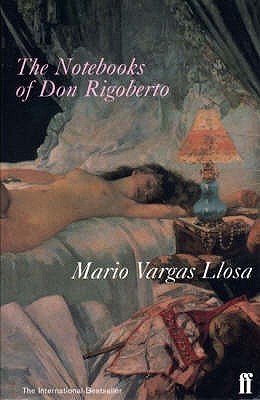
It’s already the middle of the week. This also means we have only two more days until the weekend. I hope everyone makes it through the workweek. Reading-wise, my 2026 reading journey is going as designed. I am currently in the midst of a foray into Latin American literature. It has been quite some time since I dedicated a month or two to reading works by writers from the region—if my memory serves me right, the last time was in 2023. The time is now ripe for a return. My current read takes me to a familiar name in Mario Vargas Llosa. It has been nearly a decade since I learned about the Peruvian Nobel Laureate in Literature through must-read lists. A leading voice of the Latin American literary bloom, Vargas Llosa has earned a fan in me. From my first Vargas Llosa novel, The War of the End of the World, I am now reading my fifth, The Notebooks of Don Rigoberto.
Originally published in 1997 in Spanish as Los cuadernos de don Rigoberto, The Notebooks of Don Rigoberto chronicles the life of the titular Don Rigoberto. The story unfolds through the perspective of his son from a previous marriage, Fonchito (Alfonso). Fonchito was fascinated by his father’s notebooks, which contained erotic drawings and stories. We learn that Don Rigoberto works as an insurance executive during the daytime. At night, he focuses on his after-office passionate affairs. Enveloped in anonymity by the darkness, Don Rigoberto transforms into a passionate pornographer and sexual enthusiast. Passion and sex are not unusual subjects in Vargas Llosa’s oeuvre. It reminds me of Aunt Julia and the Scriptwriter. Don Rigoberto was forced to divert his energies and attention following an emotional turmoil that stemmed from the absence of his estranged wife, Lucrecia.
Lucrecia’s absence left a gaping hole in Don Rigoberto’s life. She is, after all, his true love. But what happened between husband and wife? The crux of the story, apparently, revolves around the story behind Lucrecia’s banishment from the house of Don Rigoberto. Don Rigoberto banished her following a love affair with Fonchito. This is certainly quite an intriguing premise, especially from Vargas Llosa. It is a type of work I have yet to read from him. Although I just started reading the book today, I am looking forward to how the story unfolds. Should
What have you finished reading?
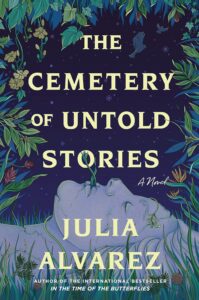
Following a very prolific reading week, my most recent one wasn’t as prolific. Still, I was able to complete two books during the previous week—both of which I had been looking forward to. The first of these two books is by a writer who has become more familiar to me. Although I was not as impressed as I had hoped by Julia Alvarez’s debut novel, How the García Girls Lost Their Accent, I did not let this preclude me from wanting to explore her oeuvre further. She redeemed herself (to me) with her sophomore novel, In the Time of the Butterflies. Just a couple of months after reading her fictionalized account of the Mirabal sisters’ martyrdom, I read my third novel by Alvarez, The Cemetery of Untold Stories. It was in early 2024 that I learned about Alvarez’s most recent release. Unfortunately, I was unable to acquire a copy at the time. Only recently was I able to do so, and without ado, I immediately made it part of my ongoing venture into Latin American and Caribbean literature.
Alvarez’s seventh novel charts the story of Alma Cruz, a novelist and professor in her sixties. Alma, like the author, has three sisters. Interestingly, there were also four Mirabal sisters. Through flashbacks, we learn that Alma’s mother objected to her writing, particularly her portrayal of family life. Her mother found her writing to be slathered with lies. Consequently, Alma publishes under the pseudonym Scheherazade to avoid upsetting her kin. Following their parents’ deaths, the sisters learn of their inheritance through the family attorney, Martillo. To their surprise, their father left them land in the Dominican Republic. However, the sisters—like any quartet of sisters—cannot agree on how to divide it. None of them intends to keep or occupy the land. On Martillo’s recommendation, the sisters randomly draw to determine who among them will get first pick. To her surprise, Alma is chosen to pick first. Going against the consensus, she chooses the largest plot, located on the outskirts of Santo Domingo. The land is deemed worthless because of its proximity to a landfill and a slum riddled with crime. Because it is the largest parcel, Alma elects to forgo any further inheritance. This naturally piqued her sisters’ interest.
Alma did not initially plan to choose this piece of land. Nevertheless, a plan forms in her mind. Following her retirement from academe, she returns to her homeland seeking a quiet existence. On that worthless land, she builds a cemetery—not for people or animals, but for her untold stories and the characters she created but never published. She arrives with boxes of unfinished manuscripts and hires Brava, a local artist, to create markers for each story’s burial plot. Access is limited: one can only enter if they can tell a good story. The first to do so is the enigmatic Filomena, whom Alma eventually hires as the cemetery’s caretaker. The Cemetery of Untold Stories is, of course, no ordinary novel. Touches of magical realism add nuance to the narrative; I was not expecting Alvarez to dabble in magical realism. Alvarez’s novel once again confronts history, as her literary inquiries lead her to grapple with the question of whose story gets to be written—a challenge to historical documentation, which often sides with the victor. Overall, The Cemetery of Untold Stories is a compelling read.

Unlike Alvarez, I have yet to read one of Oscar Hijuelos’s works. Interestingly, they both share the fate of being immigrants. While Alvarez’s family moved to the United States to escape the atrocities of Rafael Trujillo, Hijuelos was a second-generation Cuban immigrant; his parents were both from Holguín, Cuba. Before taking on a full-time career as a writer, Hijuelos practiced various professions, including working for an advertising agency, Transportation Displays Inc. He did, however, begin writing short stories and plays while working in advertising. In 1983, he published his first novel, Our House in the Last World. While it experienced relative success, it was Hijuelos’s sophomore novel, The Mambo Kings Play Songs of Love, that established him as a household name. It is one of the reasons why I included it on my 2026 Top 26 Reading List.
Originally published in 1989, The Mambo Kings Play Songs of Love charts the fortunes of the Castillo brothers, Cesar and Nestor. Their story is initially narrated by Eugenio, Cesar’s nephew. We learn that the brothers were talented musicians from a farm in Cuba who had been playing in a small band in Havana. In hopes of making it big in the music industry, the brothers arrived in New York City in 1949. Ambitious and passionate about their music, they soon formed a band—the titular Mambo Kings. The early days, however, were filled with struggle. The brothers worked in a meatpacking facility, using their nights to write and rehearse songs. Their hard work paid off, as they eventually became a sensation in the city’s vibrant music scene. One night, Desi Arnaz and Lucille Ball came to see them perform. Like Cesar, Arnaz had sung in the Julián García band in Cuba, and he, too, was from the same region. A couple of months after this initial encounter, the brothers were invited to Hollywood to film an episode of I Love Lucy. The episode was a sensation, elevating the brothers to affluence and playing a crucial role in establishing their band’s reputation. The band then embarked on their first national tour. They performed in prestigious venues, recorded albums, and made television appearances. They were the darlings of the crowd. However, this vibrancy in their public lives stood in stark contrast to the turmoil within their personal lives.
The brothers’ personal lives were riddled with tragedy and heartbreak. Cesar was charismatic and a chronic womanizer. When his first wife, Julián’s niece, Luisa, learned of one of his affairs, she left him. Cesar, however, continued to send gifts to his daughter, Mariela, in Cuba. Because of his nature, most of Cesar’s romantic connections were fleeting at best. Meanwhile, Nestor’s marriage to Dolores was hampered by his overwhelming passion for music. Unlike his brother, Nestor remained loyal to his wife. Essentially antithetical to each other, the brothers were nevertheless bound by their shared love for music. The Mambo Kings Play Songs of Love captures both the struggles and triumphs of the brothers’ lives. Filled with an eclectic cast of characters, Hijuelos’s sophomore novel explores the follies of stardom and how it can alter one’s life, both positively and negatively. Further, the novel delves into deeper themes of cultural identity as the brothers navigate the cultural differences between the United States and Cuba. Vibrant and dynamic, and at times heartbreaking, The Mambo Kings Play Songs of Love is a notable work, worthy of its 1990 Pulitzer Prize in Fiction.
What will you read next?

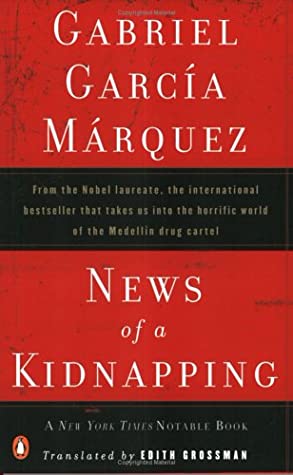

 The Pine-Scented Chronicles