A Philippine Mythopoeic
Nestled in the Orient, the Philippines is an archipelago composed of over 7,600 islands. Romantically called the Pearl of the Orient Seas, the country’s islands are individually unique, marked by rugged yet idyllic terrain. The country is also blessed with some of the finest beaches in the world. Its islands are inhabited by an equally diverse group of people who possess colorful traditions and observe distinct cultures and beliefs. They have different physical attributes and practice different values, all of which contribute to their unique cultural identities. Despite these differences, the Filipino people share certain similarities. They have earned the distinction of being among the happiest people in the world, and their story is marked by resilience. Located in the Pacific Ring of Fire, the entire archipelago is often visited by typhoons and rocked by volcanic eruptions and earthquakes. Still, Filipinos find reasons to smile. They always find reasons to celebrate, even in the midst of catastrophe.
One factor that contributed to the Filipino people’s positive demeanor is their checkered history. Once occupied by small kingdoms governed by rajahs and datus, the archipelago was soon colonized by the Spaniards in the 16th century. Portuguese explorer Ferdinand Magellan was on his way to the Moluccas, the famed Spice Islands, when he and his crew were waylaid in the Philippine archipelago. The rest, they say, was history. For over three centuries, the country was under Spanish rule and was literally named after King Philip II. The Philippines was later ceded to the United States before being occupied by Japan during the Second World War. Meanwhile, the Moro community thrived in the southern parts of the country. These various cultures have influenced and shaped contemporary Philippine society. It is this tumultuous history that provided a fertile mantle for stories, myths, and lore. Pre-colonial Philippines also had a rich literary heritage, much of it preserved in oral form.
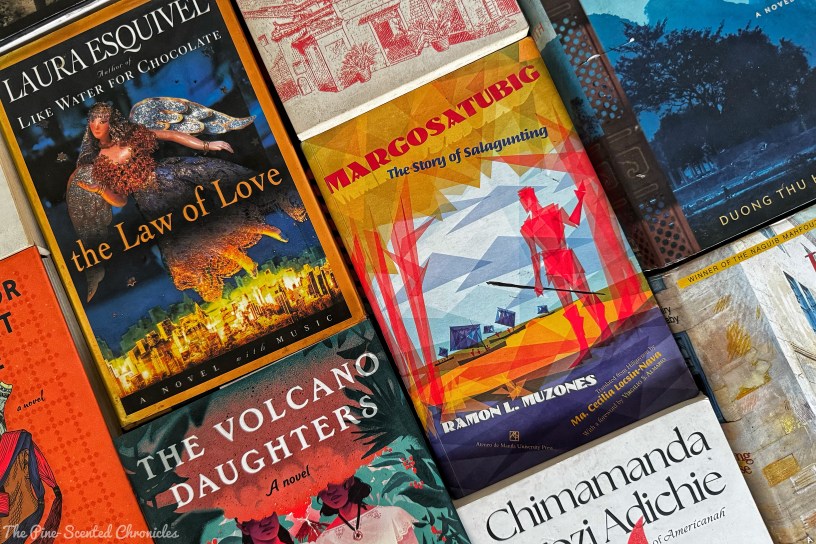
From this lush tapestry of oral literature and history, Ilonggo writer Ramon Muzones drew inspiration for his novel Margosatubig: The Story of Salagunting. Widely regarded as one of the leading advocates of the Hiligaynon novel—one of the country’s major ethnolinguistic traditions—Muzones had a prolific literary career spanning decades. Among his most popular works, Margosatubig was originally published from 1946 to 1947 in serialized form in the weekly local magazine Yuhum. With its publication, Yuhum’s weekly circulation more than quadrupled. A local publisher then capitalized on the story’s success by printing it in book form. Mariano Diolosa sold copies to homesick Ilonggos abroad who yearned for a semblance of home. Ironically, Muzones did not earn anything from the novel’s publication, as no contract existed between him and the publisher.
In the depths of the darkness, he was able to discern the biggest scallop he had ever seen in his whole life floating on the surface of the water. Sitting on the edge of this bivalve was a young man who was dangling his legs on the water. Beside him was a mermaid who was singing. Her skin was so fair it glowed in the darkness…while the wind played with her long and looseend hair, whose ends were teased by the crests of the waves.
Ramon Muzones, Marcosatubig: The Story of Salagunting
Often cited by literary scholars as Muzones’s magnum opus, Margosatubig takes its name from a place that serves as the fictional capital of the powerful Muslim sultanates of Sulu and Maguindanao in early colonial southern Philippines. At the time, Christianity and Spanish influence had reached only the northern and central shores of the archipelago, while the South remained resistant to colonization. However, the sultanates also contended with forces from distant seas and internal social tensions. In Margosatubig, leadership is fiercely contested. Datu Ibyn Parang, the only son of the reigning datu, is expelled from the kingdom and exiled to the island of Tubbataha by the Council of Elders led by Sultan Mohamed. He is censured for violating a fundamental rule: marrying a Christian woman. Dulcinea was his captive while he was navigating the Siwaragan River of the Irong-Irong seas, and it was during this time that he fell in love with her.
Sultan Mohamed, however, harbored a more sinister and selfish motivation for ousting Datu Parang—he intended to seize power. With Datu Parang removed, Sultan Mohamed put the rest of his plot into motion. Datu Parang later died in battle, while his father was poisoned by Sultan Mohamed. This paved the way for Sultan Mohamed to rule Maguindanao and Sulu. Serving as advisors to the new ruler were Pandit Gulamu, a man believed to possess magical powers as unbelievable as they were absurd, and Dayang-Dayang Morgana, the Sultan’s exceedingly beautiful and beguiling daughter. Morgana also possessed powers of enchantment and the ability to change form. Both characters wielded kinaadman—a central motif in the novel—which refers to magical abilities often derived from amulets, or anting-anting, as they are known elsewhere in the country. Kinaadman also signifies an innate status that legitimizes one’s claim to power.
But there was another character who possessed kinaadman. He is Salagunting, the son of Datu Parang and Dulcinea. As part of the punishment imposed by the Council of Elders, Salagunting and his mother were fed to the manlut (a sacred giant scallop) on the enchanted island of Paragwa. Long believed to be dead, Salagunting miraculously survived and was raised by King Balitawtaw of the sea. Upon coming of age, Salagunting was confronted with the destiny he was meant to fulfill. Through Sani, one of Datu Parang’s trusted servants who survived the battle between Parang and Mohamed, Salagunting learned of his true identity. The rightful heir then journeyed back to the world of land—to Margosatubig—to reclaim what was rightfully his by birth. Before leaving Paragwa, his surrogate father bestowed upon him several forms of kinaadman: a wild’s mutya, mantras for air and water, an enchanted banawug, an algae charm, and a binsul nga pakpakan (a magical winged knife).
Returning to his father’s kingdom with the help of Sani—who also serves as the novel’s primary narrator—Salagunting witnessed a realm overrun by corruption, greed, and evil. The sultanate stood on the brink of collapse. Sultan Mohamed, however, was not one to concede easily. Reclaiming the kingdom proved arduous, and Salagunting’s pursuit of destiny led him through trials reminiscent of the labors of Hercules. Though endowed with kinaadman, Salagunting was also a natural busalian (one of immense strength). Still, he was disadvantaged against Sultan Mohamed and his forces. At one point, he served as a gladiator against the Sultan’s greatest warrior. The banawug saved him—and, in the process, other enslaved captives. His journey also brought him into repeated encounters with Morgana. Disguised as the babaylan Saliyaw, she successfully imprisoned Salagunting within a batong bantiling (living stone) atop a mountain surrounded by quicksand.
I ceded everything taught me to my father and I put my life on the line in the name of love. When I saw you, I swore off and forsook all my dreams just to lie at your feet. All my evil designs went counter to my heart and I said to myself this must be love. This is my story. Your ill treatment of me made me do evil things, but I love you and that love trascends everything.
Ramon Muzones, Marcosatubig: The Story of Salagunting
Faced with these opposing forces, the question arises: will Salagunting be able to liberate Margosatubig from the evil and greed that proliferated after his family’s overthrow? Complicating matters was the initial reluctance of the Moros to accept his claim to the throne, as they had no knowledge of his provenance. Meanwhile, Sultan Mohamed ruled through oppression, sending his men to exploit the seas and raid Christian communities. His forces engaged in piracy and slave raids—practices that were historically prevalent among Moros even before and during Spanish colonization. This history is marked by the construction of kotas, or forts, many of which still remain across the islands.
The novel highlights the historical tensions between Moros and Christians, mirroring conflicts that persist to this day. These tensions, brought about by the encroachment of Christianity, serve as key historical influences in Muzones’s Margosatubig. In Hiligaynon, the title literally means “bitter water.” From the details of the narrative, one can infer that Margosatubig corresponds to present-day Zamboanga Peninsula. Indeed, there is a municipality called Margosatubig in Zamboanga Sibugay Province. According to the town’s website, the name is a portmanteau of two Subanen words—malagos and tubig—which together mean “swift river current.” True to this meaning, bodies of water take on near-character status in the novel. The sea and rivers actively shape the story, rendering Margosatubig a work of maritime folklore. Many confrontations unfold in open waters, and much like King Balitawtaw, the novel is populated with characters who emerge from the sea.
Beyond its historical context, Salagunting stands as the novel’s backbone. As he reclaims his birthright, the narrative unfolds as his personal odyssey, filled with adventures and misadventures. Encounters with the supernatural are pervasive as Muzones weaves folklore into the plot. Along the way, Salagunting gains a deeper understanding of his heritage, lineage, and identity. The novel thus becomes not only a quest for a lost throne but also a journey of self-discovery rooted in Moro beliefs and epic traditions. It is, at its core, a reclamation of destiny. The challenges Salagunting faces test his character and resolve, ultimately leading to personal realizations that foster his growth both as a leader and as an individual.
In his arms languished a fading flower that because of his neglect and failure to nurture slowly lost its beauty. His heart ached at the sight of his former sweetheart in dire straits: her lips and cheeks were pale, her body wasted…only a semblace of her past loveliness remained.
Ramon Muzones, Marcosatubig: The Story of Salagunting
Romantic overtones further enrich Salagunting’s story. He initially meets and falls in love with Maria Cristina, a Christian from Rom-rom. Her character appears inspired by Maria Cristina Falls in Mindanao, sharing the same name. The waterfall lies at the crossroads of Maranao communities in Lanao del Sur and predominantly Christian settlements in the Visayas and parts of Mindanao. This symbolism adds another layer to the narrative, subtly underscoring the tensions between these two ethno-religious groups. In the novel, after Salagunting and Maria Cristina are separated by Morgana’s machinations, a waterfall springs forth from the mountain where Salagunting was held captive—serving as the mythical origin of present-day Maria Cristina Falls. Margosatubig thus becomes a paean to both national and regional literary heritage.
The recovery of cultural heritage is a central theme in the novel. Steeped in Moro traditions and beliefs, Margosatubig offers a culturally immersive experience. Moro folklore and elements of magical realism deepen the narrative, while fantastical elements alternate with intense battle scenes. This blend enriches the story and highlights the lush cultural backdrop of the period, aided by a fast-paced plot and a diverse cast of characters. One limitation, however, lies in the portrayal of women. While female characters wield power, they often remain subordinate to male authority. Morgana stands out as a compelling figure, yet women largely exist in the shadows of men—a reflection of the patriarchal structure of Moro society.
Part coming-of-age tale, part historical inquiry, and part social commentary, Margosatubig: The Story of Salagunting is a lush and multilayered novel by the first regional writer to be named National Artist for Literature. Muzones received this recognition posthumously in 2018. His work transcends time, underscoring the importance of regional literature in a country historically divided by bodies of water as well as cultural and linguistic boundaries. Margosatubig is not only a hero’s journey toward self-discovery and destiny but also a powerful metaphor for nation-building and the unification of divided lands. With its rich historical and cultural contexts, the novel stands as a compelling tribute to the Philippines’ vibrant literary heritage.
By heaven’s grace, it is possible that he is among the creatures of hte sea; but he is of land. He was conceived, given birth to, and suckled by human beings. Therefore, he is of land and must return whence he had come. He must wrest from treacherous hands his heritage of power and honor so that even if his grieving father and I are in the other life, our souls will find rest.
Ramon Muzones, Marcosatubig: The Story of Salagunting
Book Specs
Author: Ramon L. Muzones
Translator (from Hiligaynon): Ma. Cecilia Locsin-Nava
Publisher: Ateneo de Manila University Press
Publishing Date: 2012 (1946)
Number of Pages: 220
Genre: Fantasy, Historical
Synopsis
Ramon L. Muzones claims his rightful place in the national literature of the Philippines with Cecilia Locsin-Nava’s English translation of Margosatubig, a Hiligaynon novel that was to re-write the history of the West Visayan fiction when it first appeared as a serial novel in 1946 in the pages of the popular magazine Yuhum. Muzones tells the story of a fictive Muslim state in Mindanao that loses its legitimate rulers through intrigue and treachery and how the hero-heir Salagunting leads the struggle to recover Margosatubig from the usurpers. Muzones shows himself a master of narrative invention in 30 installments that unfold a wealth of precolonial lore that blended romance, adventure, fantasy, subtle eroticism, and geographic information that so fascinated magazine readers and made Yuhum‘s weekly circulation jump from 2,500 to 37,000.
Dr. Nava’s is a wonder-work of an English translation, literate and literary, a rare, readable English version of a regional literary treasure. It is a lucid, unornamented rendition of the original Yuhum novel that manages quite effectively to suggest the delicious sensation of following the development, chapter by chapter, of the serialized popular novel. Through her labors, she has effectively secured for Muzones a position in the line-up for the title National Artist for Literature.
About the Author
Ramon Muzones was born on March 20, 1913, in Iloilo City. He was the oldest child of poverty-stricken Santiago Muzones and Florentina Larupay. His education was funded by his uncle; this education would be seminal in his appreciation of literature. While studying at A. Montes Elementary School, he proved himself to be a writing prodigy. His socio-economic standing did not hinder him from being ambitious. He moved to Manila to find work in the publishing industry. He later started small as a translator. He translated the comic strip of Tony Velasquez entitled Kenkoy from Tagalog to Hiligaynon. He then started writing short stories, mainly in Tagalog.
After establishing a foothold in the world of literature, Muzones pursued his studies in law. He took his pre-law degree at Far Eastern University. While working and studying, he wrote under a pseudonym for Hiwaga Magazine, a sister publication to Liwayway. Here he met the editor Abe Gozales, who convinced him to write Hiligaynon novels. Muzones then started working on his first novel, Tibud nga Bulawan, which was published in 1938. This would be the first of over 60 novels in Hiligaynon. This earned him the recognition of being the King of the Hiligaynon Novel (Hari sang Sugilambang). His works spanned different genres, from bildungsroman, romance, realist, and even sociopolitical. These are on top of short stories, essays, and poems he also published.
Among his other works are Shri-Bishaya (1969), Malala nga Gutom (1965; trans. Malignant Hunger), Babae Batuk sa Kalibutan (1959; trans. Woman Against the World), Ang Gugma sang Gugma Bayaran (1955; trans. Love with Love Be Paid), and Margosatubig (1946). Muzones’ works gained national attention, earning him a Gawad Balagtas Awardee of the Unyon ng mga Manunulat sa Pilipino (UMPIL); Gawad CCP sa Sining; NCCA Gawad Bonifacio Awardee in Hiligaynon Literature; Centennial Artist of the Philippines award, among many literary citations. In 2018, he was posthumously recognized as a National Artist in Literature, making him the first regional writer, i.e., writer who writes in a language other than English or Filipino, to earn the award.
He also founded an organization for Hiligaynon writers called Sumakwela. Apart from writing, Muzones was a lawyer by profession; he completed his law degree at the Central Philippine University in his hometown. He also served as a city councilor of Iloilo. He passed away on August 17, 1992.
 The Pine-Scented Chronicles