A Betrayal
Like most ancient literatures of the world, Hebrew literature traces its origins to an oral tradition. One of the earliest forms of Hebrew was Leshon HaKodesh (לְשׁוֹן הַקֹּדֶשׁ, “The Holy Language”). The teachings of Abraham, the first of the biblical patriarchs of Israel, also formed an integral part of early Hebrew literary tradition. While the origin of the word “Hebrew” is uncertain, it is often associated with Abraham. The development of the Bible and ancient Hebrew literature occurred in parallel. The Hebrew Bible, or Tanakh, remains one of the most important works of ancient Hebrew literature. Over the succeeding centuries, Hebrew literature continued to develop and become more widespread. The medieval period was seminal in its spread and growth. During this time, Hebrew literature flourished across the Byzantine Empire and experienced a golden age in Muslim Spain from 900 to 1200. However, Hebrew literature extends far beyond the Old Testament and other sacred scriptures.
With the passage of time, Hebrew literature expanded to encompass a vast array of literary, philosophical, and poetic works produced by Jewish authors across the centuries. Beyond rabbinic literature written in Hebrew, writers developed their own forms and explored a variety of themes, styles, and genres. All of these contributed to the richness and diversity of the broader Jewish literary tradition. The eighteenth and nineteenth centuries proved pivotal in the evolution of Hebrew literature. This period marked the ascent of prominent Hebrew writers such as Joseph Perl, who published Revealer of Secrets (מגלה טמירין), regarded as the first Hebrew novel; Kalman Schulman, who introduced the romantic form into Hebrew literature; Mordecai Aaron Ginzburg, known as “the father of prose”; and Abraham Baer Lebensohn, known as the “father of poetry.”
In 1966, Shmuel Yosef Agnon, an Austro-Hungarian-born novelist, was awarded the Nobel Prize in Literature. He shared the prize with Nelly Sachs, a German Jewish author. Notably, many of the prominent figures of Hebrew literature prior to the twentieth century emerged from the Jewish diaspora; even Agnon and Sachs belonged to this group. This changed in 1948 with the establishment of the modern State of Israel, which marked the emergence of a new generation of Hebrew writers. Novelists Aharon Megged, Nathan Shaham, and Moshe Shamir, along with poets Yehudah Amichai, Amir Gilboa, and Haim Gouri, further elevated modern Hebrew literature through their distinguished works. Another prominent figure in modern Hebrew literature is Amos Oz (עמוס עוז). Over a literary career spanning more than five decades, he published forty books across various genres, from short stories and novels to children’s literature and essays.
Those accursed god-killers were only able to kill god on condition that they really possessed monstrous resources of strength and wickedness. And so that is indeed what the Jews possess in the deepest recesses of the Jews-hater’s imagination. We are all Judas. Even eighty generations later we are still Judas. But the truth, my young friend, the real truth, we can behold before our very eyes here in the land of Israel: the modern Jew who has sprung up here, just like his ancient predecessor, is neither strong nor malicious, but hedonistic, with an ostentatious of wisdom, boisterous, confused and consumed by suspicions and fear.
Amos Oz, Judas
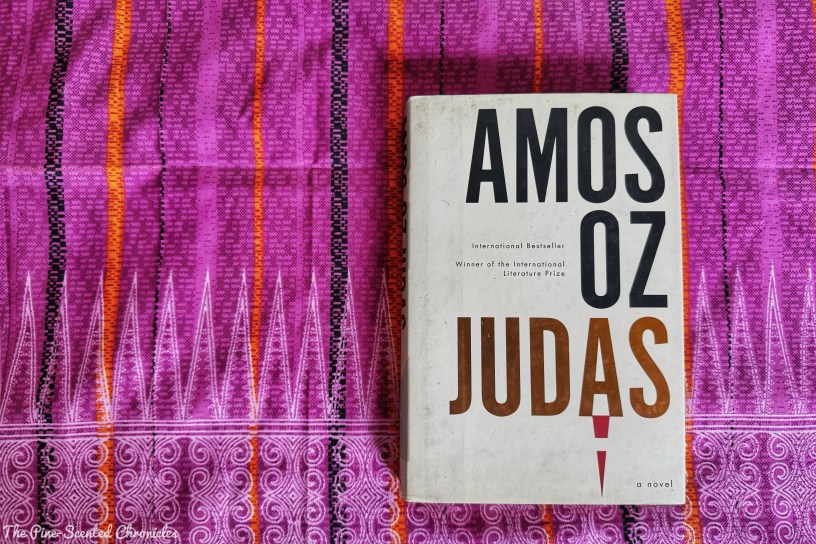
A prominent figure in Israeli literary circles, Amos Oz is especially renowned for his novels, many of which earned international acclaim. A seminal work in his oeuvre is Judas. Originally published in Hebrew in 2014 as הבשורה על-פי יהודה (Habsora Al-Pi Yehuda), which literally translates as The Gospel According to Judas, it was Oz’s last published novel before his death in 2018. Set in Jerusalem in the late 1950s, the novel follows twenty-five-year-old Shmuel Ash, a shaggy, left-wing, idealistic yet atheist graduate student ironically studying religion and history. He is forced to abandon his studies, including his MA thesis on how Jews viewed Jesus, and ultimately his dream of an academic career, following a series of adversities. His girlfriend, Yardena, leaves him for her former boyfriend, Nesher Sharshevsky, a hydrologist. At the same time, his father’s finances collapse, leading to bankruptcy and the loss of Shmuel’s allowance. Meanwhile, his socialist group begins to disintegrate.
Shmuel’s life unravels, leaving him alone and bereft of hope. Adrift and with limited prospects, he urgently searches for both employment and accommodation. During this bleak period, he comes across a job notice on a campus board. The position requires providing companionship to an elderly, religious, talkative, yet incapacitated scholar, Gershom Wald, who lives on the western fringe of then-divided Jerusalem. Wald longs for intellectual discourse and wishes to be read to and debated with. Shmuel applies and is immediately accepted. The position includes lodging in the attic of a gloomy old stone house and a modest stipend. He is barred from disclosing the nature of his work or any information about the household’s inhabitants. Shmuel accepts the arrangement, as it offers him the solitude he craves.
However, the peace he seeks is disrupted by the presence of a third occupant: Atalia Abravanel, a magnetic middle-aged woman who efficiently runs the household. Shrouded in mystery, Atalia enchants Shmuel, who gradually becomes obsessed with her. A latent sexual tension develops, though Atalia does not reciprocate his attraction. Still, she engages him in conversation. Over the course of the winter, the three solitary figures—each battling personal ghosts—open themselves to one another through long conversations over tea. Atalia confides that she was married to Micha, Wald’s son, who was killed in the War of Independence less than two years after their marriage. She now works as an investigator in the Civil Investigations Office. The shared sorrow between Wald and Atalia permeates the house, filling it with lingering grief.
The intellectual exchanges between Wald and Shmuel form the core of the novel. They debate politics, history, and religion, their generational differences underscoring the contrast in their perspectives. However, among the plethora of subjects they touched on, one particular discourse stands out: the Jewish reception of Jesus and the Christian perception of Judas. Judas is one of the most contentious biblical figures, long portrayed as the embodiment of betrayal. Much of the novel unfolds as a series of refined and philosophical discussions about Judas’s legacy. Shmuel argues that Judas was Jesus’s most loyal and devoted follower, even orchestrating the crucifixion in the belief that it would reveal Jesus’s divinity. When Jesus proved mortal, Judas, devastated, took his own life.
Personally I do not believe in world reform. No. I do not believe in any kind of world reform. Not because I consider that the world is perfect as it is—certainly not, the world is crooked and grim and full of suffering—but whoever comes along to reform it soon sinks in rivers of blood. Now let’s drink a glass of tea and leave aside these obscenities you’ve brought me today. If only all religions and all revolutions vanished from the face of the earth someday, I tell you—all of them, without exception—there would be far fewer wars in the world.
Amos Oz, Judas
For Shmuel, Judas’s betrayal was an act of devotion, making him “the first Christian. The last Christian. The only Christian.” Without the crucifixion, Christianity would not have flourished. Wald, though encouraging Shmuel’s research, offers a contrasting view. Skeptical of idealism, he sees Judas as a powerful symbol of treachery that fueled centuries of hatred. He contends that Jewish suffering throughout history is partly rooted in the portrayal of Judas in the New Testament. Judas’s alleged betrayal not only sealed Jesus’s fate but also shaped the tragic destiny of the Jewish people, resulting in persecution under various ideological movements—“slaughter, crusades, jihad, gulag, or the wars of Gog and Demagogue.” In this sense, Wald suggests, all are capable of being Judas.
Wald’s apprehension regarding Shmuel’s reinterpretation of Judas is shaped by the past. Before Shmuel’s arrival, Shealtiel Abravanel, Atalia’s father, had moved in with Wald after the untimely death of his son-in-law. In this narrative of betrayals, Abravanel represents another “Judas.” A Zionist and member of the provisional government, he nevertheless opposed the establishment of a Jewish state, advocating instead for a binational entity. He argued with David Ben-Gurion, believing that statehood would lead only to war. Wald, in contrast, revered Ben-Gurion as the greatest Jewish leader, even considering him a messianic figure. Because of his opposition, Shealtiel was branded a traitor—a modern Judas. Despite their ideological differences, Wald respected him as a dreamer and preserved his memory after he died in solitude, rejected by the political powers that would be.
Though Shealtiel has no physical presence in the narrative, his influence reverberates throughout the story. Shmuel becomes increasingly intrigued by his life and, in many ways, identifies with him. Judas thus becomes Shmuel’s journey toward self-discovery. He enters the Wald household weary and directionless, amid an existential crisis. There, he finds space for reflection while interacting with people who tickled his intellect and his personal desires. His interactions with Wald, Atalia, and even the memory of Shealtiel challenge his convictions. The philosophical debates—juxtaposed with the quiet rituals of domestic life—become metaphors for the enduring dialogue between Christianity and Judaism. Meanwhile, his relationship with Atalia signals a sexual and emotional awakening.
But Shmuel’s growing attachment to Atalia, who embodied desire and maternal care, starkly contrasts with his moral reflections on loyalty. This tension echoes the novel’s central theme. Oz created a young man caught in layers of doubt. He was a crucible for challenging the readers’ notions of fidelity and treachery. As Shmuel grapples with trust, love, and belief, readers share in his confusion. Oz further builds on this tension, with Shmuel confronting the implications of his own actions and how they impact those around him. The novel evolves into a journey toward understanding one’s own beliefs. Shmuel’s relationship with Atalia and Wald is then central to the novel’s examination of the intricacies of human connections, particularly betrayal and loyalty, and the complexities of faith.
Blessed are the dreamers, and cursed be the man who opens their eyes. True, the dreamers cannot save us, neither they nor their disciples, but without dreams and without dreamers the curse that lies upon us would be seven times heavier. Thanks to the dreamers, maybe we who are awake are a little less ossified and desperate than we would be without them.
Amos Oz, Judas
Meanwhile, Atalia remains steadfastly loyal to her husband’s memory, highlighting the contrast with Shmuel’s wavering convictions. Throughout the novel, Shmuel grappled with his own loyalties and faith. An internal conflict develops within him as his views about Judas Iscariot are challenged. His once fervent defense of Judas begins to falter under Wald’s scrutiny. This raised questions about whether Judas was a villain or visionary. This dichotomy invites broader reflections on redemption and moral ambiguity. Oz suggests that betrayal can only be understood through a nuanced examination of human motivation. Shmuel also had to confront his understanding of the intricacies of loyalty, pitting his own beliefs against figures of authority. Layers of love and sacrifice added textures and even complications to his personal quandary.
Shmuel’s personal struggles resonate beyond his personal circumstances. Judas then functions as Ash’s own coming-of-age. To a broader extent, the novel captures Israel’s own coming-of-age. Both Shmuel and Israel shared experiences of betrayal and were impacted by historical events. The ideological conflicts surrounding the nation’s founding parallel Shmuel’s internal turmoil. Jerusalem itself emerges as a silent protagonist. Physically divided and ideologically fractured, the city mirrors the inner divisions of its inhabitants. In this sense, Judas is a national allegory. As Shmuel grapples with doubt and identity, so too does Israel confront the unresolved tensions of its founding.
In his last major work, Amos Oz offers a profound exploration of betrayal, faith, and identity. Through the figure of Judas Iscariot, a prominent biblical and historical figure, he probes the boundaries between devotion and treachery, and the intricacies of loyalty and redemption. Rich in historical resonance and philosophical nuance, Judas stands as a contemplative and quietly subversive farewell from one of Israel’s most probing literary voices. Still, Judas offers no simple vindication. Instead, he invites readers into a meditation on betrayal as a deeply human—and perhaps unavoidable—condition. Loyalty, he suggests, is rarely pure; faith is often shadowed by doubt; and love carries within it the seeds of loss. It is a novel that lingers—not because it resolves its questions, but because it refuses to.
The fact is that all the power in the world cannot transform someone who hates you into someone who likes you. It can turn a foe into a slave, but not into a friend. All the power in the world cannot transform a fanatic into an enlightened man. All the power in the world cannot transform someone thirsting for vengeance into a lover.
Amos Oz, Judas
Book Specs
Author: Amos Oz
Translator (from Hebrew): Nicholas de Lange
Publisher: Houghton, Mifflin, Harcourt
Publishing Date: 2016 (2014)
Number of Pages: 305
Genre: Historical, Coming-of-Age
Synopsis
Jerusalem, 1959. Shmuel Ash, a biblical scholar, is adrift in his young life when he finds work as a caregiver for a brilliant but cantankerous old man named Gershom Wald. There is, however, a third, mysterious presence in his new home. Atalia Abravanel, the daughter of a deceased Zionist leader, a beautiful woman in her forties, entrances young Shmuel even as she keeps him at a distance. Piece by piece, the old Jerusalem stone house, haunted by tragic history and now home to the three misfits and their intricate relationship, reveals its secrets.
At once an exquisite love story and a coming-of-age novel, Judas offers an illuminating perspective on the state of Israel and the biblical tale from which it draws its title.
About the Author
Amos Klausner (עמוס קלוזנר) was born on May 4, 1939, in Jerusalem, Mandatory Palestine, the only child of his parents, who were immigrants to Mandatory Palestine. His parents met at the Hebrew University of Jerusalem, where he would eventually obtain his own education. He studied philosophy and Hebrew literature. When he was 14, he became a Labor Zionist, left home, and joined Kibbutz Hulda. There, he was adopted by the Huldai family and changed his surname to “Oz” (Hebrew: “courage”). Post-university, he began teaching in the kibbutz high school, while continuing to write. He served as an army reservist in a tank unit that fought in the Sinai Peninsula during the Six-Day War, and in the Golan Heights during the Yom Kippur War. After the Six-Day War in 1967, he actively advocated for the Israeli peace movement, becoming involved with organizations advocating for a two-state solution to the Israeli-Palestinian conflict.
As a writer, he published his first book, Artsot ha-tan (Where the Jackals Howl), a collection of short stories, in 1965. A year later, he published his first novel, מקום אחר (Makom Acher; trans. as Another Place but published in the U.S. as Elsewhere, Perhaps). His breakthrough came with the publication of מיכאל שלי (Mikha’el sheli; trans. My Michael) in 1968. Among his other works are לגעת במים, לגעת ברוח (La-gaʿat ba-mayim, la-gaʿat ba-ruaḥ, 1973; Touch the Water, Touch the Wind), קופסה שחורה (Kufsah sheḥora, 1987; Black Box), and המצב השלישי (Matsav ha-shelishi, 1991; Fima, or The Third State). Meanwhile, אותו הים (Oto ha-yam, 1999; The Same Sea) is a novel in verse. His last published novel was הבשורה על-פי יהודה (Ha-Beśorah ʿal-pi Yehudah, 2014; The Gospel According to Judas). Among the forty books that Oz published over the course of his career are collections of short stories and essays, and a memoir סיפור על אהבה וחושך (Sipur ʿal ahavah ve-ḥoshekh, 2002; A Tale of Love and Darkness).
Oz’s works earned him several accolades across the world. He was awarded the 1976 Brenner Prize, the 1986 Bialik Prize for literature, the 1988 French Prix Femina étranger, the 1992 Friedenspreis des Deutschen Buchhandels, the 1998 Israel Prize for literature, the 2007 Prince of Asturias Award in Literature, and the 2008 Primo Levi Prize, among others. In 1984, he was made an Officier of the Ordre des Arts et des Lettres in France, and was named to the French Legion of Honour in 1997. Before his death, Oz was also a part of the Nobel Prize in Literature discussions, earning him several nominations.
Oz died of cancer on December 28, 2018, in Rabin Medical Center, Petah Tikva, aged 79. He was buried at Kibbutz Hulda.
Judaism and Christianity, and Islam too, all drip honeyed words of love and mercy so long as they do not have access to handcuffs, grills, dominion, torture chambers, and gallows. All these faiths, including those that have appeared in recent generations and continue to mesmerize adherents to this day, all arose to save us and all just as soon started to shed our blood.
Amos Oz, Judas
 The Pine-Scented Chronicles