Of Rural Living and Survival
There is no doubt that the Indian subcontinent is a melting pot of different cultures. The world’s largest democracy has a long and colorful history that spans millennia. Now the world’s most populous country, India’s strategic location has made it a crossroads of various cultures. It is where different ethnicities and religions converged, resulting in a rich and diverse culture. This diversity—geographical, demographic, and cultural—also served as a backdrop for the modern nation’s equally diverse and colorful literature, inspiring writers born both within and outside the subcontinent. From these different cultures and subcultures emerged an equally diverse literary canon that captured every dimension of Indian life across the region. For millennia, these subliteratures thrived under the extensive literary umbrella now collectively referred to as Indian literature.
Among these prominent subliteratures is Tamil literature. Tamil is a Dravidian language of India and Sri Lanka. Apart from literature written in Indo-Aryan Sanskrit, Tamil is home to the oldest body of literature in India, with a history spanning over two millennia. Its earliest form, known as Śaṅgam literature, appeared around 250 BCE to 300 CE. However, it is academically accepted that Tamil literature proper flourished around the first century CE. Like most literature in the world, its earliest form was poetry transmitted orally. Most of the early poems were either religious or epic in nature. Śaṅgam literature is an exception, as it came in the form of secular poetry. From its humble beginnings, Tamil literature managed to survive the many historic and political upheavals that swept the subcontinent over the succeeding centuries. It did, however, experience upheavals of its own.
The 19th century saw the revival of Tamil literature. Leading this revival was the poet Subramania Bharathi, who infused his works with elements of nationalism, social reform, and literary innovation. He is widely regarded as the father of the modern Tamil literary style. Among his works were patriotic songs composed during the Indian Independence movement. The 19th century also marked the maturity of prose writing, which had started gaining prominence in the 17th century. During the third quarter of the 19th century, the novel as a literary genre arrived in Tamil, marking the emergence of the modern Tamil novel. Mayavaram Vedanayagam Pillai wrote the first Tamil novel, Prathapa Mudaliar Charithram (The Life of Prathapa Mudaliar), in 1879. Modern Tamil literature also highlights voices from marginalized communities who address social issues while breaking established literary norms.
None of the sheep had their neck and forelegs bound together with a rope. That was only done to the proud goats, who were forced to look at the ground as they walked. Goats always tried to break free of their shackles. Sheep had none, so they didn’t need to make the effort. If it was in your nature to bow down, why would anyone shackle you? And yet, they were fortunate, these sheep. They had no inkling that to bow was to be shackled.
Perumal Murugan, The Story of a Goat
Rising from humble beginnings, Perumal Murugan has emerged as a leading voice in modern Tamil literature. Born into a farming family in the Tamil countryside, Murugan began writing at a young age. Some of his early children’s song lyrics were aired on programs broadcast by All India Radio. His earliest published works were short stories that appeared in the Tamil journal Manavosai between 1988 and 1991. These were later collectively published as Thiruchengodu in 1994. He also published poetry and essay collections, as well as several works of nonfiction. However, he is best known for his novels, beginning with Eru Veyyil, published in 1991. Backed by the success of his first novel, Murugan went on to publish several more, the majority of which were eventually translated into English. Some of them earned Murugan international acclaim.
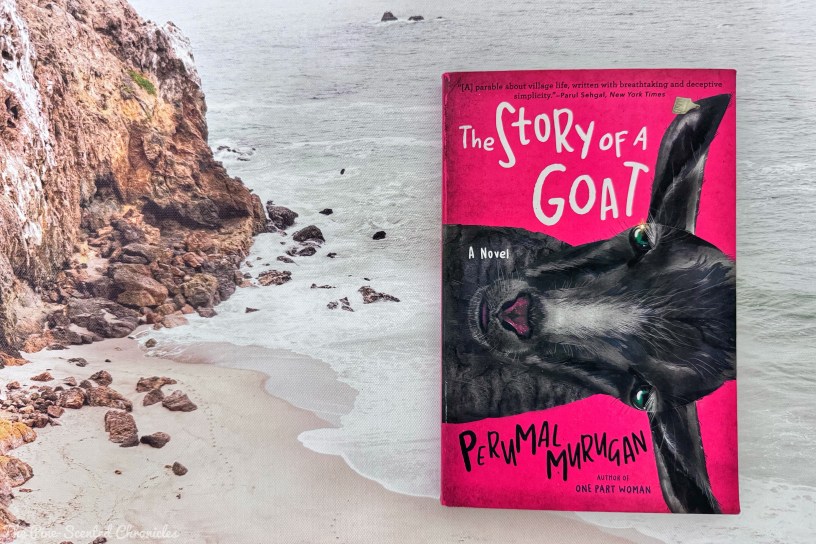
Among his novels is Pūṉācci allatu oru veḷḷāṭṭiṉ katai (The Story of a Goat). Originally published in 2017, it was made available to Anglophone readers as The Story of a Goat a year later. “Once, in a village, there was a goat. No one knew where she was born. The birth of an ordinary life never leaves a trace, does it?” Thus begins The Story of a Goat. Set in a nondescript village in the southern state of Tamil Nadu, the novel opens with an anonymous old farmer watching the sun set over the hills near his house. As darkness envelops the countryside, the quiet evening is disrupted by the arrival of a mysterious stranger. Gigantic in stature, the stranger does not appear to be an ordinary human being. Still, he offers the feeble farmer a black goat kid, the runt of the litter. The kid seems too fragile to survive. Before the old man can repay the stranger, he turns and walks away.
With no other recourse, the old man and his unnamed wife raise the goat kid, even though they initially doubt whether they will be able to care for it. It is too tiny, and the two mother goats they own refuse to feed it. It is not a promising start for the young she-goat. They name her Poonachi, hence the novel’s Tamil title. Unlike their other goats, Poonachi sleeps inside the house with the couple; the other goats sleep in the barn. The couple soon realizes that Poonachi must be registered with the local government, as regulations require newborn animals to be tagged. However, registering her presents a challenge because the process requires details about her origins. The couple waits until one of the mother goats gives birth to a small litter. The farmer’s wife then marches for miles to have Poonachi and the new litter registered.
At the government office, the old woman endures a long queue as fellow farmers arrive to register their newborn animals. When Poonachi’s turn comes, a taunting, unhelpful, and threatening official expresses skepticism, questioning whether Poonachi is truly one of the nanny goat’s offspring. Her ears are too long—ironically, it is her ears that remind the couple of the need for tagging—and her striking black color is rare among goats. This makes her stand out. Still, the couple remains unfazed in the face of scrutiny, eventually convincing the official. However, during the tagging process, he pierces her ear carelessly, causing pain and bleeding. Due to the improper ear-piercing, Poonachi falls ill, and her wound shows signs of infection. The farmer’s wife, ever maternal, remains unwavering in her dedication to nursing Poonachi back to health.
Everyone was well-versed in how they were expected to behave toward the regime. They had mouths only to keep shut, hands only to to make obeisance, knees only to bend and kneel, backs only to bend, and bodies only to shrink before the authorities.
Perumal Murugan, The Story of a Goat
Soon, the tiny creature grows stronger, largely because of the old woman’s nurturing. Not only does she treat Poonachi’s wound, but she also improves her diet. From being malnourished, Poonachi begins to grow lean and healthy. Under the old woman’s guidance, she learns how to eat various leaves and survive as a goat. In caring for Poonachi, the old woman forms an indelible bond with her. Poonachi becomes her bundle of joy, filling the emotional void left by the couple’s daughter after her marriage. When Poonachi is old enough, she joins the other goats in the grazing pastures under the farmer’s watch. There, the farmer and Poonachi develop a playful dynamic; at times, he denies her food, prompting her to obtain it through stealth.
The rural idyll, however, belies the harsh realities of countryside life. Poonachi’s frail health foreshadows the fate that awaits her. Danger lurks at every corner. Sometimes it comes from the most unexpected places, and readers become aware of the unforgiving world beyond this idyllic microcosm. The government, for instance, creates red tape that compels farmers to comply with burdensome regulations. They line up for hours to have their newborn animals tagged, yet remain uncertain about the purpose of identification. They endure hunger and heat, only to face taunting and often unhelpful officials. Those who faint are flogged and punished ruthlessly. These state-imposed sufferings add to the burden of the deprived. Ironically, officials who are meant to serve the people instead make compliance increasingly difficult, all while singing praises of the government.
The officials are quick to justify the glaringly poor conditions that farmers must endure. The novel, then, is not a simple story about a black goat. The fable subtly transforms into a potent political satire. Murugan, after all, is a prominent voice in Tamil political discourse. He does not shy away from challenging authority. As he has argued, everything is political. The government’s oppressive presence resonates in the present, as citizens across the world experience increasing state surveillance. The Story of a Goat becomes a subtle yet scathing critique of the state and its instrumentalities. The state’s ridicule of ordinary citizens is an affront to hardworking men and women who till the fields and to students required to pay fines to correct errors that were not their fault. State officials are complicit in complicating processes, demanding unnecessary requirements, and deliberately making compliance nearly impossible simply because they can.
The common man’s struggle against the state and the state’s is one of many instances of mankind’s struggle for survival explored in the novel. Survival is also a central motif in Poonachi’s life. Once nursed back to health, she becomes a source of pride and joy for the couple. She strengthens the bond between husband and wife, whose marriage had shown strain after their daughter’s departure. With Poonachi in the house, their quarrels diminish. In many ways, she lights up the household, allowing the couple to rediscover joy. This domestic story is juxtaposed with the intricacies of Indian farming life—at times idyllic, yet ultimately backbreaking.
While all the other goats in the pasture were either white or brown, her brood moved as a separate group, leaping about as though darkness itself was on the move. She loved the idea of a pasture filled with the lives she had birthed. After two or three more deliveries, the whole place would be teeming with her progeny, she thought proudly. But she also wondered whether she would be able to endure the ordeal of more delivers.
Perumal Murugan, The Story of a Goat
The idyll of domestic life, however, is repeatedly disrupted by various dangers, both natural and human-made. Early on, Poonachi’s frailty foreshadows her vulnerability. Yet through the devotion of the farmer and his wife, she survives her early trials. This underscores the transformative power of love and devotion and the resilience it inspires. The love and devotion showered by the couple were eventually repaid through the joy that Poonachi sparked in the household. As the narrative progresses, Poonachi is gradually anthropomorphized, offering readers insight into her perspective. Life, as the novel suggests, is brimming with challenges.
Beyond her frail health, danger appears in the form of a wildcat that nearly snatches and kills the young Poonachi. But this was just the icing on the cake. Ironically, Poonachi’s greatest challenges arise within her own herd. From being rejected by the mother goats when she was still a tiny kid, she was eventually ostracized by her fellow goats, mainly because of her color. What made her distinct in the eyes of the typical farmer made her an anomaly within her own group. This subtly underscores themes of prejudice and discrimination. The novel also examines caste hierarchies and societal expectations through the lens of rural life in India. Murugan vividly paints the countryside, skillfully weaving humor and poignant observations into his narrative.
Deceptively slender, The Story of a Goat is a multilayered and concise work. It tells the story of a young goat navigating the precariousness of life in rural India. As Poonachi’s journey becomes one of survival, it captures the hardships rural communities face—the oppressiveness of the state, the uncertainties of weather, and the fragility of farm life. For the weak and the deprived, these conditions are even harsher. Yet resilience persists. Discrimination and societal expectations do not hinder the pursuit of joy. The countryside thus encapsulates both beauty and brutality. In many ways, Poonachi serves as an allegory for humankind’s struggle for survival, and her story becomes a thoughtful exploration of the human condition.
They were fed up of having to protect their possessions from the rani and getting drenched whenever they stepped out. But even an enemy should be welcomed with courtesy. If we curse and drive away the rain that brings us wealth and prosperity, why should it ever visit us again?
Perumal Murugan, The Story of a Goat
Book Specs
Author: Perumal Murugan
Translator (from Tamil): N. Kalyan Raman
Publisher: Black Cat
Publishing Date: December 2019 (2016)
No. of Pages: 178
Genre: Literary
Synopsis
In his brilliant new novel, Perumal Murugan paints a bucolic portrait of the rural lives of India’s farming community through the story of a helpless young animal. A farmer in Tamil Nadu, South India, is watching the sun set over his village one evening when a giant man appears on the horizon. He offers the farmer a goat kid who is the runt of the litter, surely too frail to survive. The farmer and his wife take care of the young she-goat, whom they name Poonachi, and soon the little goat is gaining strength and even bounding with joy. But Poonachi’s life is not destined to be a rural idyll – dangers lurk around every corner, and sometimes come from surprising places, including a government that is supposed to protect the weak. A beautiful portrait of the natural world that also examines hierarchies of caste and color, The Story of a Goat is a lyrical fable from a world-class storyteller.
About the Author
Perumal Murugan was born on October 15, 1966, into a family of farmers near the temple city of Tiruchengode, India. His family belongs to the Gounder community, the largest agrarian caste in the Kongu Nadu region. As his father was not able to feed the family by agricultural labor alone, Murugan worked as a soda-seller in a local cinema. As a young boy, Murugan developed an interest in literature. He wrote several children’s songs, some of which were broadcast on an All India Radio children’s show in Trichy. Murugan then studied Tamil literature in Erode and as a postgraduate in Coimbatore. He went on to obtain an M.Phil. degree from Madras University in Tamil studies, followed by a Ph.D, with his doctoral thesis focusing on the works of author R. Shanmugasundaram.
While studying in Chennai, Murugan came into contact with Makkal Kalachara Kazhagam (Ma Ka Ka), a splinter group of the Communist Party of India. It was while studying Marxist texts that Murugan decided to write works of fiction. He began his storied literary career by publishing several short stories in the Tamil journal Manavosai between 1988 and 1991. These short stories were eventually published as a collective in a book titled Thiruchengodu (1994). In 1991, he published his first novel, Eru Veyyil (Rising Heat). His second novel, Nizhal Mutram (Current Show), was published in 1993. His international breakthrough came with the publication of Madhurobhagan in 2010. It was translated into English as One Part Woman. It was longlisted for the inaugural National Book Award for Translated Literature, and won the prestigious Indian Languages Festival Samanvay Bhasha Samman for writing in Indian languages and the Translation Prize from India’s National Academy of Letters.
His 2013 novel Pūkkuḻi was translated into English in 2016. In 2023, it was longlisted for the International Booker Prize. This makes it the first novel originally written in Tamil to be nominated for the prestigious prize. The novel was also longlisted for the DSC Prize for South Asian Literature 2017. His most recent novel, Neduneram, was published in 2022. Murugan also published collections of short stories and poetry. Apart from writing, Murugan also taught as a professor of Tamil at the Government Arts College in Namakkal. He was forced to leave Namakkal following assaults and protests by right-wing Hindu and caste groups. He was also Head of the department of Tamil literature at a government college in Attur, Tamil Nadu, and briefly taught at the Presidency College in Chennai.
 The Pine-Scented Chronicles