
First Impression Friday will be a meme where you talk about a book that you JUST STARTED! Maybe you’re only a chapter or two in, maybe a little farther. Based on this sampling of your current read, give a few impressions and predict what you’ll think by the end.
Synopsis:
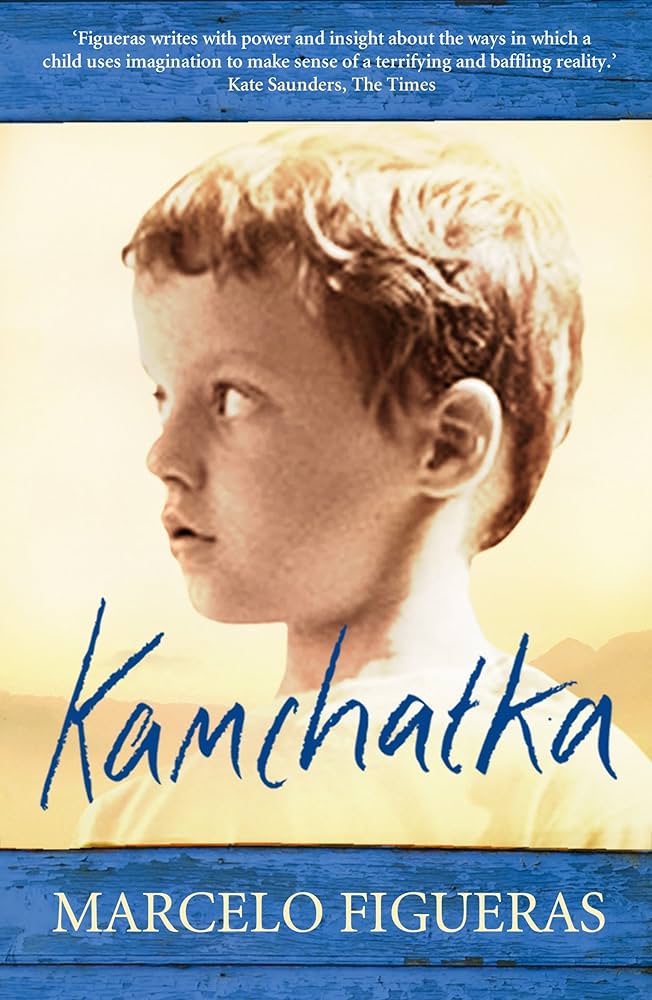
In the forecourt of a petrol station outside of Buenos Aires, a father says goodbye to his son: ‘Kamchatka,’ he whispers softly into his ear. And then they part, forever.
Ten-year-old Harry lives in a world of Superman comics and games of Risk – a world in which men have superpowers and boys can conquer the globe on a board game. But in the outside world, a military junta has taken power; and amid a political climate of fear and intimidation, people are disappearing without trace.
Kamchatka is a heartbreaking novel: set in Argentina during the bloody coup d’état of 1976, it tells the enchanting story of a young boy trying to make sense of a world during a time of extraordinary upheaval.
It’s the end of the workweek—yay! I hope the week has been kind to everyone and that you’re all ending it on a high note. Just like that, we are nearly through the second month of the year—the so-called love month. How time flies! March is just around the corner. At times, it feels like nothing of consequence has happened; yet at the same time, it also feels like a lot has happened, even though it is only the second month of the year. Nevertheless, I hope the year is providing everyone with plenty of opportunities to grow and improve.
With the weekend looming, I hope everyone has a great one and ends the workweek on a high note. It is now time to dress down and wear more comfortable clothes. I hope you spend the weekend wisely—whether by resting from the rigors of a demanding career, pursuing your passions, completing household chores, spending time with loved ones, or simply relaxing. I hope you’re all doing well—physically, mentally, and emotionally.
The month drawing to a close also means that things are about to get hectic once again. There are still many things I need to do at work, from improving current processes to correcting errors from previous years. It seems that at every turn, I keep opening a Pandora’s box. On the brighter side, I have regained my “accounting” groove. I am still a little overwhelmed, and it is a tall order, but I know I can do it. I just have to take it one step at a time, and before long, things will be whipped into shape. With February about to come to a close, I am also wrapping up my literary journey across Latin American and Caribbean literature. Toward the end of 2025, I realized it had been some time since I dedicated a full month to this region—the last time was toward the end of 2023. I am slowly concluding this literary venture by reading the remaining works of Latin American literature on my bookshelf. One of the last titles that grabbed my attention is Marcelo Figueras’s Kamchatka, my current read.
Before 2024, I had never encountered Figueras, nor had I read any of his works. It was during a random trip to the bookstore that I came across him. I didn’t even know he was Argentine. However, when I learned that he was, I decided to include the novel in my ongoing exploration of Latin American literature. Besides, my foray into the works of Argentine writers is limited. Honestly, the first thing that comes to mind when Kamchatka is mentioned is the frozen Russian peninsula. That is why I was surprised that the novel was written by a Latin American author. Apparently, the novel’s title was inspired by the game Risk, a strategic board game of diplomacy, conflict, and global conquest. Often played by two to six players, the goal is global domination by controlling all 42 territories across six continents. Among the territories in the game is Kamchatka.
At the heart of Kamchatka is an unnamed ten-year-old boy, who is also the novel’s primary narrator. At the start of the novel, he recounts how he and his younger brother, whom he affectionately refers to as “the Midget,” were abruptly pulled out of school by their mother. She tells her sons that they are going on holiday. However, it is no ordinary holiday—they are headed to a safe house. The boys are also told to choose names for themselves. After finding a book about Harry Houdini on top of a cupboard, the narrator decides to call himself Harry. This also leads him to dream of becoming an escape artist. Meanwhile, Midget chooses the name Simon. Interestingly, Harry and his father play Risk during their days of “holiday,” which they spend in a rented quinta. This chain of events naturally raises the question of why they are in hiding, which brings us to the story’s setting.
The novel is set in 1970s Buenos Aires. In Argentina, it was a time of pivotal political and social upheaval—it was when the Dirty War (Guerra sucia) began. The term refers to the period of state-sponsored violence under the civic-military dictatorship, or military junta. During this time, military and security forces, reinforced by death squads such as the Argentine Anticommunist Alliance (AAA, or Triple A), hunted down anyone suspected of being a political dissident. Anyone believed to be associated with socialism, communism, left-wing Peronism, or the Montoneros movement was persecuted. It is no wonder that Perón is often mentioned. Harry’s parents, who were upper-middle-class professionals—he was a human rights lawyer, while she was a scientist—were left-leaning and opposed to the regime. Both of Harry’s parents lost their jobs, prompting them to take their sons into hiding at a safe house in suburban Buenos Aires. Interestingly, their political activities are never fully explained.
The rest of the story chronicles their lives as they try to evade the encroaching regime. Apart from spending their days playing Risk, we see Midget and Harry doing normal childhood things—playing and fooling around. One event that leaves an impression on them occurs while they are playing in an adjacent swimming pool, where they see a dead toad floating. They then try to devise a way for the toad to escape. Of course, it is an impossible task. However, it serves as a reminder that hope springs eternal. In the case of Harry and his family—and by extension, the entire nation—they are forced into a position where they can only rely on hope. I have a feeling this is how the story will continue to unfold. Still, I am curious about the fate of Harry’s parents—a mystery I believe will reveal itself as the narrative progresses.
I was not expecting to be this invested in Harry’s story. However, the premise, complemented by the quality of Figueras’s writing, has kept me hooked. I hope he does not lose momentum. I am looking forward to seeing how the story unfolds. How about you, fellow reader? What are you reading this weekend? I hope you’re enjoying your current book. Happy weekend!
 The Pine-Scented Chronicles