
Goodreads Monday is a weekly meme started by @Lauren’s Page Turners but is currently hosted by Emily @ Budget Tales Book Blog. This meme is quite easy to follow – just randomly pick a book from your to-be-read list and explain why you want to read it. It is that simple.
This week’s book:
The Piano Teacher by Elfriede Jelinek
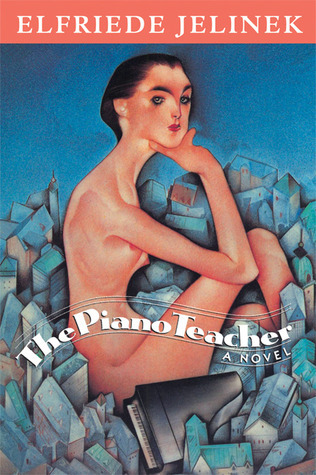
Blurb from Goodreads
The Piano Teacher, the most famous novel of Elfriede Jelinek, who was awarded the 2004 Nobel Prize in Literature, is a shocking, searing, aching portrait of a woman bound between a repressive society and her darkest desires.
Erika Kohut is a piano teacher at the prestigious and formal Vienna Conservatory, who still lives with her domineering and possessive mother. Her life appears to be a seamless tissue of boredom, but Erika, a quiet thirty-eight-year-old, secretly visits Turkish peep shows at night to watch live sex shows and sadomasochistic films. Meanwhile, a handsome, self-absorbed, seventeen-year-old student has become enamored with Erika and sets out to seduce her. She resists him at first, but then the dark passions roiling under the piano teacher’s subdued exterior explode in a release of sexual perversity, suppressed violence, and human degradation.
Celebrated throughout Europe for the intensity and frankness of her writings and awarded the Heinrich Böll Prize for her outstanding contribution to German letters, Elfriede Jelinek is one of the most original and controversial writers in the world today. The Piano Teacher was made into a film, released in the United States in 2001, was awarded the Grand Jury Prize at Cannes.
Why I Want To Read It
Happy Monday, everyone! Just like that, we are already in the second workweek of the third month of 2026. Woah—how time flies! As always, time takes its natural course, ever flowing forward, sans regard for any of us. It does not wait for anyone. As such, I hope the year is going—and will continue to go—well for everyone. I hope the year will curry favor with you all. Things are starting to look up at work. I have just survived another tedious month-end closing, although I still have quite a lot to do post-closing. I am also thankful that things are beginning to settle into a more normal rhythm. There are still challenges before me, but hey, I do enjoy challenges—well, at least from time to time. Anyway, I hope everyone has had a good start to the workweek and the year. The new week brims with hope and fresh starts. I hope it flows in everyone’s favor. Wishing you continued success and happiness.
I know—not many people get excited about Mondays (though I’m sure a few are out there). I, too, am not exactly a fan. I hope that as the week moves forward, you slowly gain a semblance of momentum. After all, we’ve got to start somewhere, and Monday is one of those starting points. More importantly, I hope everyone is doing well—mentally, emotionally, and physically. With the new month, I have commenced a new literary journey. From Latin America and the Caribbean, I have traveled across the Atlantic to Europe to immerse myself in the works of European writers. It took me some time to decide where to land next, but in the end, I chose to read European writers, since most of the books on my 2026 reading challenge list are by European authors. I am currently reading Polish Nobel Laureate in Literature Władysław Reymont’s The Peasants. It is quite a hefty book, but I am nearly done with it.
For this weekly bookish meme, I am featuring works by European writers I am looking forward to reading. This is in line with this month’s main motif. Further, I will be highlighting works by female European writers. March is Women’s History Month, while March 8 is International Women’s Day. After featuring Spanish author Rosa Montero last week, I am featuring an Austrian writer, Elfriede Jelinek. Had it not been for the Nobel Prize in Literature, I might not have come across the 2004 awardee. She was awarded by the Swedish Academy for her musical flow of voices and counter-voices in novels and plays that, with extraordinary linguistic zeal, reveal the absurdity of society’s clichés and their subjugating power. Apparently, her most renowned work is The Piano Teacher. I guess it is quite a direct reference to the Swedish Academy’s citation. I have to admit, my foray into Austrian literature is rather limited.
Originally published in 1983 in German as Die Klavierspielerin, The Piano Teacher was Jelinek’s first novel to be translated into English. The titular piano teacher is Erika Kohut, a piano teacher in her late thirties who teaches at the Vienna Conservatory. Despite her age, she lives with her controlling mother. However, there is apparently more to the story than this. Based on the premise alone, I can surmise that there are sexual undertones to the story. The premise is interesting, as it promises to be an exploration of female liberation—at least that is how I see the story. For now, my goal is to secure a copy of the book. With very few female Nobel Laureates in Literature to date, I think it is imperative to explore the work of those who have already been recognized by the Swedish Academy. Well, that is how I see it, although I am crossing my fingers that they will award more female writers in the future.
How about you, fellow readers? How was your Monday? What books have you recently added to your reading list? Drop your thoughts in the comments. For now—happy Monday, and as always, happy reading!
 The Pine-Scented Chronicles
I can’t believe that it is another new week!
This book sounds interesting. Quite a lot going on.
Have a great week!
Emily @ Budget Tales Book Blog
My post:
LikeLike