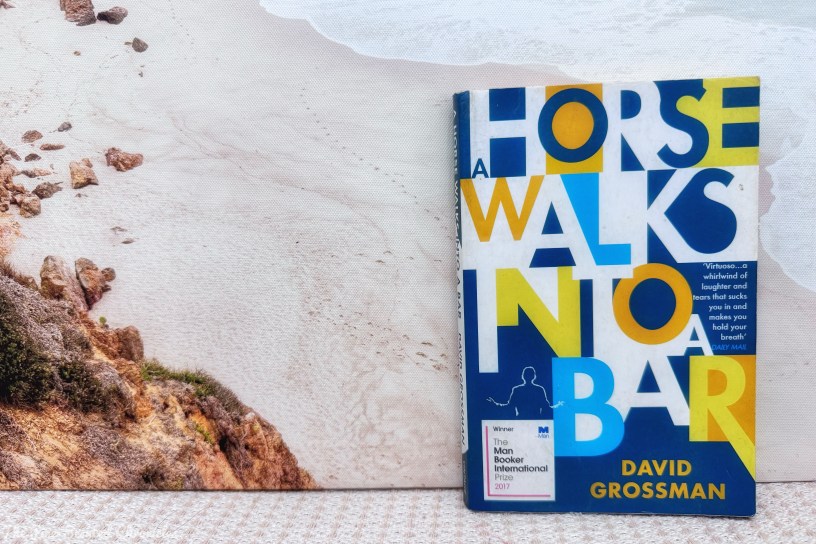
Dismantling the Self
In the ambit of contemporary Hebrew literature, David Grossman (דויד גרוסמן) stands tall among its pillars. Like many writers, he had to work his way up to the zenith of literary excellence. He was born on January 25, 1954, in Jerusalem to a poor family. His father, Yitzhak, was an immigrant from Dynów in Poland who arrived in Jerusalem with his widowed mother at the age of nine. Meanwhile, the family of his mother, Michaella, was Labor Zionist. Grossman’s grandparents had to toil hard to survive. Their humble origins, however, did not preclude his parents from cultivating their son’s interest in literature. After working as a bus driver, Grossman’s father later became a librarian; his mother, meanwhile, worked as a maid in wealthy neighborhoods. His father would bring home literature for his son to read, including the stories of Sholem Aleichem. By the age of nine, Grossman had already won a national competition on knowledge of Sholem Aleichem—an achievement that helped foster his early passion for storytelling.
When he was ten, Grossman began working in the media industry as a correspondent for youth broadcasts on Israel Radio. He would continue working for the Israel Broadcasting Authority for nearly twenty-five years. Later, he studied philosophy and theater at the Hebrew University of Jerusalem. In 1971, Grossman served in the Israeli Defense Forces (IDF) military intelligence corps and was still in the army when the Yom Kippur War broke out in 1973. Fortunately, he saw no combat. After completing his service, he returned to his literary pursuits. With his passion for literature already cultivated at a young age, he began writing in his early twenties. His literary career officially commenced with the publication of דו קרב (Du-krav) in 1982. His breakthrough, however, came with חיוך הגדי (Hiyukh ha-gedi), published a year later. Eventually translated into English as The Smile of the Lamb, the novel received the Prime Minister’s Prize for Literature and was later adapted into a film.
As the old adage goes, there was nowhere to go but up. The success of The Smile of the Lamb set the tone for what would become one of the most decorated literary careers in modern Hebrew literature. Over the decades, Grossman crafted a remarkable body of work marked by numerous memorable books. Both his individual works and his overall literary output have earned him accolades around the world. In 2018, he received the Israel Prize (פרס ישראל) in literature, a distinction he shares with Nobel Laureate Shmuel Yosef Agnon. Speaking of one of the most prestigious literary prizes in the world, Grossman is often mentioned in perennial discussions surrounding the Nobel Prize in Literature. While his sophisticated oeuvre includes children’s books, young adult fiction, and nonfiction, Grossman is perhaps best known for his full-length prose works. Among these novels is A Horse Walks Into a Bar.
The radiance of personality, I thought. The inner glow. Or the inner darkness. The secret, the tremble of singularity. Everything that lies beyond the words that describe a person, beyond the things that happened to him and the things that went wrong and became warped in him. The same thing that years ago, when I was just starting out as a judge, I naively swore to look for in every person who stood before me, whether defendant or witness. The thing I swore I would never be indifferent to, which would be the point of departure for my judgment.
David Grossman, A Horse Walks Into a Bar
Originally published in Hebrew as סוס אחד נכנס לבר (Sus Echad Nechnas LeBar), A Horse Walks Into a Bar unfolds over the course of a single night. Into the titular, somewhat obscure bar in the Israeli coastal town of Netanya walks Avishai Lazar, the novel’s narrator and witness. Nearly sixty years old, Avishai is a retired district judge who has been invited by his childhood friend to attend his comedy performance. This friend, Dovaleh Greenstein, stands at the center of the novel. Dov— as he is affectionately called— is a stand-up comedian. Interestingly, Dov and Avishai have not been in contact for many years. In fact, the last time they saw each other was when they were both fourteen. How, then, does one bridge the vast gap created by time? The invitation to witness the comedic performance is both unexpected and welcome. When the judge walks into the bar that night, everyone expects laughter and amusement from the evening’s routine.
However, both the audience and Avishai are in for a surprise. The novel— and thus the “comedic” performance— begins with Dov walking onto the stage and cheekily greeting his audience as Caesarea, a neighboring city to Netanya. His act gradually gathers momentum. Like most stand-up routines, he begins by establishing rapport with the audience. He offers a run-down of their outfits and even assigns them monikers based on prominent body parts. His opening routine is initially met with laughter and applause. Yet as the night deepens, the lighthearted jokes and playful banter gradually give way to more scathing remarks. Dov continues his routine by hurling increasingly abrasive insults and jokes that oscillate between humor and hostility. The comedic atmosphere that once filled the bar slowly shifts toward tense discomfort. The jokes grow worse, and Dov refuses to cater to his audience. Relentless in his insults, he no longer seeks to amuse them. The once lighthearted atmosphere gradually turns hostile, as members of the audience begin responding to his thinly veiled antagonism.
Tensions escalate, with Avishai also drawn into the unfolding spectacle. As the narrative progresses, Dov’s motivations slowly begin to surface. As the jokes become less amusing and more offensive and vulgar, they also grow increasingly personal. At this point, Dov abandons his entire routine and embarks on an unexpected trajectory. What began as comedy begins to resemble tragedy. As is often the case, the answers lie in the past. Dov takes the audience back to his youth, particularly to the time when he first met Avishai. Dov was a lonely boy with a troubled childhood. He was physically abused by his father, while his mother— haunted by her own memories of the Holocaust— remained largely passive. While attending an after-school math tutoring class, he crossed paths with an equally lonely and friendless Avishai. The meeting proved serendipitous, as the two boys soon found companionship in each other, forming a bond that seemed to transcend their personal struggles.
As a teenager, Avishai was stern and reserved. Yet Dov managed to make inroads, loosening him through stories about his family. It did not take long before Avishai began opening up. Eventually, the two friends joined a quasi-military youth training camp where they were taught various drills, including escape exercises meant to prepare them for potential national emergencies. Living in a nation surrounded by hostile neighbors, such training was not uncommon. Israel has long existed in a state of geopolitical tension. Yet the training camp marked a turning point in the boys’ friendship. It was there that their relationship began to unravel. Dov became the target of bullying. Rather than defend his friend, Avishai distanced himself, turning a blind eye to the harassment his awkward and vulnerable companion endured. To him, Dov had become invisible—perhaps because acknowledging him might have made Avishai the next target. He understood that if Dov were not bullied, he himself might be.
He takes his glasses off and glances at me. I believe he is reminding me of his request: that thing that comes out of a person without his control. That’s what he wanted me to tell him. It cannot be put into words, I realize, and that must be the point of it. And he asks with his eyes: but still, do you think everyone knows it? And I nod: Yes. And he persists: And the person himself, does he know what this one and only thing of his is? And I think: Yes. Yes, deep in his heart he knows.
David Grossman, A Horse Walks Into a Bar
What initially begins as a stand-up routine gradually transforms into something darker and more unsettling. The audience is not immediately aware of the deeper narrative unfolding before them, as mediocre jokes slowly give way to self-deprecating humor rooted in painful memories. As nostalgia overtakes him, the past resurfaces with persistent force. His reunion with his old friend awakens resentments long buried beneath the passage of time. Time, it is often said, heals all wounds. Yet Dov’s story suggests otherwise. For the young Dov, Avishai’s failure to defend him during a moment of profound vulnerability felt like a betrayal. It was particularly devastating because Dov was already on the brink of an existential crisis, with no one else to rely on. The bitter residue of his friend’s abandonment remained with him, a burden he carried into adulthood.
As members of the audience begin walking out in anger, Dov recounts how these past traumas have shaped the course of his life. While he continues roasting the audience, he is simultaneously peeling away layers of his own identity. Stripped of pretense, he reveals intimate details about his life—such as being the father of five children. “I swear to God,” he jokes, “standing before you tonight is the first man in history to get postpartum depression. Five times!” Ironically, he is estranged from all of them. He also reveals that he has recently been diagnosed with prostate cancer. To his childhood friend and the increasingly bewildered audience, such disclosures seem excessive and unsettling. Yet the narrative continues to move forward, blurring the boundary between past and present. Under Grossman’s astute guidance, the comedic stage becomes a crucible through which the enduring power of memory is examined. As humor intertwines with personal confession, one is compelled to ask: where does comedy end and tragedy begin?
As self-deprecating as Dov’s brand of comedy may be, his story offers a vivid exploration of the mechanisms people use to cope with suffering. For Dov, that mechanism is comedy. After all, laughter offers fleeting respite from life’s deeper horrors. Humor becomes a balm capable of masking profound pain. It is one of the many masks he wears to conceal the trauma of his childhood and the betrayal he once experienced. Grossman skillfully uses humor as a literary device to explore profound themes of loss, identity, trauma, betrayal, and the fragile complexities of friendship. By weaving together the present-day performance with flashbacks from Dov’s past, Grossman crafts a narrative filled with mounting tension that reverberates throughout the novel.
Yet while Dov’s story dominates the narrative, Avishai is also given space to reflect. Ironically, he was initially reluctant to accept his friend’s invitation. Dov invited him because he wanted his friend to “see me—really see me.” The remark serves as a poignant allusion to the moment in their youth when Dov was treated as invisible by the very person he trusted most. Dov wants Avishai to bear witness to his performance and ultimately tell him what he saw. Several times during the routine, Avishai feels tempted to leave, just like the other members of the audience. Yet the performance compels him to reflect not only on his own life but also on his past relationship with Dov. He begins to confront the reasons he failed to defend his friend from the bullies. As the night progresses, he gradually acknowledges his moral failure. This realization underscores the weight of their shared history. His introspection captures the burden of his silence and his complicity.
It starts with an awkward hum, with sidelong glances, then something makes their necks swell, and within a second they’re up in the air, balloons of idiocy and liberty, released from gravity, rushing to join the one and only camp that can never be defeated: Hands together for death!
David Grossman, A Horse Walks Into a Bar
The confessions of both Avishai and Dov gradually prepare the ground for a cathartic conclusion. In a surprising turn, the raw honesty of Dov’s revelations begins to evoke sympathy from some members of the audience. It serves as a quiet reminder of the power of human connection. In their youth, the friendship between Dov and Avishai had provided a brief refuge from their individual struggles, allowing them to experience moments of ordinary adolescence. In the present, a few members of the audience manage to see beyond the veneer of self-deprecating humor. They recognize in Dov’s story echoes of their own grief, vulnerability, and search for identity. In many ways, what appears to be Dov’s swan song—though emotionally exhausting—becomes an act of healing and self-acceptance. By confronting their past and the choices they once made, Dov and Avishai slowly begin freeing themselves from its lingering grip. Their personal story also unfolds against the backdrop of Israel’s complex social and political landscape. Dov’s performance includes digressions that reference the Israeli-Palestinian conflict and even the lingering shadows of the Holocaust.
Beyond themes of nostalgia, memory, and guilt, the novel also celebrates the transformative power of art and storytelling. It illustrates the intimate relationship between artistic expression and human experience. Grossman vividly portrays the delicate craft of a comedian who simultaneously commands and manipulates the emotional currents of an audience. Yet comedy also becomes a tool for confronting personal history and reflecting upon one’s life. The intricate relationship between art and suffering is explored with remarkable sensitivity, challenging readers to reconsider their understanding of vulnerability. The audience’s role as spectators reinforces this tension, as Grossman creates an atmosphere of intimacy permeated by unease. All the novel’s elements are intricately woven together into a rich narrative tapestry. Grossman’s prose captures subtle emotional shifts and the delicate interplay between the absurd and the painful, resulting in a story that is both heartbreaking and tender.
Winner of the 2017 International Booker Prize, A Horse Walks Into a Bar is an evocative portrait of a man at odds with himself. Dovaleh Greenstein has endured profound personal struggles. Haunted by a traumatic childhood and by the silence of the only friend he believed he could rely upon, he confronts memories that have long defined him. His final performance becomes a dismantling of the self—a painful excavation of memory that ultimately leads to catharsis. His journey toward self-understanding culminates in a moment of fragile clarity and acceptance. Dov’s story is saturated with loss and suffering while also raising difficult questions about the responsibilities we bear in one another’s lives. Yet it is also a story of resilience amid the storms that have shaped him. Through comedy, Grossman deftly explores the intricate relationship between art and human suffering. A Horse Walks Into a Bar ultimately stands as a powerful meditation on the human condition—and on the many masks, including humor, that we wear to survive our deepest pain.
A man walks into a bar and says, ‘Give me a whiskey, quick, before it starts!’ The bartender pours him a drink, and the man downs it in one gulp. ‘Quick, another one!’ he demands. The bartender complies, and the man gulps it down again. ‘Hurry, one more!’ he insists. The bartender, puzzled, asks, ‘When is this ‘it’ supposed to start?’ The man replies, ‘Any second now, when my wife walks in and sees the tab!’
David Grossman, A Horse Walks Into a Bar
Book Specs
Author: David Grossman
Translator (from Hebrew): Jessica Cohen
Publisher: Vintage
Publishing Date: 2017
No. of Pages: 198
Genre: Literary
Synopsis
A comedy club in a small Israeli town. An audience has come expecting an evening of amusement. Instead they see a comedian falling apart on stage; an act of disintegration, a man crumbling, as a matter of choice, before their eyes. Dovaleh G, a veteran stand-up comic, charming, erratic, repellent – exposes a wound he has been living with for years: a fateful and gruesome choice he had to make between the two people who were dearest to him.
Flaying alive both himself and the people watching him, Dov provokes revulsion and empathy from an audience that doesn’t know whether to laugh or cry – and all this in the presence of a former childhood friend who is trying to understand why he’s been summoned to this performance.
About the Author
David Grossman (דויד גרוסמן) was born on January 25, 1954, in Jerusalem. He was the elder of two brothers, born to Michaella and Yitzhak. Both of his parents were children of immigrants. His mother was born to a poor Labor Zionist family, and her mother immigrated from Poland after experiencing police harassment. His father emigrated from Dynów to Jerusalem at the age of nine with his widowed mother. Grossman was raised in a humble household. His father initially worked as a bus driver before later becoming a librarian. This proved important during Grossman’s formative years, as his father often brought home books for his son to read, including the stories of Sholem Aleichem. At the age of nine, Grossman won a national competition on knowledge of Sholem Aleichem’s works. When he was ten, he began working in the media industry as a correspondent for youth broadcasts on Israel Radio. He would continue working for the Israel Broadcasting Authority for nearly twenty-five years.
Grossman later studied philosophy and theater at the Hebrew University of Jerusalem. In 1971, he served in the military intelligence corps of the Israel Defense Forces and was still in the army when the Yom Kippur War broke out in 1973, though he saw no combat. After completing his military service, he began taking his writing more seriously. In 1982, Grossman published his debut novel, דו קרב (Du-krav). His breakthrough came a year later with his second novel, חיוך הגדי (Hiyukh ha-gedi), later translated into English as The Smile of the Lamb. The novel received the Prime Minister’s Prize for Literature and was later adapted into a film. The success of The Smile of the Lamb helped establish Grossman as one of the most important voices in modern Hebrew literature.
His other major works include עיין ערך: אהבה (Ayen erekh—ahavah, 1986; translated as See Under: Love), ספר הדקדוק הפנימי (Sefer ha-dikduk ha-penimi, 1991; The Book of Intimate Grammar), and סוס אחד נכנס לבר (Sus Echad Nechnas LeBar, 2014; translated as A Horse Walks Into a Bar). His more recent novel, אתי החיים משחק הרבה (Iti ha-chaim mesachek harbeh, 2019), was translated into English as More Than I Love My Life. In addition to his novels, Grossman has also written children’s literature and nonfiction. For both his individual works and his broader literary contribution, Grossman has received numerous accolades in Israel and around the world. These include the 1984 Prime Minister’s Prize for Hebrew Literary Works, the 1985 Bernstein Prize, the 1991 Nelly Sachs Prize, the 2004 Bialik Prize for literature, and the 2007 Ischia International Journalism Award. In 2017, A Horse Walks Into a Bar received the International Booker Prize. The following year, Grossman was awarded the Israel Prize in literature, a distinction he shares with Nobel laureate Shmuel Yosef Agnon.
Grossman currently resides in Mevaseret Zion on the outskirts of Jerusalem.
 The Pine-Scented Chronicles