Hello, readers! It is Monday again! As it is Monday, welcome to another #5OnMyTBR update. The rule is relatively simple. I must pick five books from my to-be-read piles that fit the week’s theme.
This week, I am featuring works by Latin American female writers. This is in commemoration of Women’s History Month and International Women’s Day, celebrated every March 8. Here are some works by North American women writers on my ever-growing reading list.

5OnMyTBR is a bookish meme hosted by E. @ Local Bee Hunter’s Nook where you choose five books from your to-be-read pile that fit that week’s theme. If you’d like more info, head over to the announcement post!
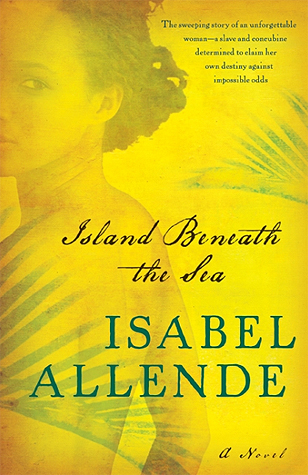
Title: Island Beneath the Sea
Author: Isabel Allende
Translator (from Spanish): Margaret Sayers Peden
Publisher: Harper
Publishing Date: 2010
No. of Pages: 457
Synopsis:
Born on the island of Saint-Dominigue, Zarité – known as Tété – is the daughter of an African mother she never knew and one of the white sailors who brought her into bondage. Though her childhood is one of brutality and fear, Tété finds solace in the traditional rhythms of African drums and voodoo loa she discovers through her fellow slaves.
When twenty-year-old Toulouse Vamorain arrives on the island in 1770, it’s with powdered wigs in his trunks and dreams of financial success in his mind. But running his father’s plantation, Saint Lazare, is neither glamorous nor easy. Although Valmorain purchases young Tété for his bride, it is he who will become dependent on the services of his teenaged slave.
Against the merciless backdrop of sugarcane fields, the lives of Tété and Valmorain grow ever more intertwined. When the bloody revolution of Toussaint Louverture arrives at the gates of Saint Lazare, they flee the brutal conditions of the French colony, soon to become Haiti, for the raucous, free-wheeling enterprise of New Orleans. There Tété finally forges a new life, but her connection to Valmorain is deeper than anyone knows and not easily severed. With an impressive richness of detail, and a narrative wit and brio second to none, Allende crafts the riveting story of one woman’s determination to find love amid loss, to offer humanity though her own has been so battered, and to forge a new identity in the cruelest circumstances.

Title: Undiscovered
Author: Gabriela Wiener
Translator (from Spanish): Julia Sanches
Publisher: HarperVia
Publishing Date: 2023 (2022)
No. of Pages: 183
Synopsis:
Alone in a museum in Paris, Gabriela Wiener confronts her complicated family heritage. She is visiting an exhibition of pre-Columbian artifacts, spoils of European colonialism, many stolen from her homeland of Peru. As she peers at countless sculptures of Indigenous faces, each resembling her own, she sees herself in them – but the man responsible for pillaging them was her own great-great-grandfather, Austrian colonial explorer Charles Wiener.
In the wake of her father’s death, Gabriela returns to Peru. In alternating strands, she begins to probe her father’s infidelity, her own polyamorous relationship, and the history of her colonial ancestor, unpacking the legacy that is her birthright. From the eyepatched persona her father adopted to carry out his double life to the brutal racism she encounters in her ancestor Charles’s book, she traces a cycle of abandonment, jealousy, and fraud, in turn of reframing her own personal struggles with desire, love, and race.
Probing wounds both personal and historical, Wiener’s provocative novel embarks the reader on a quest to pick up the pieces of something shattered long ago in the hope of making it whole once again.

Title: A Small Place
Author: Jamaica Kincaid
Publisher: Farrar, Straus and Giroux
Publishing Date: 2000 (1988)
No. of Pages: 81
Synopsis:
Lyrical, sardonic, and forthright, A Small Place magnifies our vision of one small place with Swiftian wit and precision. Jamaica Kincaid’s expansive essay candidly appraises the ten-by-twelve mile island in the British West Indies where she grew up, and makes palpable the impact of European colonization and tourism. The book is a missive to the traveler, whether American or European, who wants to escape the banality and corruption of some large place. Kincaid, eloquent and resolute, reminds us that the Antiguan people, formerly British subjects, are unable to escape the same drawbacks of their own tiny realm – that behind the benevolent Caribbean scenery are human lives, always complex and often fraught with injustice.
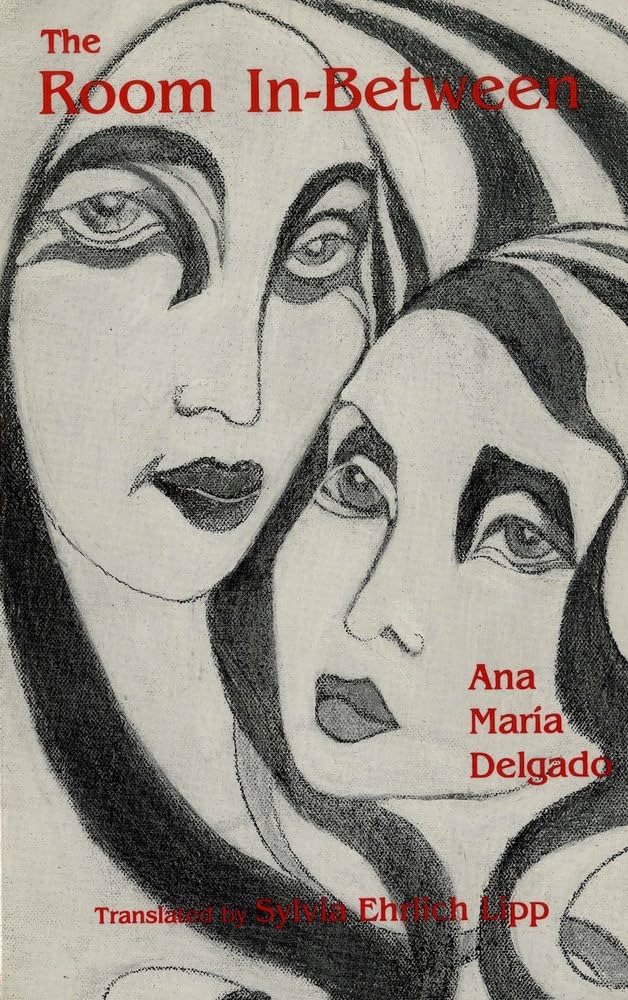
Title: The Room In-Between
Author: Ana Maria Delgado
Translator (From Spanish): Sylvia Ehrlich Lipp
Publisher: Latin American Literary Review Press
Publishing Date: 1995 (2021)
No. of Pages: 91
Synopsis:
Mariana, a woman haunted by memories of an unhappy childhood and fear of abandonment, travels to her dying mother’s beside. In a series of interior monologues, directed toward herself and her mother, she confronts the vents and decisions which have shaped her adult life. Mariana learns to break through her bitterness, eventually understanding and forgiving her mother, husband, and children.
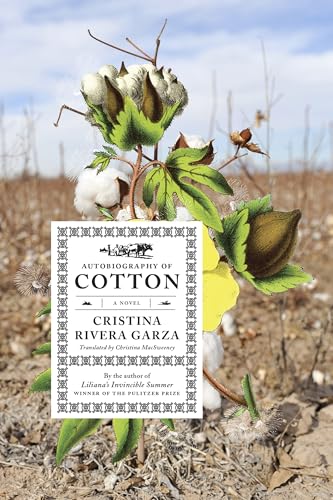
Title: Autobiography of Cotton
Author: Cristina Rivera Garza
Synopsis:
In 1934, a young José Revueltas traveled to Tamaulipas to support the cotton workers’ strike in Estación Camarón, which became the basis of his landmark novel Human Mourning. In her own groundbreaking novel, Autobiography of Cotton, Cristina Rivera Garza recounts her grandparents’ journey from mining towns to those same cotton fields as it intersects with Revueltas’s life in a vivid and evocative history of cotton cultivation along the Mexico-US border.
Through archival research and personal narrative, Rivera Garza chronicles the way cotton transformed the borderlands by reconstructing the cotton workers’ strike and reveals how cycles of deprivation and ecocide persist across generations. Deeply personal and politically acute, Rivera Garza crafts a new kind of border novel that tells how a brittle land radically altered her grandparents’ lives and the territories they helped develop. An intimate fictionalization, Autobiography of Cotton reveals a rich social history of agricultural colonization, labor activism, environmental degradation, and cross-border migration. (Source: Goodreads)

Title: Electric Shamans at the Festival of the Sun
Author: Mónica Ojeda
Synopsis:
The ear is the organ of fear. It is a door to that which is not of this world.
Leaving behind the dread and decay of the city, Noa and her best friend, Nicole, travel up into the Andes, headed for Solar Noise: an eight-day festival that takes place in the infinite expanse of the páramo. Nestled on the side of a volcano, it is a world of mysticism, shamanism and underground music, a world in tune with the thunder of the earth and the bellows of the mountains, a world in which the belief systems of Ecuador’s indigenous communities live on.
Noa also harbours a secret motive for attending the festival: she’s been drawn there in search of her father, who abandoned her as a child, and who now lives somewhere near the festival site. But soon after their arrival, she becomes prone to somnambulism and begins speaking in a voice that is not her own. Uncertain of whether Noa is in danger or is communing with something primal and eternal, Nicole struggles to care for her friend. Until, as the party spills into Inti Raymi – the Incan festival of the sun – the girls’ desire for belonging burns, incandescent, collapsing the thin membrane separating life from death, trauma from transcendence, and ecstasy from oblivion.
Wild and incantatory, Electric Shamans at the Festival of the Sun is both an hallucinogenic trip of a novel, and a heartfelt meditation on love, family and kinship – one that announces the arrival of a major writer. (Source: Goodreads)

Title: The Chandelier
Author: Clarice Lispector
Synopsis:
Fresh from the enormous success of her debut novel Near to the Wild Heart, Hurricane Clarice let loose something stormier with The Chandelier. In a body of work renowned for its potent idiosyncratic genius, The Chandelier in many ways has pride of place. “It stands out,” her biographer Benjamin Moser noted, “in a strange and difficult body of work, as perhaps her strangest and most difficult book.” Of glacial intensity, consisting almost entirely of interior monologues—interrupted by odd and jarring fragments of dialogue and action—the novel moves in slow waves that crest in moments of revelation. As Virginia seeks freedom via creation, the drama of her isolated life is almost entirely internal: from childhood, she sculpts clay figurines with “the best clay one could desire: white, supple, sticky, cold. She got a clear and tender material from which she could shape a world. How, how to explain the miracle …” While on one level simply the story of a woman’s life, The Chandelier’s real drama lies in Lispector’s attempt “to find the nucleus made of a single instant … the tenuous triumph and the defeat, perhaps nothing more than breathing.” The Chandelier pushes Lispector’s lifelong quest for that nucleus into deeper territories than any of her other amazing works. (Source: Goodreads)
 The Pine-Scented Chronicles