
First Impression Friday will be a meme where you talk about a book that you JUST STARTED! Maybe you’re only a chapter or two in, maybe a little farther. Based on this sampling of your current read, give a few impressions and predict what you’ll think by the end.
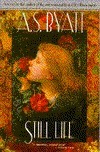
Synopsis:
From the author of The New York Times best seller Possession , comes a highly acclaimed novel which captures in brilliant detail the life of one extended English family-and illuminates the choices they must make between domesticity and ambition, life and art.
Stephanie Potter gives up a promising academic career to marry Daniel Orton, while her sister, Frederica, enters Cambridge, and her brother, Marcus, begins recovering from a nervous breakdown. (Source: Goodreads)
It’s the end of the workweek—yay! I hope the week has been kind to everyone and that you’re all ending it on a high note. Just like that, we’re already on the first Friday of the fourth month of the year. How time flies! With March not going as planned, tensions in the Middle East escalated. I hope April is a more promising month. I hope the conflict will begin to de-escalate—or, if not, be resolved soon. The world has become cruel and seems to be growing even crueler every day, as men in power continue to instigate hate and chaos. Still, I hope the year is providing everyone with plenty of opportunities to grow and improve. With the weekend looming, I hope everyone has a great one and ends the workweek on a high note. It’s time to dress down and wear more comfortable clothes. I hope everyone spends the weekend wisely—whether by resting from the rigors of a demanding career, pursuing passions, completing household chores, spending time with loved ones, or simply relaxing. I hope you’re all doing well—physically, mentally, and emotionally. As the Philippines observes Holy Week, today and yesterday were holidays, allowing us more time to rest and reflect.
Anyway, my venture into European literature is in full swing. After spending the first two months of the year reading the works of Latin American and Caribbean writers, I decided to cross the Atlantic and explore the lush, diverse tapestry of the European literary landscape. With March over, it was a no-brainer to extend this literary journey into April. After all, I’ve listed several works of European literature in my ongoing reading challenges. March, however, was dedicated to European women writers, in line with the month’s major motif. March is Women’s History Month, and International Women’s Day is celebrated on March 8. Except for the first book I read in March—Polish Nobel laureate Władysław Stanisław Reymont’s The Peasants—all the books I read were written by women.
This venture spills over into April, as I am currently reading A.S. Byatt’s Still Life. My reading journey has been alternating between French and British writers. It was must-read lists that first introduced me to Dame Antonia Susan Duffy (Byatt is her former married name, which she retained for her works). Her Booker Prize–winning novel Possession was ubiquitous and was even listed as one of the 1,001 Books You Must Read Before You Die; it was also the first of her novels that I read. Nearly a decade later, I am now reading my third A.S. Byatt novel, Still Life; I have also read The Children’s Book. I wasn’t originally planning to read Still Life, but since I’m focusing on European women writers, I decided to include it in my ongoing reading journey. Apparently, it is the second book in Byatt’s Frederica Quartet. I would have held off on reading it had I known this; I would have secured copies of all the books in the series first.
But since I’ve already started, there’s no turning back. Originally published in 1985, the novel begins in 1980, when Alexander Wedderburn visits an art exhibition at the Royal Academy of Arts in London, specifically to see works by Van Gogh. He is waiting for his old friend Frederica Potter, who, I later learned, is the muse of the quartet. When she arrives—stylish and beautiful—the two reconnect and engage in lively conversation about fashion and the arts. They analyze various paintings, discussing the messages subtly embedded in them. Their early exchanges highlight their contrasting personalities: Alexander is philosophical, while Frederica values clarity. This dynamic establishes the tone for the rest of the novel, where art—and even literature—is woven into its rich fabric. Beauty and aesthetics are, from the outset, overarching themes, much like in the other Byatt novels I’ve read—or at least, that’s my impression so far.
The narrative then shifts to Yorkshire and moves back in time. In December 1953, we meet Stephanie, Frederica’s older sister. She is married to Daniel Orton and is six months pregnant. While she loves her husband and unborn child, she is filled with regret over lost opportunities. Before marriage, Stephanie was a gifted student and part of the academic world. However, marriage came at a cost: she had to give up her intellectual life to focus on building a family. Her idealistic and gentle husband is also facing challenges. As a curate, he struggles with the indifference of his parishioners and his own doubts. Stephanie, in turn, begins to question her faith amid the demands of motherhood and societal expectations.
Although the couple shares a generally tender relationship, underlying tensions ripple beneath the surface. One source of strain is Marcus, Stephanie’s younger brother, who moved in with them after experiencing a mental breakdown. Meanwhile, Frederica is busy with her college applications, with Cambridge University as the obvious choice. Interestingly, Frederica’s presence in this section is limited, as the narrative focuses primarily on the family she left behind in Yorkshire. With their children gone, their parents, Bill and Winnifred, must also confront life on their own. In many ways, each family member is navigating a period of transition—mirroring the broader changes taking place in the United Kingdom after World War II.
The novel explores a wide range of themes. Stephanie’s storyline examines the weight of societal expectations placed on women, particularly in terms of gender roles. This burden is not unique to her; many of the women in the novel face similar pressures. Marcus’s storyline touches on mental health, while Frederica’s engages deeply with the arts. The title itself is an artistic reference, and beyond that, the novel is rich with intellectual and literary discourse. The characters discuss works such as John Milton’s Paradise Lost, Kingsley Amis’s Lucky Jim, Charles Dickens’s Our Mutual Friend, Jean-Paul Sartre’s Nausea, and Evelyn Waugh’s Brideshead Revisited, among others. Tolstoy, George Eliot, and Jane Austen are also mentioned. The novel is as much about literature as it is about art.
I’m nearly finished with the book and look forward to seeing how the characters confront their struggles and inner conflicts. Even without reading the first book in the quartet, The Virgin in the Garden, I was able to follow the story with ease. The writing is distinctly Byatt—Possession served as an excellent introduction to her work, though her style isn’t always the most accessible. The novel’s intellectual tone contrasts with the domestic concerns that unfold as the story progresses. I’m confident I’ll finish it over the weekend.
 The Pine-Scented Chronicles