
First Impression Friday will be a meme where you talk about a book that you JUST STARTED! Maybe you’re only a chapter or two in, maybe a little farther. Based on this sampling of your current read, give a few impressions and predict what you’ll think by the end.
Synopsis:
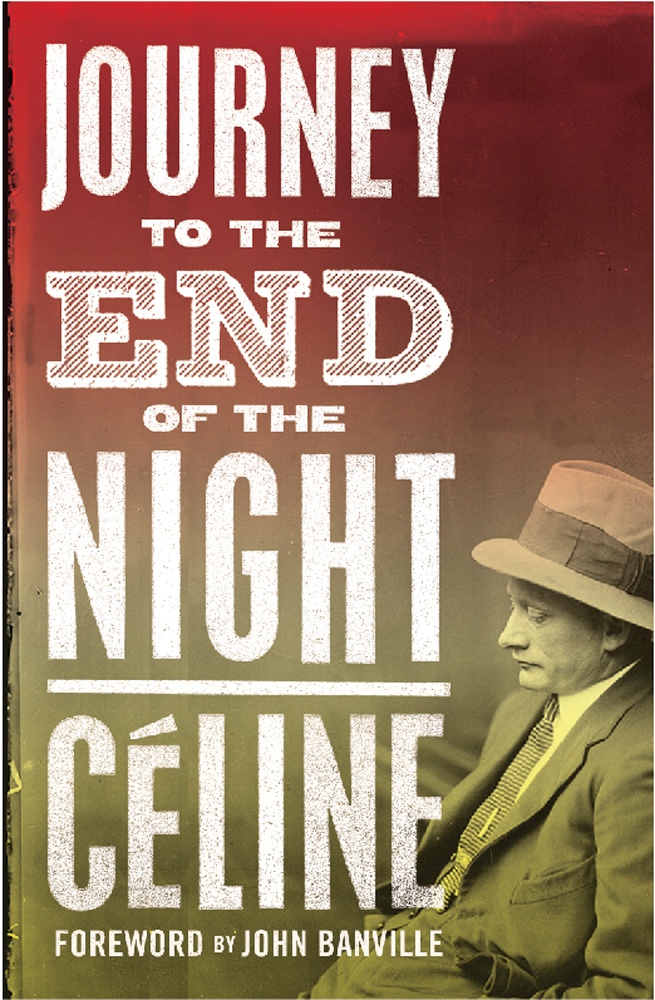
First published in 1932, Journey to the End of the Night was immediately acclaimed as a masterpiece and a turning point in French literature. Told in the first person by Céline’s fictional alter ego Bardamu, the novel is loosely based on the author’s own experiences during the First World War, in French colonial Africa, in the USA and, later, as a young doctor in a working-class suburb in Paris.
Céline’s disgust with human folly, malice, greed and the chaotic state in which man has left society lies behind the bitterness that distinguishes his idiosyncratic, colloquial and visionary writing and gives it its force.
It’s the end of the workweek—yay! I hope the week has been kind to everyone and that you’re all ending it on a high note. Just like that, we’re already on the second (!) Friday of the fourth month of the year. How time flies! I hope April is a more promising month. I hope the conflict in the Middle East will continue to de-escalate—or, if not, be resolved soon. The world has become cruel and seems to be growing even crueler every day, as men in power continue to instigate hate and chaos. Still, I hope the year is providing everyone with plenty of opportunities to grow and improve. With the weekend looming, I hope everyone has a great one and ends the workweek on a high note. It’s time to dress down and wear more comfortable clothes. I hope everyone spends the weekend wisely—whether by resting from the rigors of a demanding career, pursuing passions, completing household chores, spending time with loved ones, or simply relaxing. I hope you’re all doing well—physically, mentally, and emotionally.
After spending the first two months of the year reading the works of Latin American and Caribbean writers, I have now crossed the Atlantic to explore the lush, diverse tapestry of the European literary landscape. Interestingly, I was not planning to embark on a European literature adventure this early. However, I realized toward the end of February that I have several works by European writers in my reading challenges. March, however, was dedicated primarily to European women writers, in line with the month’s major motif. March is Women’s History Month, and International Women’s Day is celebrated on March 8. Except for the first book I read in March—Polish Nobel laureate Władysław Stanisław Reymont’s The Peasants—all the books I read were written by women. With March over, it was a no-brainer to extend this literary journey into April. After all, I still have several works of European literature in my ongoing reading challenges.
By design—or perhaps by coincidence—my reading journey has alternated between French and British writers, although I have also just finished a work by a Hungarian writer, Sándor Márai’s Embers. Currently, I am reading French writer Louis-Ferdinand Céline’s Journey to the End of the Night. It was must-read lists that first introduced me to the French writer, and Journey to the End of the Night was a prominent presence on such lists. It was even included in 1,001 Books You Must Read Before You Die. These are all good reasons for me to read the book, even though I did not include it in any of my ongoing reading challenges. Nevertheless, I have been looking forward to reading it. I even contemplated including it in my annual Top 20+ Reading List. But then again, there are just too many good books out there. Journey to the End of the Night is Céline’s debut novel, originally published in 1932 as Voyage au bout de la nuit.
At the heart of the novel is Ferdinand Bardamu, whom we first meet as a medical student in Paris. The year is 1914, and the First World War is just over the horizon. Military parades are in vogue. During one such parade, Bardamu is moved by its pageantry, despite his political ideologies. At the same time, a sense of heroism seizes him, prompting him to voluntarily enlist in the French Army at the outbreak of the war. Sent to the battle lines to serve as a runner, he is soon disillusioned by the realities of war. Its horrors and absurdities strip him of his youthful enthusiasm and fleeting sense of nationalism. He finds the war and its ubiquitous violence pointless. Faced with the Germans, he cannot make sense of the conflict.
On the front lines, he faces enemies he has never met before, prompting him to question his purpose and intentions. His body refuses to adhere to the commands of his officers. He questions why he must shoot at men who have not harmed him. He also realizes that his ambivalence makes him a coward in the eyes of his countrymen. He is later given a reconnaissance mission, during which he meets a fellow soldier—another “coward”—named Léon Robinson. Robinson is looking for a way to desert the army, and together they plot an escape. However, their efforts fail. When Bardamu is wounded, he returns to Paris, where he receives treatment and is awarded a military medal. During his recovery, he meets Lola, an American volunteer nurse. They have an affair, but when Lola realizes that Bardamu is avoiding a return to active duty, she leaves him.
Lola’s abandonment sends Bardamu spiraling downward. He experiences a mental health crisis and is transferred between a series of psychiatric hospitals. He is eventually declared in good health but unfit for duty, and is released. He then begins an affair with a dancer and violinist named Musyne, who entertains the troops. It seems that Bardamu cannot escape the shadows of war. When she breaks things off with him, he travels to French West Africa. There, he takes up a position at a rubber trading post, which turns out to be nothing more than a solitary hut in the middle of the African bush. There, he replaces a mysterious trader—whom he soon realizes is none other than Robinson. Taking Robinson’s place, Bardamu is soon confronted with the unbearable heat and boredom of colonial life. He also witnesses the blatant exploitation of the natives. He falls ill again and becomes delirious with fever. In his delirium, he sets fire to the hut and deserts it.
Thus begins yet another leg of the novel’s journey. From the trading post, he travels to the coast, where he encounters a Spanish priest. The priest arranges for Bardamu to serve as an oarsman on a ship bound for America. You get the drift—the novel is picaresque. It is eventful and takes the reader across different places as Bardamu grapples with his anger and repulsion toward everything around him. For him, life becomes a cycle of adventures and misadventures, romances and heartbreak, and fortune and misfortune. Invective is woven deftly with dark humor, underscoring Céline’s sharp observations of the frivolities of bourgeois society. Superficial ideals are exposed through Bardamu’s interactions with various characters and social structures.
In many ways, Journey to the End of the Night is not an easy read. Bardamu is an interesting and complex character. Over the course of the story, he undergoes a kind of reverse character development: his enthusiasm dissolves, replaced by disdain and resentment. The novel is semiautobiographical, which helps explain its raw and often cutthroat tone. Céline’s writing is incisive, yet he allows moments of reflection. Layers of existentialism shape Bardamu’s search for meaning in a tumultuous world, exacerbated by his inner conflicts. The absurdities he witnesses invite disillusionment, eroding his sense of self. Alienation emerges as a recurring theme in his life. Still, his picaresque journey offers him a fleeting sense of being. With just a few pages left, I am looking forward to the conclusion of Bardamu’s adventures and misadventures.
How about you, reader? What book or books are you taking with you this weekend? I hope you all have a great one—and that whatever you’re reading provides a brief respite.
 The Pine-Scented Chronicles