A Memorable Literary Debut
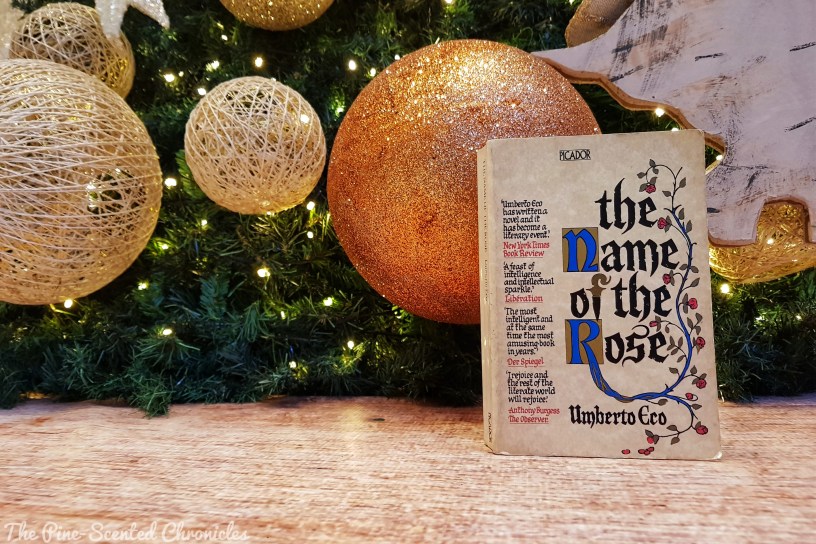
The Name of the Rose is a book I keep encountering on list challenges. Although the title immediately piqued my interest, I barely had any iota on what the book is about. I wasn’t familiar with the author, Umberto Eco, as well. These precluded me from exploring the writer’s oeuvre. I would eventually learn that the Italian writer is well-established and well-renowned. He is a prominent name not only in Italian literary circles but in global literary circles. His works are integral in contemporary literary discussions. As such, it was no surprise to encounter his works in must-read lists.
Take the case of his debut novel. The Name of the Rose is one of the 1001 Books You Must Read Before You Die, further piquing my curiosity. As a result, I made a resolution to avail a copy of the book. Numerous tries at acquiring a copy of the books, both from physical and online bookstores, ended in futility. But just when I was about to give up on my search for Eco’s elusive book, I finally saw a copy on an online seller. Not one for taking further chances, I immediately acquired a copy of the book. Because I couldn’t hold the suspense any longer, I included The Name of the Rose in my 2017 Top 20 Books To Read.
What is love? There is nothing in the world, neither man nor Devil nor any thing, that I hold as suspect as love, for it penetrates the soul more than any other thing. Nothing exists that so fills and binds the heart as love does. Therefore, unless you have those weapons that subdue it, the soul plunges through love into an immense abyss.
Umberto Eco, The Name of the Rose
For the nth time this year, I find myself devouring yet another historical novel. Not that I have any qualms about it, considering how highly praised Umberto Eco’s The Name of the Rose is. I’ve already had a taste of Eco with his pseudo-historical and picaresque work, Baudolino, which really confounded me and left me dumbfounded because of its eccentricity. Due to this eccentricity, I approached The Name of the Rose with a bit of skepticism and caution.
The book opened with a third-person narrator, probably the author himself, discovering a manuscript relating the events that unfolded in a Benedictine abbey located in northern Italy. This manuscript was written and narrated by Adso of Melk, a Benedictine novice monk who assisted Brother William of Baskerville, a Franciscan friar. Set in 1327, Adso and William were to attend a theological disputation in the said Benedictine monastery. However, upon their arrival, they were greeted by the news of a monk’s death.
William, a former inquisitor, ended up being tasked by Abo, the abbot of the abbey, to investigate this death. However, more deaths ensued. William and Adso diligently tried to gather clues surrounding these deaths, but with every clue that they uncovered, they hit a dead end. It wasn’t all a dead end, however, as these clues led them to the labyrinth under the aedificium, the building containing the abbey’s library. But even before the deaths were solved, Bernard Gui, a feared inquisitor, arrived at the abbey, stirring troubles further.
A book is a fragile creature, it suffers the wear of time, it fears rodents, the elements and clumsy hands. so the librarian protects the books not only against mankind but also against nature and devotes his life to this war with the forces of oblivion.
Umberto Eco, The Name of the Rose
I am most impressed with the way Eco expertly and extensively depicted medieval monastic life. I am also astonished by how he dealt with numerous theological arguments that involved the Abbey’s monks. Lengthily and often with zest, the occupants argued on a plethora of religious and theological subjects such as heresy and gospel interpretations. But the most fiery argument was the argument on whether Jesus lived in poverty or in opulence.
The story contained numerous allusions to a plethora of religious dogmas and subjects. This was balanced by the mystery part of the book, which had a Sherlock Holmes feel to it. Eco was successful in keeping the reader on tenterhooks all throughout the story. The mystery is muddled until the very end of the story. Just like any successful mystery piece, unmasking the murderer was a great challenge.
Umberto Eco, a renowned semiotician, also bequeathed his encyclopedic knowledge to Brother William. Brother William solved most mysteries, even the most mundane ones, using signs and symbolism that his keen perception had observed. As a result of this allusion to signs and symbolism, the book often drew comparisons to Dan Brown’s books. Personally, I felt that Brown employed more symbolism and less literature, while Eco employed literature more in his work than he did with the symbolism.
Another facet that I liked about The Name of the Rose is that it is a book about books. Aside from the abbey’s library and the library’s staff playing a key role in the mystery, there were also numerous references to different texts, such as Aristotle, Revelation, and to one of Eco’s personal favorite authors: Jorge Luis Borges. Aside from the textual references, the book is laced with numerous apocryphal and authentic Latin quotes.
But is the unicorn a falsehood? It’s the sweetest of animals and a noble symbol. It stands for Christ and for chastity; it can be captured only by setting a virgin in the forest, so that the animal, catching her most chaste odor, will go and lay its head in her lap, offering itself as prey to the hunters’ snares.
Umberto Eco, The Name of the Rose
The ending of the book was a bit anticlimactic, though. The text was woven in a manner that makes the reader believe that there is an established pattern to the murders. The book’s ending was ironic. Although the perpetrator was apprehended, the mystery was solved merely through chance and not through the sleuthing skills of William and Adso. As Eco explained it himself, “very little is discovered and the detective is defeated.”
However, in spite of the unexpected ending, the book itself was a marvel. The themes it covered, from medieval studies to biblical analysis to literary theory, are extensive. It was a perfect mix of mystery and literature. I have read a lot of mystery novels, and I easily got bored reading them because they seem to follow one pattern. Books like The Name of the Rose, with their apparent lack of patterns, challenge the inner reader in me.
Overall, The Name of the Rose is one of the best reads I’ve had in recent memory. The writing style and the story were great. It is a heavy read, but it was not as challenging as I initially thought it would be. It was a pleasure reading the book because of its pace, which is neither too fast nor too slow. The Name of the Rose is a unique and epic work, and it is easy to understand why numerous readers around the world refer to it as a classic.
The good of a book lies in its being read. A book is made up of signs that speak of other signs, which in their turn speak of things. Without an eye to read them, a book contains signs that produce no concepts; therefore it is dumb. This library was perhaps born to save the books it houses, but now it lives to bury them. This is why it has become a sink of iniquity.
Umberto Eco, The Name of the Rose
Rating

Recommended for history buffs, particularly the medieval era. It is for readers who like the mystery of the Sherlock Holmes kind, and readers who like to read about medieval and monastic life. It is also recommended for readers who like the complexities of the symbols woven into the works of Dan Brown.
Book Specs
Author: Umberto Eco
Translator: William Weaver
Publisher: Picador
Publishing Date: 1984
Number of Pages: 502
Genre: Historical, Mystery
Synopsis
The year is 1327. Franciscans in a wealthy Italian abbey are suspected of heresy, and Brother William of Baskerville arrives to investigate. When his delicate mission is suddenly overshadowed by seven bizarre deaths, Brother William turns to the logic of Aristotle, the theology of Aquinas, and the empirical insights of Roger Bacon to find the killer. He collects evidence, deciphers secret symbols and coded manuscripts, and digs into the eerie labyrinth of the abbey (“where the most interesting things happen at night”) armed with a wry sense of humor and a ferocious curiosity. (Source: Goodreads)
About the Author
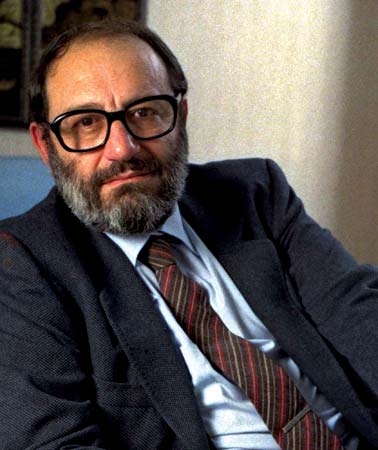
Umberto Eco was born on January 5, 1932, in the city of Alessandria, in Piedmont in northern Italy. His father urged him to become a lawyer,r but he ended up taking medieval philosophy and literature at the University of Turin. After earning his degree in 1954, he became a cultural editor for Radiotelevisione Italiana (RAI), a state-owned broadcasting station. He also lectured at the University of Turin from 1956 to 1964.
In 1962, he married Renate Ramage, a German art teacher, with whom he fathered a son and a daughter.
A voracious reader, he kept two large-volume libraries in his apartment in Milan and in his vacation house near Urbino. Although he has been an active writer post his collegiate years, it wasn’t until 1980 that he published his first novel, Il nome della rosa, which became an instant bestseller, especially with the publication of its English translation, The Name of the Rose, in 1983. He followed up this instant classic with yet another classic, Il pendolo di Foucault. It was published in 1988 and translated into English in 1989 as Foucault’s Pendulum. He would go on to publish five more novels, with Numero Zero, published in 2015, as his last.
Aside from being a novelist and a writer, he was also a visiting professor at Columbia University and the Norton professor at Harvard University. Because of his works, he received numerous honorary doctorates from various educational institutions like Indiana University Bloomington and the University of Tartu.
Umberto Eco died on February 19, 2016, in his Milanese home after a two-year battle with pancreatic cancer.
 The Pine-Scented Chronicles