Ogbanje, Identity and Trauma
On the fringes of every culture lurks a phenomenon that they find challenging to interpret. Defining these extraordinary occurrences is difficult. They are, oftentimes, feared and viewed as taboo. As the old adage goes, “People fear things they don’t understand.” To validate these fears, they are labeled and given distinct and peculiar names. They are interjected in conversations with ominous implications. They, especially the seemingly supernatural, evoke doom and invite fear.
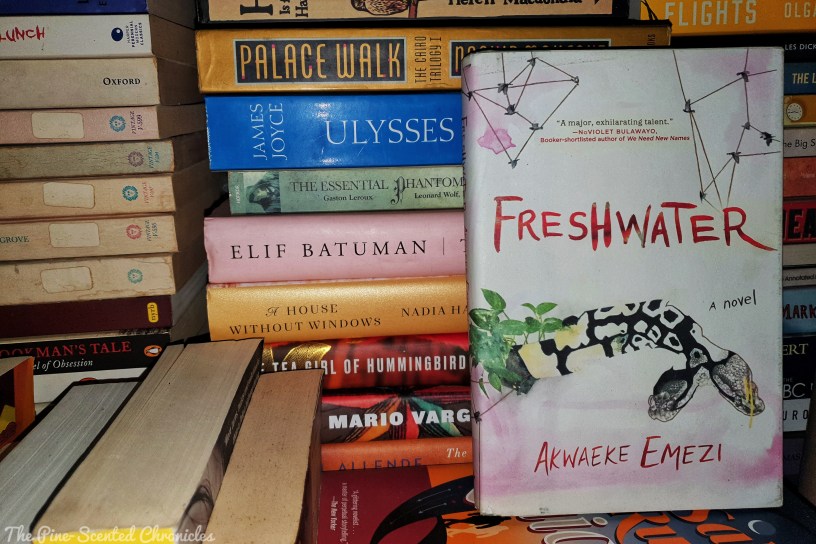
In Nigeria’s Igbo culture, the term Ogbanje is feared. Every family fears it with every newborn. Literally translated, it means “children who come and go”. With malice, it is believed that they deliberately plague a family with misfortune. In popular literary culture, it was popularized by Chinua Achebe’s highly popular work, Things Fall Apart (1958). Sixty years after the publication of this monumental masterpiece, Achebe’s countrywoman and fellow writer Akwaeke Emezi puts on her own take on the supernatural in her dazzling and bewitching debut work, Freshwater.
Freshwater starts with a young Nigerian woman, Ada. She is the daughter of Saul, a Nigerian Catholic doctor, and Saachi, a Malaysian nurse. Emezi plotted Ada’s story from birth to young adulthood. With a strong, independent woman for a. mother and a traditional father, she grew up in a household that incorporates both modern and traditional values. Traditions and systems of beliefs aside, her childhood was uneventful but made up for a dysfunctional one.
“I held my breath, but it didn’t feel like I was holding my breath, it felt like there should never have been breath. It felt like the entire concept of breath had been something I imagined. After all, my body was never meant to move like this. These lungs had to have been built for show. They should never have expanded and I should never have been alive.”
~ Akwaeke Emezi, Freshwater
Ada is not your typical young woman; there is something special about her. She is an ogbanje who was destined to die and was born multiple times. In the mortal world, she is the daughter of Saul and Saachi, but in the world of spirits, she is the daughter of Ala, an Igbo deity. Ada might own the physical, but she didn’t exist as an individual. Within Ada’s singular being resided a plurality of different selves. Ada the person is but one of many proprietors of her body.
It was also these various manifestations that pieced together Ada’s story, a being they fondly referred to as “The Ada”. The narrative’s perspective shifted between a collective “we” and singular narratives. Each with its own strong persona and brimming with wit, they tirelessly conspire and pan, influencing Ada’s every action and reaction. They were bewildered spectators to Ada’s human concerns, lenses through which Ada’s character is intimately examined. As denizens of Ada’s mind, it was also their primordial duty to protect the physical vessel that houses them. In looking after her, they are looking after themselves.
In Ada’s mind, where various streams of consciousness swim, surfaces one of the novel’s main themes. Shadows of mental health and mental health issues loom above the story. Although never directly referred to, Ada’s manifestations of various selves pertain to dissociative identity disorder (DIA), more commonly referred to as multiple personality disorder. People who suffer from DIA have several alters, which were the products of different traumatic experiences or important life milestones. Asughara, one of the strong spirits living in Ada, manifested when Ada entered puberty. Sewn into the rich tapestry of the novel are the overtones of depression, suicidal tendencies, and self-harm.
Freshwater is a rich novel that touches on several profound but dark and heavy subjects. These include sexual abuse, eating disorders, bisexuality, and being transgender. All of these forays culminate in the novel’s centrifugal point – the search for one’s identity. It is a universal theme and one that Ada has to grapple with. In a way, Ada’s spirits can be viewed as allegories for the different faces we project to the world. They are masks we manufacture to mix in the masquerade we call life. Rather than being deliberately manufactured, they were born out of instinct.
“We understood what was necessary -humans often fail at listening, as if their stubbornness will convince the truth to change, as if they have that kind of power. They do, however, understand forceful things, cruelties–they obey those.”
~ Akwaeke Emezi, Freshwater
It is this immersion into identity that made Freshwater interesting. In Freshwater, the search for identity was mostly influenced by internal factors. This is in dichotomy to some of its contemporaries, which viewed the search for identity as an external struggle driven by factors such as culture. Ada came full circle by learning to trust herself, her decisions, and her choices, and accepting the spirits that dwell within her. There were vestiges of cultural influences, but Ada’s development and growth throughout the story were greatly owed to the epiphany she experienced as the story concluded.
Ada, uncharacteristically, was treated simultaneously as a primary and secondary character. Her spirits, on the other hand, were no mere figments or interpretations of her imagination. They were, in their own right, central characters who dictated the flow of the stories and, in the process, altered the landscape of the story. Ada, as the vessel, felt ephemeral, but by deliberately narrating the story through a different center, Emezi elevated the story. Among the ranks of Nigerian authors, supernatural elements as primary narrator(s) is prevalent. Chigozie Obioma’s An Orchestra of Minorities was narrated by a chi, while Ben Okri’s The Famished Road was narrated by an abiku. These cultural touchstones afforded the tales a magical and fantastical atmosphere.
The novel was sustained by Emezi’s steady writing. She wrote in a lyrical manner that brilliantly flowed with the well of unreliable characters and narrators. The quick pace also complemented the nonlinear narrative. Emezi fused different elements of the mythological and the realistic to come out with a splendid debut work. It was also propped with elements from Emezi’s personal experiences. Freshwater is an ambitious and lofty narrative that challenges several conventions of identity.
Emezi did so many things well that it took some time before the novel’s flaws started to manifest themselves. The novel did touch several dark and heavy subjects, but some were shrouded in ambiguity. Emezi barely gave any solid resolution for the subjects that are deeply rooted in her country’s roots. The proverbial microscope wasn’t placed on the moral implications of Ada’s choices, a stark contrast to how some heavy subjects were greatly explored and resolved. There were instances where Emezi took the safer route.
“Think of brief insanities that are in you, not just the ones that blossomed as you grew into taller, more sinful versions of yourself, but the ones were born with, tucked behind your liver.”
~ Akwaeke Emezi, Freshwater
The story is far from perfect. Its flaws, however, are minor in comparison to what Emezi accomplished all throughout the narrative. Freshwater is an upbeat tale, an unconventional story that flourishes because of its balance of the supernatural and the conventional. It explored identity and mental health not through the lenses of Western assumptions but through the perspectives of a culture rarely read of in mainstream literature. Yes, it was lacking, but it was a promising debut from a voice that possesses stories the world must hear or at least read of. Her voice echoed from all corners of the world.
Ratings:
92%
Characters (30%) – 27%
Plot (30%) – 30%
Writing (25%) – 22%
Overall Impact (15%) – 13%
Ah. Freshwater. The moment I picked up the book and read its synopsis, I knew I was reeled in. I have always been enamored by tales connected to mental health, and Freshwater is even more interesting because it was written through the lens of an African writer. I have already read the perspectives of Latin, European, Asian, and American writers, but I have yet to read it through the lens of an African writer. And it was beyond interesting – it was captivating, riveting, and thought-provoking. Exploring identity through internal factors rather than external factors is one of the novel’s strongest facets.
Book Specs
Author: Akwaeke Emezi
Publisher: Grove Press
Publishing Date: 2018
Number of Pages: 226
Genre: Bildungsroman
Synopsis
We came from somewhere, everything does. When the transition is made from spirit to flesh, the gates are meant to be closed. It’s a kindness. It would be cruel not to. Perhaps the gods forgot – they can be absent-minded like that.
Ada has always been unusual. As an infant in southern Nigeria, she is a source of deep concern to her family. Her parents successfully prayed her into existence, but something must have gone awry, as the young Ada becomes a troubled child, prone to violent fits of anger and grief.
But Ada turns out to be more than just volatile. Born “with one foot on the other side,” she begins to develop separate selves. When Ada travels to America for college, a traumatic event crystallizes the selves into something more powerful. As Ada fades into the background of her own mind and these alters – now protective, now hedonistic – move into control, Ada’s life spirals in a dangerous direction.
About the Author
Akwaeke Emezi was born on June 6, 1987, in Umuahia, the capital city of Abia State, southeastern to a Nigerian father and a Malaysian mother. Emezi grew up in Aba, Nigeria, where they and their sister, Yagazie, resorted to storytelling to escape the riots, dictatorship, and dark realities of their childhood. At the age of five, Emezi started writing short stories and received their MPA from New York University. They came out as a non-binary trans and plural person and used the personal pronouns they/them/theirs. In 2014, they entered the MFA creative fiction writing program at Syracuse.
In 2015, they were awarded the 2015 Miles Morland Writing Scholarship. They also won the 2017 Commonwealth Short Story Prize for Africa. Emezi’s debut novel, Freshwater, was published in 2018 to critical acclaim. It was recognized as a New York Times Notable Book and was named a Best Book of the Year by the New Yorker and NPR. It also won the 2019 Nommo and Otherwise Awards. In 2019, Freshwater was nominated for the Women’s Prize for Fiction, making them the first non-binary transgender author nominated for the prize. In 2019, they published their first young adult novel, Pet. Bitter, a prequel to Pet, was released in 2022. In 2020, they published their second adult novel, The Death of Vivek Oji. You Made a Fool of Death with Your Beauty was published in 2022, while Little Rot was released in 2024.
In 2018, they were also chosen as a 2018 National Book Foundation “5 under 35” honoree. This is on top of several nominations for their works. They currently live in Brooklyn, New York City.


This book sounds really fascinating, and perhaps a bit heavy for summer reading. I have read and heard a lot about Nigerian writers recently but right now I’m exploring Japanese writers. So many books . . .
LikeLiked by 1 person
Indeed! There are so many books haha. But isn’t that great? I love Japanese fiction too 🙂 I hope you enjoy what you’re reading right now 🙂
LikeLike
Freshwater is a great read! It seems Emezi has a penchant for exploring ‘common’ (or uncommon depending on your perspective) topics in a new way. Her writing style definitely offers a fresh perspective on the topic of ogbanje, as Emezi is also an ogbanje. I read PET earlier in the year, and it was so good! It’s a bit of a lighter read than Freshwater. I can’t wait until The Death of Vivek Oji comes out!
LikeLiked by 1 person
Freshwater is indeed a great read and Emezi’s writing flowed very well. The autobiographical elements of the book were subtly incorporated. I look forward to reading more of their work.
LikeLiked by 1 person