Small Town Living
One of the prominent names in contemporary American literature is Richard Russo. Born on July 15, 1949, in Johnstown, New York, he was the only son of a domineering mother and an absentee father. Growing up in a small town in upstate New York, his future seemed to be headed into a state of mediocrity. It was at this juncture that he decided to seize control of his future. Ditching the waning town of Gloversville – once the hub of America’s glove-making industry – he moved as far away as possible, to Tucson, Arizona to study at the University of Arizona. There, he completed his bachelor’s degree, master’s in fine arts, and a Ph.D. in American literature.
Russo made his literary debut in 1986 with the publication of Mohawk. His debut novel established a recurring theme in his works: the indelible connection with and his memories of his hometown. In his works, Gloversville took on various fictional names such as the titular Mohawk, North Bath, and Empire Falls, small towns located in New England. The last town, Empire Falls, was also the title of Russo’s most renowned work. Published in 2001, Empire Falls earned Russo one of the most prestigious literary awards, the 2002 Pulitzer Prize. This further elevated Russo’s status as one of contemporary American literature’s most prominent voices.
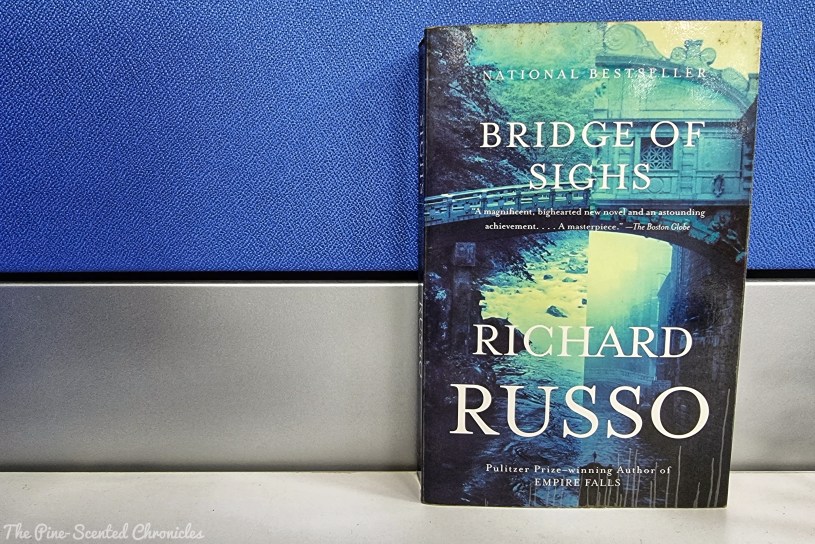
Building upon the success of Empire Falls, Russo published Bridge of Sighs in 2007. His sixth novel, Bridge of Sighs takes the readers to the New England countryside, to the (fictional) town of Thomaston located in upstate New York. The focal point and the prevailing voice of the novel was Louis Charles (“Lucy”) Lynch who was introduced in the contemporary as a sixty-year-old man. He was born, raised, and spent his entire life in Thomaston. He was married to Sarah, formerly Sarah Berg. Sarah was Lucy’s high school sweetheart. The couple earned a living by running convenience stores.
“Odd, how our view of human destiny changes over the course of a lifetime. In youth, we believe what the young believe, that life is all choice. We stand before a hundred doors, choose to enter one where we’re faced with a hundred more and then choose again. we choose not just what we’ll do, but who we’ll be. Perhaps the sound of all those doors swinging shut behind us each time we select this one or that one should trouble us, but it doesn’t. Nor does the fact that the doors are identical and even lead in some cases to the exact same place.”
~ Richard Russo, Bridge of Sighs
After being married for nearly four decades, the couple were now preparing for a trip to Venice. It was a plan they were both looking forward to but it caused them certain levels of anxiety. A trip to Venice has the potential of making them cross paths with Bobby Marconi. Bobby was a long-time friend whom the couple first met when they were high school seniors. He meant a lot to both Lucy and Sarah on an individual level. Sarah was once in love with Bobby while Lucy looked up to his friend. In his own way, Lucy was in love with his friend, but not the romantic type of love. However, after Bobby left Thomaston for Italy, the couple lost touch with their friend. Despite the passage of time, Bobby loomed large in the couple’s life.
From the contemporary, the story then flashed back to the trio’s childhood as Lucy attempted to write his own memoir. As a young boy, Lucy was an awkward child. He was the only child of Big Lou and Tessa Lynch. His parents shared very few similarities. His father was an optimist, naively so. Meanwhile, his mother was a realist. However, her portrayal bordered cynicism because Lucy was pretty much like his father. Early on, the son favored the father. He was bequeathed with his father’s optimist spirit but his mother’s domineering presence still lingered in the present. He also obtained some sense of humor from his sarcastic Uncle Declan.
Big Lou’s optimism plays an important role in the story, and, by extension, into his own son’s story. His compunction for optimism even when he finds himself in dire straits may be attributed to his humble beginnings. His inordinate optimism, however, obscured his view of reality; he did not take things as they were. He was described as “an amiable man who believed in amiable solutions, who forgave easily and couldn’t understand that other people derived pleasure from withholding the very thing he always gave so freely.” When he bought a rundown shop called Ikey Lukins against his wife’s wishes, he was brimming with enthusiasm. His lack of foresight, however, was more than made up for by his wife. Practical and armed with a keen business acumen, she helped him slowly overturn their fortunes. Their paradoxical views made the couple a prominent presence in the community.
Lucy’s childhood was shaped by a home where the members are constantly at odds with each other. Arguments, which stemmed from the petty to the serious, were commonplace in the Lynch household. Even the manner in which to run a business becomes a reason for heated discussions. All of these factors helped shape Lucy’s sense of himself and of the world. These factors have adversely impacted the way he sees his own potential. He was cynical about his own aspirations. A childhood traumatic incident at the Thomaston railroad trestle further played a critical role in the development of his worldview.
“I told him the truth, that I loved him and didn’t regret anything about our lives together. But do we ever ‘tell the truth, the whole truth, and nothing but the truth, so help me God’ as my father used to say, to those we love? Or even to ourselves? Don’t even the best and most fortunate of lives hint at other possibilities, at a different kind of sweetness and, yes, bitterness too? Isn’t this why we can’t help feeling cheated, even when we know we haven’t been?”
~ Richard Russo, Bridge of Sighs
As the story moved forward, details of Sarah and Bobby’s lives rose to the surface. Sarah was raised by her father, a snooty high school known for his eccentricity. His eccentricity was compared by one of his students to Herman Melville’s Captain Ahab. His mind, however, was brimming with grandiose ideas but this, in turn, obscured his view of reality. Sarah’s mother was a runaway and cared little about her daughter. On the other hand, Bobby was raised by a bitter and angry family who held a grudge against the Lynches. Like Russo, the moment Bobby got an opportunity to distance himself from his family, he did not hesitate. Off to Italy he went and assumed a new identity as Robert Noonan. For years, he established a career as an artist.
On the surface, Bridge of Sighs was a story about friendship; it was one of the novel’s more heartwarming facets. Despite the contrasting personalities of the characters, their bond grew. Lucy and Bobby were also the antithesis of each other, just like Lucy’s parents were the polar opposites of each other. While Bobby was a tough child, Lucy was timid. Both were the products of their upbringing. The story takes the readers into the intricacies of their friendship. It is the type of friendship that unexpectedly blossoms in the midst of the bedlam and despite the contrasts. The main characters’ contrasting personalities and the crosses they bear render the story different textures. It is a story populated by seemingly ordinary characters but it is this quality which makes readers identify with them and their quandaries.
Like Russo’s other works, forming an integral part of the story was the setting. Thomaston slowly developed into a character of its own. It was also a fictional rendering of Russo’s childhood home. Thomaston was once a thriving town teeming with commerce and industry ushered in by the tanning industry. However, recent years saw the decline of the town. It was losing its former glory, with old establishments once brimming with activities going inactive and even closing. The affluent have started their own diaspora, leaving their old houses to move to other states. The signs of decay were all over the town: “The loss of a place isn’t really so different from the loss of a person. Both disappear without permission, leaving the self diminished, in need of testimony and evidence. This happened. I was there.”
Russo was resplendent in laying out the landscape of Thomaston. It was a town where class divisions were palpable. On the West End lived families with humbler backgrounds while on the East End lived businessmen and members of the community who were climbing up the social ranks. The Borough is where the owner of the Tannery resided. The last section of the town was referred to as The Hill. Movements across the parts of the town signify changes in status, which, most of the time, takes hard work as prospects for individual success are limited. The Lynches, for instance, once lived in the West End but the success of their business allowed them to move to the East Side.
“The line of gray along the horizon is brighter now, and with the coming light I feel a certainty: that there is, despite our wild imaginings, only one life. The ghostly others, no matter how real they seem, no matter how badly we need them, are phantoms. The one life we’re left with is sufficient to fill and refill our imperfect hearts with joy, and then to shatter them. And it never, ever lets up.”
~ Richard Russo, Bridge of Sighs
In conveying the story of Thomaston, Russo also underscored the factors that drove its decline. Its story ran parallel to that of the tannery and of the industry as a whole. Despite the decline of the industry, its vestiges were palpable in parts of the town, with the weight of industrialization hovering above the town. The industry has an adverse impact on the environment. The river running through Thomaston was polluted and there was also a growing concern about how water sources have been polluted. A growing spate of cancer cases was causing concern in the community. This was, however, not directly addressed in the novel, with the readers left to draw their own conclusions: “Can it be that what provides for us is the very thing that poisons us? Who hasn’t considered this terrible possibility?”
But as Lucy confronts his own history, and that of the town, what prevailed was a story that also examined the what-ifs and the what-could-have-beens. What if he shared the traits of his realist mother? Would he have run off the moment he had the opportunity, like his friend? If he did run off, would he have been better off? There is something comfortable in the familiar, hence, there are among us who prefer to stay rooted in the same place for our lives. In a way, it was the product of dreams beaten down to a pulp by the circumstances surrounding them. Despite this, there are still questions that linger and the passage of time makes us reflect on our choices. Standing opposite Lucy was Bobby. Bobby escaped the claustrophobic world of Thomaston and reinvented himself.
At one point, Lucy intimates: “I’m not trying to own my life just acknowledge it, as well as the narrative of our family, its small significant journey. Is this not an American tale?” This line encapsulates the literary journey he took the readers. Bridge of Sighs is a family saga, a coming-of-age story, and an intimate examination of small-town living. It is a compulsive story that examines relationships, between loves, between friends, between members of the family, and between members of the community. It was also an intimate story about what anchors us to a place and the menial comforts we derive from these places. There was a bleakness that hovered above the story but breaking through this darkness were hopeful and humorous passages.
“We stand before a hundred doors, choose to enter one, where we’re faced with a hundred more and then choose again. We choose not just what we’ll do, but who we’ll be. Perhaps the sound of all those doors swinging shut behind us each time we select this one.”
~ Richard Russo, Bridge of Sighs
Book Specs
Author: Richard Russo
Publisher: Vintage Contemporaries
Publishing Date: September 2008
Number of Pages: 642
Genre: Literary
Synopsis
Louis Charles Lynch (also known as Lucy) is sixty years old and has lived in Thomaston, New York, his entire life. He and Sarah, his wife of forty years, are about to embark on a vacation to Italy. Lucy’s oldest friend, once a rival for his wife’s affection, leads a life in Venice far removed from Thomaston. Perhaps for this reason Lucy is writing the story of his town, his family and his own life that makes up this rich and mesmerizing novel, interspersed with that of the native son who left so long ago and has never looked back.
About the Author
Richard Russo was born on July 15, 1949, in Johnstown, New York, and was raised in nearby Gloversville. From 1967 to 1979, he attended the University of Arizona where he received his bachelor’s, Master of Fine Arts, and Doctor of Philosophy degrees.
While teaching in the English department at Southern Illinois University Carbondale, Russo published his debut novel, Mohawk (1986). He followed it up with The Risk Pool (1988) and Nobody’s Fool (1993). A year after its publication, Nobody’s Fool was adapted into a film of the same title starring Paul Newman. His fourth novel, Straight Man (1997), on the other hand, was adapted into a television show entitled Lucky Hank. Russo achieved greater heights with his fifth novel, Empire Falls (2001), which won the 2002 Pulitzer Prize for Fiction. His succeeding novels include Bridge of Sighs (2007), Everybody’s Fool (2016), and Chances Are… (2019). His most recent novel is Somebody’s Fool (2023).
His short story Horseman appeared in The Best American Short Stories 2007 edited by Stephen King and Heidi Pitlor. He also published a collection of short stories and a memoir, Elsewhere. Russo also has screenwriting credits for films such as Twilight (1998) Ice Harvest (2005), and Keeping Mum (2005). Russo also taught literature at Colby College; he retired in 1996 to pursue writing full-time.
Russo is currently residing in Portland, Maine with his wife, Barbara. They have two daughters, Kate and Emily.
 The Pine-Scented Chronicles
🤍🖤
LikeLike