
Happy midweek everyone! Wow. We are already halfway through the week. How time flies. How has the year been going for you so far? I hope that the year has been kind to everyone. If not, I hope you will experience a reversal of fortune in the coming months. More importantly, I hope everyone is happy and healthy, in body, mind, and spirit.
With the midweek comes a fresh WWW Wednesday update, my first this year. WWW Wednesday is a bookish meme hosted originally by SAM@TAKING ON A WORLD OF WORDS. The mechanics for WWW Wednesday are quite simple, you just have to answer three questions:
- What are you currently reading?
- What have you finished reading?
- What will you read next?

What are you currently reading?

Wow, we really are in the last quarter of the year. Before we know it, we will be welcoming a new year. Anyway, with a new month comes more reading adventures. For the rest of the year, I will focus on books that are part of my reading challenges although I will be doing some segues. My current read, José Mármol’s Amalia fits both categories as it is part of my 2023 Top 23 Reading List. At the same time, it is aligned with what I planned to be this month’s reading theme: Latin American literature. My first novel by the Argentine writer, Amalia is a seminal work of Argentine literature; it has also been integrated into the education system. I just started reading the book earlier so I can’t share much impression on the book right now. However, I will be sharing my initial impressions in this week’s First Impression Friday update.
What have you finished reading?
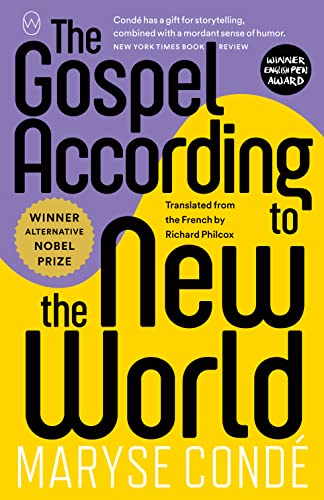
After a slow start to my venture into Latin American Literature, I gained some kind of momentum in the past week. I was able to read three books, the first of which was Maryse Condé’s latest novel, The Gospel According to the New World. This is my third novel by the Guadaloupean-born writer who first piqued my interest during the leadup to the announcement of the 2018/2019 Nobel Prize in Literature winners. Although the honor/s was/were given to other writer/s, Conde eventually became one of the writers I looked forward to.
Said to be her final work – Conde is losing her eyesight – The Gospel According to the New World charts the story of Pascal Ballandra who, as a baby, was abandoned in a shed. He was then adopted by the childless couple who found him: Jean Pierre, owner of The Garden of Eden plant nursery, and his beloved wife Eulalie. When he became an adult, Pascal became a messianic figure or a semblance of one. He healed a disabled man named Lazare and even recruited 12 disciples. Interestingly, one of his disciples was named Judas. It doesn’t take a genius to figure out the literary device that Conde was employing. With adulthood also loomed the question about his provenance. Pascal set out to find his parents. He soon found them but what he unveiled surprised him. Alas, it was not about the destination but the journey. Over the course of Pascal’s journey, Conde explored familiar subjects, the foremost of which was the legacy of colonialism and slavery. The novel also explores sexuality, gender, race, and inequality. There was a lot to unpack but, unfortunately, the overall impact was ephemeral.

From Guadeloupe – or at least a fictionalized version of it – my reading journey next took me to Brazil, specifically to the state of Bahia. One of Bahia’s most famous sons was Jorge Amado. Amado would rise above obscurity and establish himself as a foremost storyteller. He had a prolific literary career that produced volumes of novels. My first novel by the Brazilian writer was Showdown which was part of my first foray into Latin American literature. Two years later, another novel by Amado formed part of my second foray into Latin American literature.
Originally published in Portuguese in 1968 as Tenda dos Milagres, Tent of Miracles forms part of a series Amado called “The Bahia Novels”. The heart of the novel was Pedro Archanjo, a forsaken Bahian writer and self-taught social scientist. During the centennial of Archanjo’s birth, Dr. James D. Levinson, an American professor, traveled to Brazil to research more about Archanjo. Levinson believed that Archanjo’s works are seminal to mulatto literature. To assist him in his endeavor, Levinson enlisted the help of a Brazilian poet named Fausto Pena. The novel then transports the readers to the Pelourinho – the book’s setting – of the past. Pelourinho was a utopia for creative minds. It is there that artists, musicians, craftsmen, capoeiristas, poets, and even shamans have converged. The heart of the community was the titular Tent of Miracles, a tiny printing press where Archanjo and his friend Lídio Corró hold court. The novel was set in a very contentious part of Brazilian history, hence, its political overtones. Tent of Miracles, however, is not just a political novel as it is a literary smorgasbord that deep dives into crime, religion, and the dichotomies between the creative and the intellectual communities. Amado, as always, was splendid.

While my 2021 Latin American Literature Month was dominated by Chilean writers, my 2023 version, it seems, is slowly being shaped by Argentine writers. I have to admit, however, that my exploration of Argentine literature is quite limited. In fact, Pedro Mairal is just the second Argentine writer, after Hernan Diaz, whose oeuvre I explored. When The Woman from Uruguay was making the rounds last year, my interest was immediately piqued. What does the book hold? I soon found out.
Surprisingly, The Woman from Uruguay was rather thin. However, its thin appearance belied the message it carried. At the heart of the novel was Lucas Pereyra. He was already in his mid-forties. He was a writer buried in debt. He was lacking inspiration. Exacerbating his position was the fact that his wife, Catalina was successful; Lucas was relegated to being a house husband. Adding to his troubles was the growing suspicion that his wife had been unfaithful. He also suspected that their child was not his. A last-minute salvation came in the form of a $15,000 advance from his Spanish publisher. To save on taxes, he traveled to Montevideo, Uruguay to cash in the advance and then exchange it in Buenos Aires “at the unofficial exchange rate.” His travel to Montevideo was also driven by his desire to meet Guerra again; they first met during a literary festival two months prior. What rose to the forefront was the story of a man experiencing an existential crisis. While it was not unfamiliar, Mairal was able to conjure a compulsive story that probes deep into one’s motivations, flaws, and desires.
What will you read next?


 The Pine-Scented Chronicles
🩵
LikeLike
Finished- A Tale of Sorcery
Currently- soon to start Ariadne
Next- Fragile Threads of Power
LikeLiked by 1 person