A Swan Song
While Caribbean literature has no lush indigenous tradition, it has risen above obscurity to achieve global recognition. Perhaps due to its tumultuous and long colonial history, Caribbean literature drew influences from Spanish, British, Dutch, and English literature. Despite this interesting albeit strange mix, Caribbean literature has, over the years, slowly assumed a form that distinguishes it from its precursors. What emerged is a literature with diverse voices, as diverse as the islands that make up the Caribbean. The ascent of Caribbean literature was driven by highly esteemed writers such as Elma Napier (Dominica), Alejo Carpentier (Cuba), Aimé Césaire (Martinique), Paule Marshall (Barbados), Michelle Cliff (Jamaica), and Jean Rhys (Dominica), among others.
The region also produced two Nobel Laureates in Literature in Saint Lucia’s Sir Derek Alton Walcott (1992) and Trinidad’s Sir Vidiadhar Surajprasad (V.S.) Naipaul (2001). 1960 Nobel Laureate in Literature Alexis Leger, better known by his pseudonym Saint-John Perse was born in Guadeloupe. In the contemporary, writers of Caribbean origin are earning accolades across the world. Junot Diaz’s (Dominican Republic) The Brief Wondrous Life of Oscar Wao won the Pulitzer Prize in Fiction. Marlon James of Jamaica won the prestigious Booker Prize in Fiction in 2015 with his novel A Brief History of Seven Killings. These highly decorated writers have written some of the most recognized titles in the world of literature. This also underlines how more voices from the region are rising to global recognition.
Another prominent name that has come to represent the region is Guadeloupean writer Maryse Condé. She discovered her love for writing at a young age; she even wrote a play when she was just 12 years old. However, her writing endeavors would take the backseat for a majority of her adulthood as she pursued a career in teaching, holding teaching positions in Guinea, Ghana, and Senegal. She would take to the pen again upon entering her forties. Upon the publication of her debut novel, Conde admitted to lacking the confidence to pursue a literary career. Success, however, was not instantaneous as it took Condé her third novel, Segu before she made her long-awaited international breakthrough. From this point on, there was no looking back for Condé, as she soared into literary stardom, prompting many literary pundits to consider her as a possible Nobel Prize in Literature honoree.
“On his return Pascal’s character had changed. He who was always cheerful, always joking, had turned solemn, sententious, and moralising. His origins had become more than ever an obsession and an enigma, which he constantly sought to solve. He became pompous as well. Two of his favourite subjects of conversation were slavery and colonisation, and countries and societies that have been totally ignored or marginalised; but above all he loved to discuss the place and role of God in the world.“
~ Maryse Condé, The Gospel According to the New World
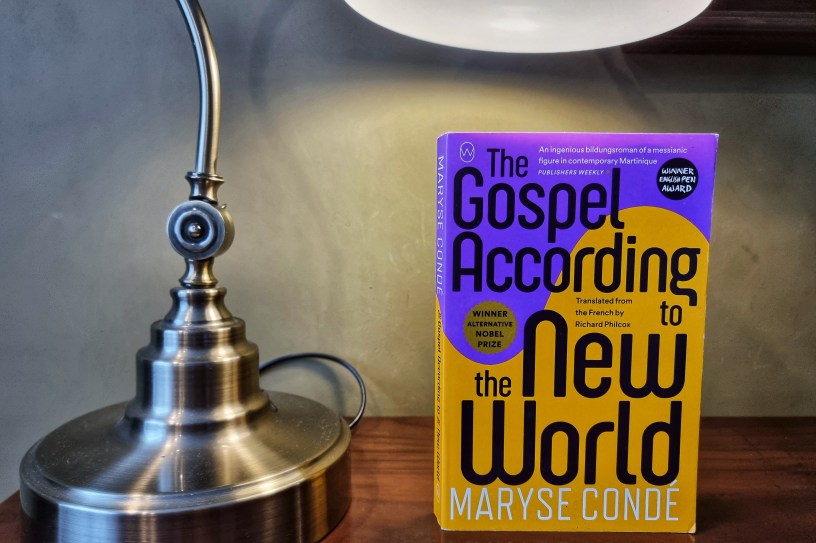
In 2023, her 2021 novel L’Évangile du Nouveau Monde was translated into English by her husband Richard Philcox. The novel was set on a modern-day fictionalized Caribbean island akin to Condé’s provenance of Guadeloupe: “It’s a land surrounded by water on all sides, commonly known as an island, not as big as Australia, but not small either.” At the heart of the novel was Pascal Ballandra. Born on Easter Sunday in a shed, Pascal was abandoned by his mother, Maya, shortly after his birth. The lack of support from her son’s father and her family left her with no recourse but to abandon her son. The young Pascal would eventually be found and adopted by the childless couple who owned the shed: Jean Pierre Ballandra, owner of The Garden of Eden plant nursery, and his beloved wife Eulalie.
Pascal’s arrival in the Ballandra household was described as “a big event.” This ‘big event” also has not escaped the attention of the community and its prying denizens. It did not help that Eulalie proudly showed off Pascal every time she visited shops and parks. The mysterious circumstances of Pascal’s sudden appearance and his provenance inevitably became the subject of rumors. His racial ambiguity – Pascal was brown in complexion and had grey-green eyes like the sea – further stoked these rumors. These rumors slowly transformed into a belief that Pascal was the second son of God the Father. They believed that Pascal was sent to change the world. While Jean Pierre found these claims blasphemous, Eulalie did not discourage them. When he was five, Pascal was informed by Eulalie that they were not his birth parents.
The enigma surrounding his provenance haunted Pascal. This made him pay more attention to the rumor mills, hoping that he would gain more information or insights about his potential parentage. It would eventually spark a journey that prompted Pascal to leave his parent’s home shortly after graduating from school. This was despite his uncertainties about the path he wanted to pursue. At first, he enjoyed success as a fisherman. As he embarked on his journey, he performed acts of miracles such as healing a man named Lazare. Over the course of his journey, he would perform acts of miracles that further reinforced the rumor that Pascal was a messianic figure.
Backed by these acts of miracles, Pascal developed a group of devout followers, specifically 12 “disciples.” As these details are slowly unveiled, the readers can easily connect the dots. The novel was brimming with Biblical references; the Gospel in the title was another giveaway. There were parallels between Pascal’s experiences and the people he encountered with Biblical events and characters. There was also a scene in the story that was a pastiche of the Last Supper. Among his twelve disciples was a man named Judas Eluthère. The irony of these “strange coincidences”, however, was not lost on the characters. Pascal, for instance, was bemused by the fact that among his devout followers was a man named Judas.
“Well, call it an angel if you must, but it was one of the strangest creatures she had ever seen. He was wearing thigh-high shiny leather boots and his curly gray hair fell down to his shoulders. The oddest thing was this protuberance concealed behind his back. Was it a hump? One night in exasperation she had chased him away with a broomstick but he had simply returned the following night as if nothing had happened.“
~ Maryse Condé, The Gospel According to the New World
Meanwhile, Pascal’s pursuit of his biological parents continued. He spent several years crisscrossing the Americas in search of answers. Through these journeys, he gained important life lessons and answers to philosophical questions that plagued him even when he was younger. He also learned about other religious leaders such as Siddhartha Gautama and Mohammed. However, the story does not reduce itself to a mere exploration of the role of religion in our lives. As the story moved forward, it was palpable how the story was being transformed from a satire of the Gospel into a story about a young man’s search for meaning. Condé reminded her readers of Pascal’s original goal which was to learn more about his origins.
In a way, Pascal was a vessel upon which Condé explored a plethora of subjects familiar in the landscape of her oeuvre. While he roamed around riding his private jet, Pascal witnessed the injustices that surrounded him. The affluence he achieved has not clouded his vision as he remained cognizant of the glaring dichotomies between the poor and the rich. Perhaps due to the circumstances surrounding his origin, Pascal, at a young age, showed an interest in people from all walks of life. This helped mold a revolutionary mind, with his desire for change carried over into adulthood. The injustice he witnessed, including the explicit prejudices that migrants experienced at the hands of the locals and the mistreatment of women. Pascal’s story conveyed the story of those who are often forgotten.
The novel may be predicated on the Bible but it probes well beyond its religious overtones. Beyond the darker sides of society, Pascal’s story probed into the darker side of humanity. We read about moral corruption. Betrayal was a subject explored in the story as one character possessed sycophantic tendencies. He sells his morals, betrays his friends, and ingratiates himself with those in power to ensure his steady climb up the ladder of success. The grander picture, however, zooms in on more seminal subjects of race, slavery, sexuality, and identity. A staple in Condé’s works, colonialism, and its legacies were again prominently featured in The Gospel According to the New World. Condé’s biting commentaries effectively underscored these subjects.
While Pascal loomed large in the narrative, he was no Messiah as many perceived him to be. He was, like most of us, an ordinary man who yearned for a better life. In ways more than one, Pascal was a conduit of the author herself, with the odyssey they undertook individually uncannily mirroring each other. But despite being imbued with a messianic persona, Pascal was also impartial to the vices of men. He indulged in rum punch and Lucky Strike cigarettes. Everywhere he went, he engaged in affairs with women; these affairs, more often than not, ended in disappointment. There were, nevertheless, undertones of romance as Pascal found himself under the spell of a prostitute named, unsurprisingly, Maria.
“He would stop and gaze at the sky. The heavens had opened up a second time and the mystery of the Incarnation had taken shape. This time the Creator had taken care to make His son of mixed blood so that no race might take advantage over others, as has happened in the past. The weak point was that He didn’t explain to His flesh and blood what was expected of him. What was he expected to do with this world streaked with bomb attacks and scarred with violence?“
~ Maryse Condé, The Gospel According to the New World
Without a doubt, Condé is a gifted storyteller. However, with The Gospel According to the New World, she tried to do a lot. While her vision is laudable, the same cannot be said about the execution. The Biblical references slowly became heavy-handed as the story moved forward. She tempered it by infusing the narrative with Caribbean folklore, which worked, to some extent. The fixation on Pascal meant that the more interesting characters were left in the background. Moreover, people believed that Pascal was the messiah but little justification was provided. It did not help that potentially interesting storylines petered out and eventually abandoned.
Shortlisted for the 2023 International Booker Prize, The Gospel According to the New World can be considered as Condé’s swan song. With Condé rapidly losing her eyesight, the possibility of a new work is virtually nil. Nevertheless, and despite its shortcomings, The Gospel According to the New World was imbued with everything that made Condé’s works stand out. Through the story of its flawed main character, the novel probed into humanity and social conscience while examining the dynamics of familial and filial relationships. The novel also expounded on familiar subjects – in the ambit of Condé’s oeuvre – such as race, slavery, and colonialism and its heritage. Ultimately, the novel crumbled underneath the weight of its ambition. It spread itself too thin and its impact was fleeting.
Book Specs
Author: Maryse Condé
Translator (From French): Richard Philcox
Publisher: World Editions
Publishing Date: 2023 (2021)
Number of Pages: 251
Genre: Literary
Synopsis
One Easter Sunday, Madame Ballandra puts her hands together and exclaims: “A Miracle!” Baby Pascal is strikingly beautiful, brown in complexion, with gray-green eyes like the sea. But where does he come from? Is he really the child of God? So goes the rumor, and many signs throughout his life will cause this theory to gain ground. From journey to journey and from one community to another, Pascal sets off in search of his origins, trying to understand the meaning of his mission. Will he be able to change the fate of humanity? And what will the New World Gospel reveal? For all its beauty, vivacity, humor, and power, Maryse Condé’s latest novel is above all a work of combat. Lucid and full of conviction, Condé attests that solidarity and love remain our most extraordinary and lifesaving forces.
About the Author
To learn more about Maryse Condé, please click here.
 The Pine-Scented Chronicles
💙
LikeLike