
Happy midweek everyone! Wow. We are already halfway through the week. How time flies. How has the year been going for you so far? I hope that the year has been kind to everyone. If not, I hope you will experience a reversal of fortune in the coming months. More importantly, I hope everyone is happy and healthy, in body, mind, and spirit.
With the midweek comes a fresh WWW Wednesday update, my first this year. WWW Wednesday is a bookish meme hosted originally by SAM@TAKING ON A WORLD OF WORDS. The mechanics for WWW Wednesday are quite simple, you just have to answer three questions:
- What are you currently reading?
- What have you finished reading?
- What will you read next?

What are you currently reading?

Oh, how time flies. We have less than two weeks before we turn in a new month. Before we know it, we will be welcoming a new year. At this point, I am scrambling to finish all books on my reading challenges; most are still ongoing. I am currently reading Valeria Luiselli’s Lost Children Archive, one of the 23 books in my 2023 Top 23 Reading List. The book is also aligned with this month’s reading motif: Latin American literature. Lost Children Archive is the first novel Luiselli wrote in English. It caused quite the literary sensation. It won prestigious awards such as the 2020 Rathbones Folio Prize and the 2021 International Dublin Literary Award. It was also longlisted for the Booker Prize and the Women’s Prize for Fiction. The New York Times Book Review also listed it as one of the 10 Best Books of 2019.
The novel is narrated by an unnamed female documentarian. She had a daughter whose biological father was a sensitive subject. The narrator was married to a fellow documentarian who had a son. All characters were unnamed and were living in New York City. The couple met while working on a project that charted all languages in New York City. The crux of the novel is when the husband informs his wife that he is moving the family to Arizona where he will work on documenting the Apache. The narrator was reluctant at first but relented. Thus commenced a long drive across the Northern American continent. These are just, however, preambles for I understand that the novel tackles a sensitive subject during Trump’s term as president: the American policy of separating children from their parents at the American-Mexican border. This was a controversial policy and was depicted in other literary works. I can’t wait to see how Luiselli will steer the narrative.
What have you finished reading?

In the past week, I was able to complete two books, the first of which was 2010 Nobel Prize in Literature honoree Mario Vargas Llosa’s Aunt Julia and the Scriptwriter. Originally published in Spanish in 1977 with the title La tía Julia y el escribidor, Aunt Julia and the Scriptwriter was the Peruvian writer’s seventh novel. This is the third novel written by Vargas Llosa I read. Interestingly, this is the first of the three that was set in his native Peru; imagine my surprise when I learned he was Peruvian. Vargas Llosa has certainly been growing on me.
Anyway, the titular Aunt Julia was the novel’s narrator’s love interest. Already thirty-two years old, she had no blood relation with Mario Vaguitas, an eighteen-year-old student; she was the sister of Mario’s biological uncle Lucho’s wife. She moved to Lima from Bolivia following a divorce. Mario was not initially entranced but her but the more he visited his uncle’s house, the more he became fascinated with Aunt Julia. Soon enough, they consummated a secret love affair; they were cognizant that Mario’s family was against the affair. This was just one half of the story. The second thread of the novel charted Mario’s friendship with Pedro Camacho, the titular scriptwriter. Mario himself was an aspiring writer but he was finding it a challenge to find motivation. In contrast, Pedro had a prolific career as a writer for radio. The plot of some of Pedro’s serials was woven into the story. Each story was increasingly getting more grotesque and erratic. The novel was based on Vargas Llosa’s first marriage. I did feel like the two strands did not converge but it was, nevertheless, a compelling story, as expected from Vargas Llosa.
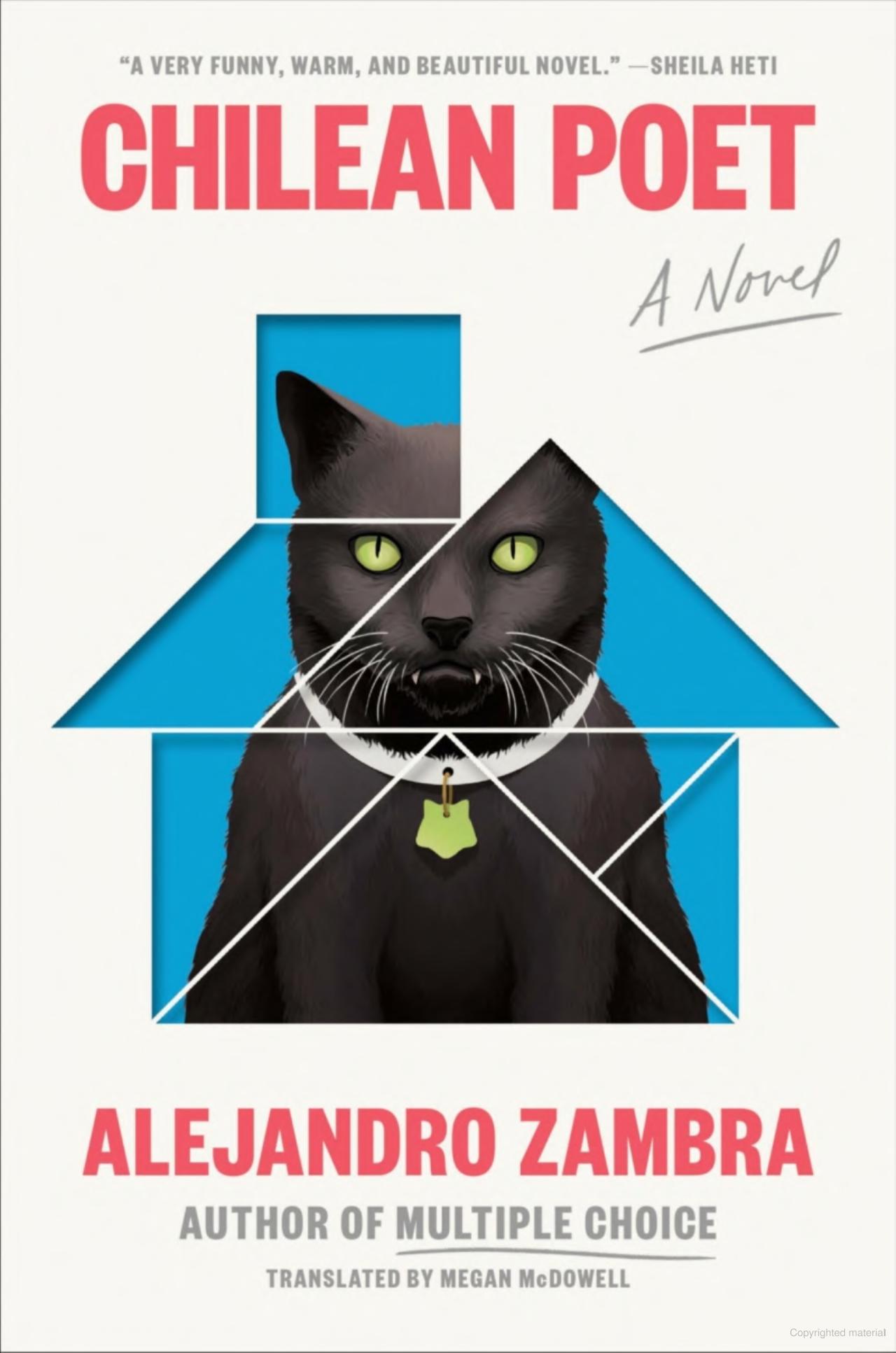
During the first time I hosted Latin American Literature Month, the Chilean writers won me over. Among the Chilean writers who immediately caught my attention was Alejandro Zambra whose Multiple Choice fascinated me for its unconventional structure which came in the form of a college entrance examination. It made me want to his more conventional novels. That opportunity came when I recently encountered Chilean Poet. I was not planning on reading the book but I can’t keep the tenterhook so here I am.
Chilean Poet charted the story of Gonzalo Rojas, a poetry-loving teacher in Santiago who had a torrid love affair with his high school sweetheart Carla during the 1990s. However, the two lovers inevitably separated only to reconnect nine years later. Carla had a son, Vicente, with one of her previous lovers, Leon. Although Vicente seemed like a dealbreaker for Gonzalo at first, he eventually took a liking to Carla’s son although Gonzalo was prone to second-guessing his role in Vicente’s life. Gonzalo planned to move the family to the United States because he found Chile too indolent, stuck in adolescence. Carla didn’t want to leave her roots, thus, prompting another separation. There was a shift in the second half of the novel as it focused on an eighteen-year-old Vicente. There is a lot to unpack in the novel but Zambra was resplendent in adroitly weaving all of the novel’s various elements together. Chilean Poet was an insightful read on family dynamics and filial relationships while, at the same time, subtly probing into the maladies of modern Chile.
What will you read next?


🩵
LikeLike