
Happy November everyone! Woah. We really are in the last two months of the year. Wow. We have chalked up the first ten months of 2023. How has the year been? I hope that it has been kind to everyone. Sadly, during the month, tensions between Palestine and Israel have escalated once again. It breaks my heart to read about it. My prayers go to those who were caught in the crossfire. I have been fervently praying for a peaceful resolution to this decades-old conflict. Anyway, I am still hoping that the rest of the year will be kind to everyone and that peace will prevail. I hope that everyone will reap the benefits of everything they have worked hard for. I hope that the remainder of the year will be filled with great news and blessings. More importantly, I hope everyone is and will be healthy, in body, mind, and spirit.
Reading-wise, October has been another productive reading month. The month was divided into two phases, with the first phase a continuation of my September reading journey. I continued reading works of Latin American literature. It was, as always, an enchanting experience. I was able to revisit familiar worlds while being introduced to new ones. Following the conclusion of my literary journey across Latin America, I crossed the Atlantic to commence a literary journey across Europe. I have so much planned for this journey but the year is slowly dwindling down which means I have to focus on my reading challenges; I am lagging behind on many of them. As such, my stay in Europe will be cut short but I will be focusing on books on my reading challenges; one-half of the books I read during the month were from these challenges. Without more ado, here is a peek into how my October reading journey shaped up. Happy reading!

Amalia by José Mármol
I commenced my journey through Latin American literature with Argentine writer José Mármol’s Amalia. My 100th book for the year, Amalia is said to be the Argentine writer’s magnum opus. Because of the accolades attached to the book, I included it in my 2023 Top 23 Reading List. Mármol wrote the novel while he was in exile in Montevideo, Uruguay. Across the border, strongman Juan Manuel de Rosas ruled with an iron fist. It was originally published in a series and charted the story of the titular Amalia, the woman at the heart of the novel. Widowed, she fell in love with Eduardo Belgrano, a friend of Daniel, Amalia’s cousin. Daniel rescued Eduardo when Eduardo, a Unitarian, was attacked by the Federalists. Daniel then enlisted the help of Amalia who opened the door of her home to the injured Eduardo. Beyond the romantic overtones, Amalia is, first and foremost, a political novel. Most of the book dealt with the political landscape of Argentina shortly after it gained its independence from Spain, particularly the tumultuous phase instigated by the Rosas regime; the novel would be a precursor to what would be known in the contemporary as dictator novels. Interestingly, it was Daniel who emerged as the book’s hero, overshadowing the titular Amalia. The romance and the political elements of the novel never seemed to converge. Despite its flaws, Amalia was an evocative and compulsive read.

The General in His Labyrinth by Gabriel García Márquez
I wasn’t originally planning to read Gabriel García Márquez’s The General in His Labyrinth but because I could not locate my copy of Vargas Llosa’s Death in the Andes, I was prompted to read a work by another Nobel Laureate in Literature. Don’t get me wrong, I like García Márquez’s brand of magical realism and The General in His Labyrinth is already my sixth novel by the Colombian writer. This makes him my second most-read Nobel Laureate in Literature, just behind Kazuo Ishiguro’s eight. In a way, The General in His Labyrinth shares similarities with The Autumn of the Patriarch as both novels were about men in power. Both novels fall in the ambit of the dictator novel, a subgenre of Latin American literature. The titular General is Simón Bolívar, the liberator and leader of Gran Colombia. The novel traced Bolívar’s journey along the Magdalena River, starting from Bogotá, Colombia, in May 1830, until his death on an estate near Santa Marta in December 1830. Over the course of this journey, Márquez reimagined the general’s triumphs and passions. His political and romantic life and success in warfare came in the form of flashbacks and dreams. Interestingly García Márquez admitted in the Author’s Notes that he was more interested in capturing the landscape of the adventure rather than in rebuilding Bolívar’s profile. The novel was, nevertheless, a compelling story of a man in the throes of death and a continent about to emerge from the ashes of its past.

Aunt Julia and the Scriptwriter by Mario Vargas Llosa
In lieu of Death in the Andes, I decided to read the 2010 Nobel Prize in Literature honoree Mario Vargas Llosa’s Aunt Julia and the Scriptwriter. Originally published in Spanish in 1977 with the title La tía Julia y el escribidor, Aunt Julia and the Scriptwriter was the Peruvian writer’s seventh novel and his third novel I read. Interestingly, this is the first that was set in his native Peru. The titular Aunt Julia was the love interest of Mario Vaguitas, an eighteen-year-old student who was also the novel’s primary narrator. The two were not related by blood but Aunt Julia, who was already thirty-two years old, was the sister of Mario’s biological uncle Lucho’s wife. She moved to Lima from Bolivia following a divorce. When they first met, Mario ignored her but the more he visited his uncle’s house, the more he became fascinated with Aunt Julia. It wasn’t long before it turned into a secret love affair; Mario’s family was against the affair. This was just one half of the story. The second thread charted Mario’s friendship with Pedro Camacho, the titular scriptwriter. Mario himself was an aspiring writer but he was slowly losing his passion. In contrast, Pedro had a prolific career as a writer for radio, with the plot of some of his serials woven into the story. The novel was based on Vargas Llosa’s first marriage. I did feel like the two strands did not converge but the novel was still a compelling read; one can expect nothing less from Vargas Llosa.
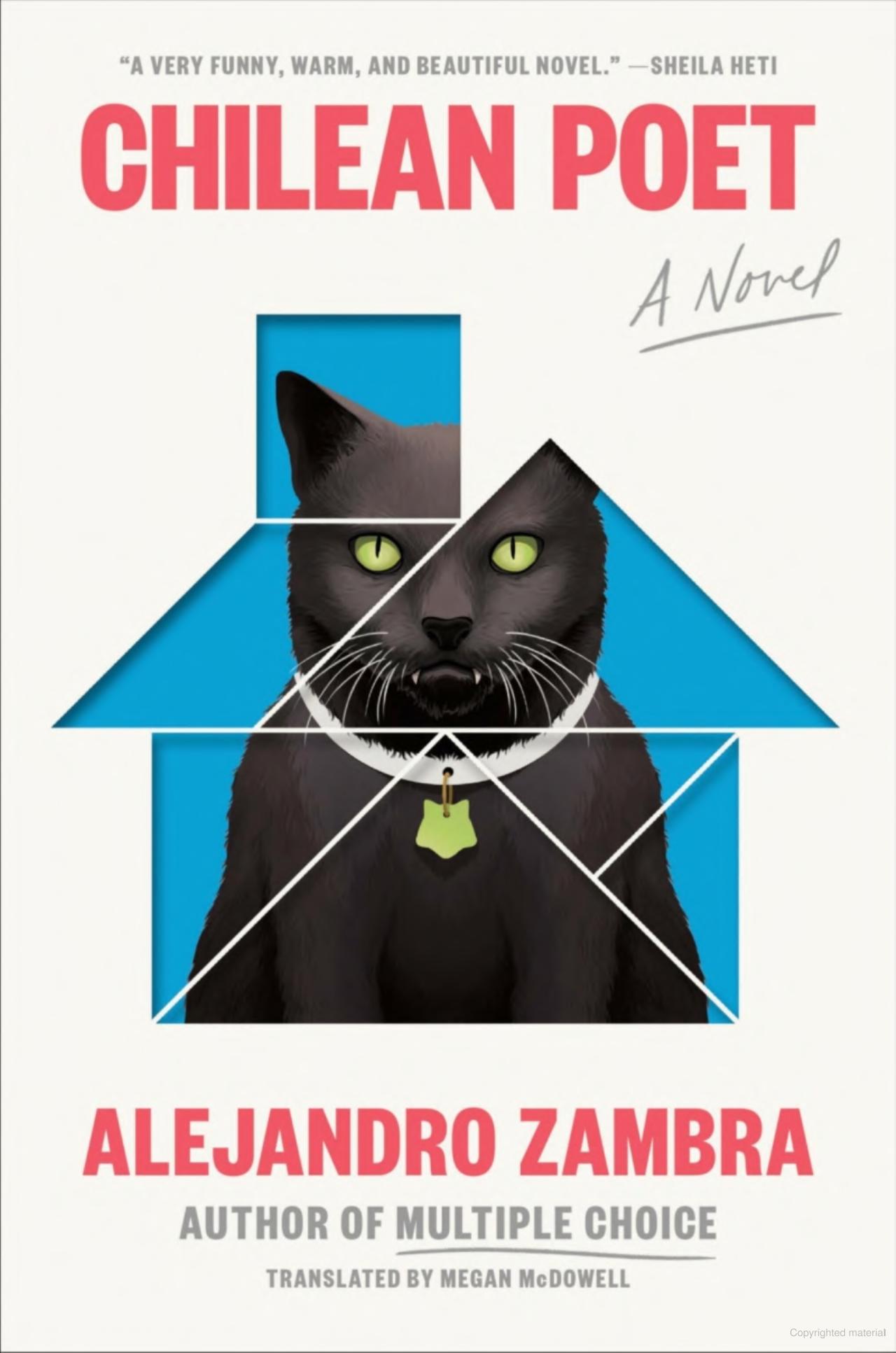
Chilean Poet by Alejandro Zambra
During the first time I hosted Latin American Literature Month, one of the writers whose prose captivated me was the Chilean writer Alejandro Zambra. His Multiple Choice fascinated me for its unconventional structure. This made me want to read more of his works. The opportunity came when I recently encountered a copy of his latest novel Chilean Poet. Like The General in His Labyrinth, I was not planning on reading the book but I can’t keep the tenterhook. Chilean Poet charted the fortunes of Gonzalo Rojas, a poetry-loving teacher in Santiago who had a torrid love affair with his high school sweetheart Carla during the 1990s. They broke up only to reconnect nine years later. Carla now had a son, Vicente, with one of her previous lovers, Leon. At first, Vicente seemed like a dealbreaker for Gonzalo but they eventually formed a bond. Things turned south when, without Carla’s acquiescence, Gonzalo planned to move the family to the United States. He found Chile too indolent. What he did not expect was Carla’s vehement refusal to agree to the plan, prompting another separation. The second half of the novel focuses on eighteen-year-old Vicente and his relationship with Pru, an American journalist. Zambra was resplendent in adroitly weaving all of the novel’s various elements together. In Chilean Poet, he crafted an insightful read on family dynamics and filial relationships. At the same time, he probed into the maladies of modern Chile.

Lost Children Archive by Valeria Luiselli
The final stretch of my foray into Latin American literature was comprised of a trio of female writers, starting with Valeria Luiselli and her 2019 Booker Prize-longlisted novel Lost Children Archive. In the months before the pandemic, the book was ubiquitous; it was even cited by the New York Book Review as one of the 10 Best Books of 2019. These naturally piqued my interest in the book which I also listed on my 2023 To 23 Reading List. The Mexican writer’s first novel to be written in English, Lost Children Archive charted the story of an unnamed family, with a documentarist for a matriarch and a documentarian for a patriarch. Their story started in New York City where they first met while on a project to document the Big Apple’s diverse soundscape. Prior to meeting, they already had children, with the man having a son while the woman had a daughter. Their domestic life was typical until the father decided to move the family to the West to pursue a soundscape in the region once known as Apacheria. His wife was resistant at first, but she eventually relented, thus commencing a long journey across the American continent. The novel was set during the Trump administration when a controversial policy segregating parents from children at border crossings was implemented. The book reminded me of Daša Drndić’s Trieste, a novel about the Second World War and its impact on children. Interestingly, Drndić was mentioned in this complex book interspersed with tender moments.

The Wind Knows My Name by Isabel Allende
Without design, Isabel Allende’s latest novel, The Wind Knows My Name was effectively an extension of Lost Children Archive; I didn’t realize that the Chilean writer was releasing a new work until recently. While I was planning to read a book by Allende, I had a different one in mind but this deviation was still welcome. Lost Children Archive and The Wind Knows My Name share some elements. However, Allende’s latest novel follows two narrative lines. The first thread introduced Samuel Adler who we first met in the years leading to the Second World War. With Adolf Hitler consolidating power, his mother Rachel, an Austrian-Jewish, used her connections to send her five-year-old son to the United Kingdom. Samuel managed to cross safely with only his violin and the clothes on his back. Samuel would grow up a reticent musician. The novel’s second thread followed Anita Diaz who, along with her mother, traveled from El Salvador. They risked crossing the US border and were separated because of Trump’s controversial policy. Anita’s blindness was caused by an accident that prompted her mother to move them to the Land of Milk and Honey. As she has proven through her works, Allende managed to weave the threads that inevitably connect the past with the present. Her latest novel is pretty much present, with its exploration of the follies of Trump’s policy while probing into the factors that drove refugees in flocks to take the treacherous journey. The Wind Knows My Name is yet another thought-provoking and heartwarming, sometimes tragic, piece from a gifted storyteller.

Our Share of Night by Mariana Enríquez
Wrapping up my literary journey across Latin America is Mariana Enríquez’s Our Share of Night. I first came across the Argentine writer in 2021 when her book, The Dangers of Smoking in Bed, was shortlisted for the International Booker Prize. I was looking forward to the book but I then learned it was a short story collection. The universe conspired for me and Our Share of Night became her first novel to be translated into English. At the heart of Our Share of Night is the father and son duo of Juan and Gaspar Peterson. The story commenced in 1981 when Juan’s wife passed away. To grieve and heal, Juan took his son to his in-laws’ estate, in the Argentine countryside. Little did Juan know that the trip would open Pandora’s box when they uncovered a deeply kept family secret: the Order, a cult with an obsession with the supernatural evil presence called Darkness and immortality. Things became more complicated when it was revealed that Gaspar’s fate was tied up with the cult. As the Order’s threat encroaches, Juan and Gaspar flee. Juan, to ensure his son’s safety must also confront his own demons. Set during the dictatorship (1976-1983), the novel captures the horrors of the regime. The Order was a conduit as it volunteered to take victims of the regime and torture them. They also made human sacrifices under the cover of state-sponsored abductions. Yet amidst this darkness, friendship and familial love flourished. Our Share of Night is a complex and compelling novel and no amount of words can fully capture the beauty of this story of a father and son and of a nation reeling from the horrors of the regime.

The Notebooks of Malte Laurids Brigge by Rainer Maria Rilke
When a door closes, a new one opens. Immediately following the conclusion of my foray into Latin American literature, I commenced a literary journey across Europe. I opened my foray into European literature with a new-to-me writer but a writer who is quite ubiquitous. Austrian writer Rainer Maria Rilke has long piqued my interest; he is often part of literary discourses. However, his oeuvre is comprised primarily of poetry, an alley I still couldn’t imagine myself exploring, at least for now. I was surprised when I learned that he published a novel, The Notebooks of Malte Laurids Brigge which I included in my 2023 Top 23 Reading List; this says how much I was looking forward to the book. As the title suggests, the book has an epistolary structure, interspersed with notebook and journal entries made by the titular Malte Laurids Brigge. In his mid-twenties, Brigge traveled from Denmark to Paris to document the works of sculptor Rodin. Through his notebook entries, Brigge captured life on the streets of Paris, beyond the glitz and glamour often attached to it. The novel transforms into a philosophical musing that revolves mainly around existentialism, detailed with childhood stories. Writing for Brigge was a distraction from his fear of death. The novel provides an intimate glimpse into the psychological profile of Rilke; some of the letters were actual letters Rilke sent his wife. Rilke’s poetic roots were palpable in the novel and some of his ramblings readers can relate to.

The Leopard by Giuseppe Tomasi di Lampedusa
From gay Paris, my literary journey next took me to the island republic of Salina on the Italian Peninsula with Sicilian Prince Giuseppe Tomasi di Lampedusa’s The Leopard. I first came across The Leopard in mid-2020, just shortly after the easing of COVID-19 protocols. I was curious about the book, especially after I learned it was one of the 1,001 Books You Must Read Before You Die. I listed the book as part of my 2023 Beat the Backlist Reading Challenge. Published posthumously in 1958 – after several rejections as publishers found the book “rather old-fashioned” – the novel charted the fortune of Prince Fabrizio di Salina, the titular Leopard after his family crest. He was at the helm of the Kingdom of Salina. Set during the period of Italian unification called the Risorgimento, the novel opened in May 1860 with the arrival of Giuseppe Garibaldi and his Redshirts in Sicily. This was the first step to the dismantling of the aristocracy (the Kingdom of Two Sicilies), thus, starting the unification process into the unified Italian Kingdom under Victor Emmanuel. This was a development that Prince Fabrizio was cognizant of, prompting him to move his family to Donnafugata where the family had an estate. Through the story of a declining aristocrat and a family undermined by infighting, the novel captures the political and social shifts taking place in Italy during and following the Risorgimento. It captured the overall attitude of Sicily toward this change while meditating on death and loss of collective memory.

Jacob’s Ladder by Ludmila Ulitskaya
I can’t remember when I first encountered Ludmila Ulitskaya. One thing is for sure, the Russian writer – at least her works – has been ubiquitous lately. This didn’t escape my attention. My interest in her oeuvre was further piqued when I kept seeing her name in discourses apropos possible honorees for the Nobel Prize in Literature. These were among the reasons why I listed her novel, Jacob’s Ladder, in my 2023 Top 23 Reading List. Said to be Ulitsakaya’s final full-length prose, Jacob’s Ladder follows two narrative threads: one in the present and one in the past. The present charted the story of Nora Ossetsky, a set designer, theatrical director, and writer in late-Soviet and post-Soviet Moscow. Following the decline of her marriage of convenience with Vitya, she raised her wayward son Yurik as a single mother. The second plotline followed the story of Nora’s grandparents Marusya Kerns and Jacob Ossetsky in the revolutionary and Stalinist periods. The second plotline was built from a cache of letters and journal entries made by Jacob uncovered by Nora while cleaning her grandmother’s house. On the surface, Jacob’s Ladder is a family saga oscillating across time periods. Beyond the examination of family dynamics and strenuous relationships, the novel chronicled Russia’s modern history, from the fall of the Romanovs to the rise of Joseph Stalin to the dismantling of the Union of Soviet Socialist Republics. With the vast territory it covered, Jacob’s Ladder is certainly one of my best reads this year.
Reading Challenge Recaps
- My 2023 Top 23 Reading List: 17/23
- 2023 Beat The Backlist: 12/20; 104/60
- 2023 Books I Look Forward To List: 3/10
- Goodreads 2023 Reading Challenge: 109/90*
- 1,001 Books You Must Read Before You Die: 14/20
- New Books Challenge: 5/15
- Translated Literature: 59/40
*I updated my Goodreads target from 70 to 90 as I am quite ahead of my original target.
Book Reviews Published in October
- Book Review # 463: The Gospel According to the New World
- Book Review # 464: Wandering Star
- Book Review # 465: A Bend in the River
- Book Review # 466: Pure Colour
- Book Review # 467: Young Mungo
- Book Review # 468: Afterlives
- Book Review # 469: Memphis
Finally, after a little bit of perseverance, I was able to complete all my book review backlogs from 2022; this was a bit of a surprise as I forecasted that I would finish all in November. I was also able to have a more productive writing month, at least in comparison to the rest of the year. I guess it helped that the month wasn’t as hectic as I expected it to be. Now, I will be shifting my focus to books that I read earlier this year. I have a lot of catching up to do because I currently have about ninety book reviews pending for this year. I sure hope that I will be able to find the motivation to write as many as I can although the general attitude would still be taking it one step at a time.
As has been customary, the last two months of the year will be focused on books that are part of my reading challenges. I still have six from my 2023 Top 23 Reading List and eight from my 2023 Beat the Backlist Challenge. I also have some new books I really can’t wait to dip my toes into. Like the past two months, November is bound to be a busy reading month and a hybrid one as well. The first half will be dedicated to works of European literature. In the second half, I will be crossing the Atlantic again as I will be immersing in the works of North American writers, primarily American with Margaret Atwood being the single anomaly. So this is how the rest of the year is going to be, a scramble to finish these said books. But this is how I have always concluded my recent reading years. So what else is new I guess?
How about you fellow reader? How is your own reading journey going? I hope you enjoyed the books you have read. For now, have a great day. As always, do keep safe, and happy reading everyone!
 The Pine-Scented Chronicles
Great post 💖💓💚
Since you have a good day 🌈🌞
A cordial greeting 👋 🇪🇸
LikeLike
📖
LikeLiked by 3 people