Historical Parallels and A Dash of Kindness
It is, without a doubt, that in the ambit of contemporary Chilean literature, Isabel Allende is a titan. With a prolific literary career that spanned over five decades, Allende is easily one of the most recognized and successful Latin American writers of the present. However, before commencing a full-time career as a writer, Allende took on a plethora of jobs. The most pivotal juncture in her career was when she worked as a journalist in Chilean television prior to her being put into exile in Venezuela in 1973. Her journalistic ventures made her interview Pablo Neruda, one of two Chilean writers to win the prestigious Nobel Prize in Literature. Allende’s wide imagination did not escape the Nobel Laureate’s attention. Neruda advised Allende to pursue a career as a novelist. He also advised her to compile her satirical columns and publish them in book form, thus, the conception of her first published book.
Allende’s literary breakthrough came in 1982, with the publication of her debut novel, La casa de los espíritus (The House of the Spirits). It was an immediate literary sensation, a masterpiece that earned her accolades in different parts of the world. Her integration of subtle elements of magical realism into lush Chilean and Latin American historical contexts consolidated her ascent as a global literary star. There was no way but up for Allende. Her works are recognized everywhere and even earned Allende several literary awards such as Premio Nacional de Literatura (Chilean National Prize in Literature) in 2010. She was also the recipient of the 2014 Presidential Medal of Freedom, awarded by US President Barack Obama. In 2016, the PEN Center USA recognized her achievements by awarding her a lifetime achievement award.
Beyond the Latin American brand of magical realism, Allende has also demonstrated an astute ability to find parallels between the past and the present. It is around these parallels that she built compelling stories. These parallels are deliberate as they are vessels upon which Allende conveyed deeper messages vis-a-vis history. Essentially, the present is a mirror of the past as history keeps repeating itself. What Allende is reiterating is that we should learn from the past. However, it is apparent that we are not learning from our past. As writer and philosopher George Santayana remarked, “Those who cannot remember the past are condemned to repeat it.” Finding parallels between the two time periods was apparent in Allende’s 2022 novel, Violeta which was bookended by two pandemics.
“Immediately a second rock crashed through another window and the curtain fell from the rod, hanging loose from one corner. Through the splintered glass she glimpsed a fragment of orange-tinted sky and inhaled a whiff of smoke and fire. A wild racket howled through the apartnemt and then she understood that they were dealing with something much more dangerous than a group of drunk boys. She heard furious shouting and shrieks of panic amid the continuous din of shattering glass.”
~ Isabel Allende, The Wind Knows My Name
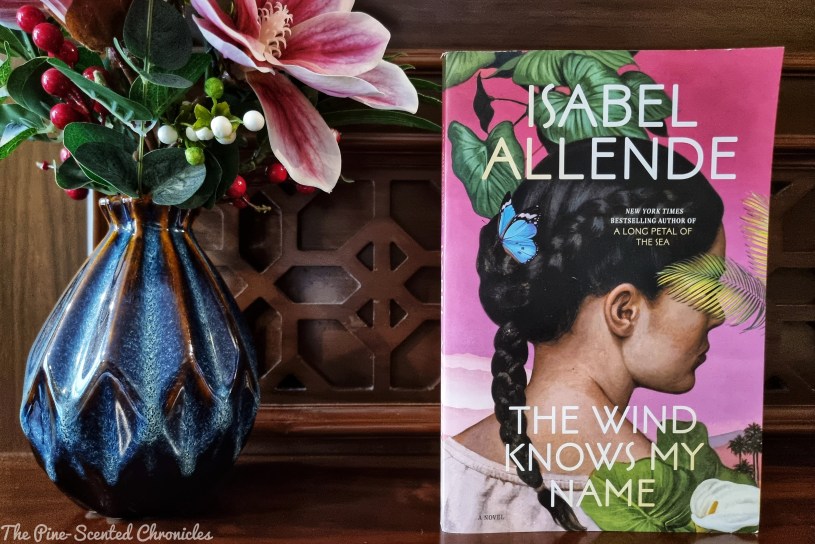
In what has become her comfort zone, Allende again scoured the past to amplify a concern in the present. The result is her latest novel, The Wind Knows My Name which was released in 2023. The novel charted two narrative threads, the first of which commenced in 1938 in Vienna, Austria. It was a time of political turmoil across the European continent as Adolf Hitler and Nazi Germany are slowly consolidating power. Hitler hatched a plan that would inevitably lead to war; the Second World War as we know it today. He annexed Austria, thus, extending his policies to the country of his birth. With the Nazis wreaking havoc all over their occupied territories, Austrian Jews were cowering in fear due to the uncertainties and the brutal policies of Nazis toward Jews. Afraid of their safety, Austrian Jews were scrambling to flee Austria.
The first chapter of the novel captured how the Nazis were instilling fear amongst the denizens of Vienna. Many were cognizant of the Nazis’ growing threat but still, everyone was caught off guard by the explosion of violence. The pervasive horror, the resulting fear, and the ensuing chaos were vividly captured by Allende in the opening chapters of the novel. Among the Austrian Jews who were being zeroed in by the Nazis were the Adlers. With the situation becoming dire with each passing day, Rachel, the matriarch, enlisted the help of family friends to assist her in smuggling her son, Samuel, from Vienna. Rudolph, her husband, was a violinist who was first flogged by the Nazis before finally disappearing following the November 5, 1938 pogrom known as Kristallnacht, or the Night of Broken Glass.
Samuel, who was just five years old when all of these happened, was safely able to safely ride the Kindertransport train with only his violin and the clothes on his back. With him, Samuel carried the hope that he would reunite with his parents someday. He was able to make it through to England where he lived from one family to another. The trauma of living through this phase of history made Samuel would grow up reticent. Worse, he was disconnected from his surroundings, especially after learning of his parents’ fate during the Holocaust. He then moved to the United States where his interest in music – once lost during his youth – was reinvigorated. He immersed himself in the jazz music scene of New Orleans, Louisiana. He eventually married a woman who was his antithesis. Her vivacious personality makes up for his reticence.
The second narrative thread takes the readers to a more recent time. The year was 2019 and Anita Diaz, a seven-year-old girl, found herself alone at a camp in Nogales, Arizona. Like Samuel eight decades prior, Anita and her mother, Marisol, boarded a train and traveled all the way from El Salvador to the United States. Anita was partially blind after getting involved in an accident. This accident was among the catalysts that prompted her mother to make the treacherous journey to the Land of Milk and Honey. While most would take on this treacherous diaspora for the promises of the American Dream, Anita and Mirasol took to the road to flee from the looming violence instigated by military gangs who were invading their town.
“She remembered little from her childhood before the border crossing, just the smell of the wood-burning stove, the dense vegetation, the taste of ripe corn, the chorus of birds, warm tortillas for breakfast, her grandmother’s prayers, her brothers’ and sisters’ cries and laughter. She never forgot her mother and treasured the single surviving photograph of her, taken in a town square when she was pregnant with her first child.”
~ Isabel Allende, The Wind Knows My Name
As fate would have it, the safety mother and daughter pairing was looking forward to was hampered by a recent controversial policy, the Family Separation Policy. Enforced by the Trump administration, the policy empowered border patrols at the US-Mexico border. They can forcefully separate children from their parents, deterring refugees. Anita’s case was soon picked up by Selena Durán, a social worker for the Magnolia Project for Refugees and Immigrants. Selena immediately took a liking to Anita and her case as Anita, despite the apparent barriers brought by her disability and the language barrier, was smart and mature for her age. To help locate Marisol, Selena enlisted the assistance of Frank Angileri, a promising lawyer working for the top legal brasses in San Francisco. Frank took on the case pro bono. Allende’s latest novel then charts the fate of the two characters as they move forward from the individual traumas they experienced.
In drawing parallels between the present and the past, The Wind Knows My Name sheds light on seminal social and political concerns. At the heart of these growing concerns are children who innocently found themselves at the crossfire of geopolitical violence. The novel’s message is further amplified by the ongoing conflict between Israel and Palestine. Images of children getting killed by missiles have proliferated social media pages. Children also account for the majority of the casualties and the figures are only bound to get higher with still no clear signs of ceasefire on the horizon. In times of violence and war, children suffer the most. Over the years, literature gave them voices, with novels such as Daša Drndić’s Trieste, Markus Zusak’s The Book Thief, and Valeria Luiselli’s Lost Children Archive serving as reminders of the vulnerability of children during times of conflict.
For those who survived these ordeals, such as Samuel and Anita, the horrors and trauma remain with them. They are mortally wounded by circumstances that are beyond their control. To cope with the trauma, the children build their own coping mechanisms. For Samuel, he found comfort in music. Meanwhile, Anita built the imaginary world of Azabahar and conversed about it with Claudia, her imaginary friend. The novel is a homage to these children who are left to fend for themselves and navigate the intricacies of bureaucracy by themselves. While this is familiar territory in literature, Allende builds on this tradition while, at the same time, underlining the factors that created such. The Second World War is an example prevalent in literature, and for good reason. Allende also drew examples from a place closer to her home.
Recently, a recent uptick in the Central American diaspora to the United States was noticed. It was a growing concern that former US President Donald Trump tried to address by suggesting radical measures such as the aforementioned Family Separation Policy. He even famously revived the idea of a border wall between the United States and Mexico. In 2021 alone, it was estimated that around 1.7 million migrants were returned to their home country or at least detained in the US-Mexico border. Being returned home or evicted at the borders entails facing the same horrors they were escaping from, such as abject poverty and rampant criminality. Gang culture and the illicit drug trade have crippled most Central American cities, with several topping the most dangerous cities list. Some of these ugly realities were captured by Allende.
“All the people, animals, and magical creatures that we already know about are going to get dressed up in costumes for the party, because it’s a carnival. They’re going to give us costumes to wear too, yours is a butterfly, so you can fly, and mine is a hummingbird, so I can fly with you. I wanted a mermaid costume to swim in the sea with the dolphins and seals, but I have to stay with you. You need to pay attention because this is our first party there and we have to make a good impression so they’ll invite us back.”
~ Isabel Allende, The Wind Knows My Name
The story of Leticia, who like Samuel and Anita was a child survivor, provided more historical context vis-a-vis El Salvador. The El Mozote massacre of December 1981 was referenced. During the Salvadoran Civil War, the Salvadoran Army killed over 800 civilians in what is considered the largest massacre in the modern Americas. Leticia and her father survived and managed to escape the United States: “She’d entered the United States clinging to the back of her father, Edgar Cordero, as he swam across the Rio Grande.” The different definitions of family were subtly woven into the story. Blood relations are not always required for families to be formed. Filial relationships can be formed among strangers, such as when a socialite opens her house to a group of homeless people during the height of winter or when an aging man accepts an orphaned child. All throughout, kindness was a catalyst in these found families.
Politics figure prominently in the novel. It was an explicit commentary on Trump’s separation policy and how it has adversely affected families. This she did without being sanctimonious but rather drawing the readers into the real picture. Frank is then an allegory for those who are skeptical of these realities taking place at the borders. The controversial zero-tolerance policy has long been abolished but its effects still reverberate. Despite the creation of the Family Reunification Task Force by President Biden, roughly 1,000 children remain separated from their families. Despite these dark realities, the novel is illuminated with hope. Resilience was a quality the characters showed. It also showed how the kindness of strangers can have a ripple effect. Elsewhere, the novel captured the early days of the pandemic. It also had romantic undertones but the element barely overshadowed the bigger picture.
Overall, The Wind Knows My Name is a welcome addition to Allende’s oeuvre. It examined familiar subjects and themes while, at the same time, adding her own take. Some of the experiences encapsulated in the stories of the characters were reflective of Allende’s own. Despite the passage of time, we keep on repeating the same mistakes. Wars and conflict divide countries but we exacerbate the situation by further tearing families apart. It is then up to us to protect the vulnerable and to provide them voices when they are at their weakest. Allende’s advocated for social justice and tackled timely and relevant subjects, such as the refugee crisis. She deftly wove a lush tapestry that vividly captured forced migration, identity, trauma, loss, found family, and healing. In The Wind Knows My Name, Allende continues her long-standing tradition of crafting thought-provoking but equally heartwarming literary pieces. Also, kindness goes a long way.
“I thought that Azabahar was simply Anita’s refuge, a place she escaped to when she felt alone and frightened. But now I know that it’s more than that. It’s the mysterious realm of imagination, a place you can only see with the heart.”
~ Isabel Allende, The Wind Knows My Name
Book Specs
Author: Isabel Allende
Translator (from Spanish): Frances Riddle
Publisher: Ballantine Books
Publishing Date: 2023
Number of Pages: 252
Genre: Historical
Synopsis
Vienna, 1938. Samuel Adler is five years old when his father disappears during Kristallnacht – the night his family loses everything. As her child’s safety becomes ever harder to guarantee, Samuel’s mother secures a spot for him on a Kindertrasport train out of Nazi-occupied Austria to England. He boards alone, carrying nothing but a change of clothes and his violin.
Arizona, 2019. Eight decades later, Anita Diaz and her mother have boarded another train, fleeing looming danger in El Salvador and seeking refuge in the United States. But their arrival coincides with the new family separation policy, and seven-year-old Anita finds herself alone at a camp in Nogales. She escapes her tenuous reality through her trips to Azabahar, a magical world of the imagination. Meanwhile, Selena Duran, a young social worker, enlists the help of a successful lawyer in hopes of tracking down Anita’s mother.
Intertwining past and present, The Wind Knows My Name tells the tale of these two unforgettable characters, both in search of family and home. It is a testament to the sacrifices that parents make and a love letter to the children who survive the most unfathomable dangers – and never stop dreaming.
About the Author
To learn more about the prolific Chilean writer Isabel Allende, please click here.


📖
LikeLike