
Happy Tuesday everyone! Just like that 2023 is slowly drawing its curtain. I can’t believe that today is the last Tuesday of the year and that within a couple of days, we will be welcoming 2024. With the year dwindling down, I hope that the remaining days of the year will be filled with blessings and good news.
Before we could wave goodbye to 2023, let me cap it with my last Top 5 Tuesday update for the year. Top 5 Tuesday was originally created by Shanah @ the Bionic Bookworm but is now currently being hosted by Meeghan @ Meeghan Reads.
This week’s topic: Top Five Books of 2023
For the second year in a row, I completed over 100 books. When I finally achieved this feat last year, I thought I would never be able to replicate it. But hey! Lo and behold, I managed to replicate it. I also did something better: I was able to reset my personal record for most books read in a year. Among these 100 books, there were several that stood out, really stood out. This makes it a little challenging to pick which ones to include in this list. I bet I will be having the same struggles when I try to list my top ten outstanding books for the year. Nevertheless, here are some of the books that stood out for me.

Title: Ulysses
Author: James Joyce
Ironically, James Joyce’s Ulysses is the most recent book I did not finish; it was part of my 2027 Top 20 Reading List but I gave up on the book when I was midway through. The book barely made sense but I also resolved to re-read the book once I gain more literary experience. That opportunity came this year when I was on the brink of my 1,000th novel. I reserved it for this important milestone. I guess the gap between my first time with Ulysses and my rereading it helped in my appreciation of the book. I struggled during the first time but I was more at ease this time around even though there was still a sense of intimidation. The book was inspired by the adventures of Odysseus (from Homer’s Odysses”; the Latinized version of his name was Ulysses). From this vantage point, the story started to make sense. The novel tracked a one-day “adventure” of Leopold Bloom while he ventured across the busy streets of Dublin; the book was set in the early years of the 20th century. What makes the book stand out, however, is its complex structure. Joyce employed different literary styles and the plot was never straightforward. It was this nonconformance to literary conventions that flummoxed me the first time around. However, reading the book this time around made me appreciate it, enveloping me with the wonders of literature, from its ability to leave one in awe to its ability to frustrate.

Title: Our Share of Night
Author: Mariana Enriquez
I first came across the Argentine writer in 2021 when her book, The Dangers of Smoking in Bed, was shortlisted for the International Booker Prize. I wanted to read the book but held back when I learned it was a short story collection. The universe conspired for me and Our Share of Night became her first novel to be translated into English. At the heart of Our Share of Night is the father and son duo of Juan and Gaspar Peterson. The story commenced in 1981 when Juan’s wife passed away. To grieve and heal, Juan took his son to his in-laws’ estate, in the Argentine countryside. Little did Juan know that the trip would open Pandora’s box when they uncovered a deeply kept family secret: the Order, a cult with an obsession with the supernatural evil presence called Darkness and immortality. Our Share of Night, for its sheer ambition, is a towering accomplishment of literature. It is the conjunction of literal and metaphorical horrors set in a nation – Enríquez’s writing was vivid in capturing a sense of place and time – that was still reeling from the atrocities it recently witnessed. While its horrific elements were local, its overall messages resonate on a universal scale. Enríquez’s novel gave voice to those who were muted by the insatiable appetite for power and control. Beyond history and the occult, Our Share of Night was a moving story about the power of parental love.

Title: The Magic Mountain
Author: Thomas Mann
Like Ulysses, The Magic Mountain occupies an important part of my literary journey as it is the 1,100th novel I read. Thomas Mann has long been on my list of writers whose works I wanted to read. The Magic Mountain was his first book that caught my attention. It took time but I was finally able to obtain a copy of the book which I made part of my 2023 Top 23 Reading List. Set in the decade immediately before the First World War, the heart of one of the 1,001 Books You Must Read Before You Die is Hans Castorp, the only son born to a Hamburg merchant family. He lost his parents when he was young, he was raised by his grandfather, and, following his grandfather’s death, by his maternal uncle James Tienappel. When the story commenced, he was a young adult studying for a career in shipbuilding. The crux of the story was when he decided to pay a visit to his cousin, Joachim Ziemssen an officer in training suffering from tuberculosis and was convalescing in the International Sanatorium Berghof in the Swiss Alps. Hans was supposed to stay for three weeks but he extended his stay as his health became frail. During his stay, Hans got more immersed in the world of the titular “magic mountain,” getting acquainted with the other denizens of the sanatorium who were a microcosm of pre-war Europe. Mann takes the reader across a spectrum of subjects, such as death and the inevitable flow of time. It was a challenging read but it was, nevertheless, worth the long wait.

Title: Jacob’s Ladder
Author: Ludmila Ulitskaya
I can’t remember when I first encountered Ludmila Ulitskaya although it did not escape my attention that the Russian writer – at least her works – has been ubiquitous lately. My interest in her oeuvre was further piqued when she was a regular presence in discourses apropos possible honorees for the Nobel Prize in Literature. These were among the reasons why I listed her novel, Jacob’s Ladder, in my 2023 Top 23 Reading List. Said to be Ulitsakaya’s final full-length prose, Jacob’s Ladder follows two narrative threads: one in the present and one in the past. The present charted the story of Nora Ossetsky, a set designer, theatrical director, and writer in late-Soviet and post-Soviet Moscow. Following the decline of her marriage of convenience with Vitya, she raised her wayward son Yurik as a single mother. The second plotline followed the story of Nora’s grandparents Marusya Kerns and Jacob Ossetsky in the revolutionary and Stalinist periods. The second plotline was built from a cache of letters and journal entries made by Jacob uncovered by Nora while cleaning her grandmother’s house. On the surface, Jacob’s Ladder is a family saga oscillating across time periods. Beyond the examination of family dynamics and strenuous relationships, the novel chronicled Russia’s modern history, from the fall of the Romanovs to the rise of Joseph Stalin to the dismantling of the Union of Soviet Socialist Republics. With the vast territory it covered, Jacob’s Ladder is certainly one of my best reads this year.
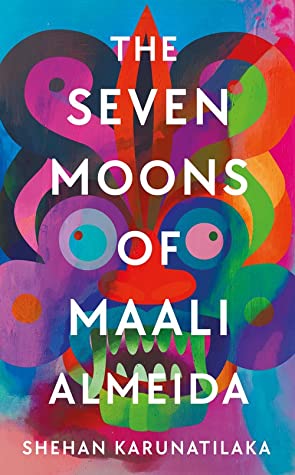
Title: The Seven Moons of Maali Almeida
Author: Shehan Karunatilaka
One of the books I was badly looking forward to this year is Shehan Karunatilaka’s The Seven Moons of Maali Almeida. Had it not been for the Booker Prize, I would have not heard of him. The Seven Moons of Maali Almeida was among the first books that piqued my interest when the longlist was released. Its winning the prestigious literary prize sealed its faith: I will have to read it no matter what. Obtaining a copy of the book was another subject. When the opportunity arose, I did not hold back. As expected, there was nothing normal about the book. When the novel commenced, the titular Maali Almeida woke up in a place he least expected to be: the place between heaven and hell. The year was 1990 and Almeida was unsure what happened to him. He, however, had seven moons to uncover what happened. We learn that he was a photographer by profession and was all over Sri Lanka, capturing images of the civil war that hounded the island from the early 1980s until 2009. The humor and wit that the book was riddled with belie the devastation caused by the Sri Lankan Civil War, a seminal part of the country’s modern history. Overall, The Seven Moons of Maali Almeida was a strange read but it was also a compelling and immersive mix of history and fantasy.
Here are other books that captured my interest during the year.



 The Pine-Scented Chronicles
Congrats on reading over 100 books again this year! I read some of Ulitskaya’s “The Green Tent” and found her an intriguing author I wanted to return to. Maybe I’ll try reading “Jacob’s Ladder.” Thanks for suggesting it!
LikeLike