
Happy New Year everyone! We’ve successfully completed a 365-day revolution around the sun. But with every end comes a new beginning. We are provided with 366 blank pages – 2024 is a leap year – upon which to paint new memories. I hope that we will all paint these blank canvases with good and lasting memories, may it be with the people we love or all by ourselves. Thankfully, things are finally looking up after spending nearly three years under a shroud of uncertainty due to the pandemic. I sure hope that the good times keep on rolling.
As has been the tradition in the past few years, I will be kicking off the new year by looking back to the previous year, its hits, and of course, its mishits. It is also an opportunity to take a glimpse of how the coming year is going to shape up. This book wrap-up is a part of a mini-series that will feature the following:
- 2023 Top Ten Favorite Books
- 2023 Book Wrap Up
- 2023 Reading Journey by the Numbers
- 2023 20 Most Memorable Book Quotes (Part I)
- 2023 20 Most Memorable Book Quotes (Part II)
- 2023 New Favorite Authors
- 2024 Books I Look Forward To List
- 2024 Top 24 Reading List
In the past few weeks, I have reiterated how, reading-wise, 2023 has been a record-breaking year. When I finished 2022 with 103 books, I honestly thought that I would not be able to replicate the feat. But lo and behold! Not only was I able to replicate reading at least 100 books in a year – a long-time dream – but I was able to go above and beyond my 2022 achievement. Since my annual book wrap-ups tend to be lengthy, I have decided to separate my reading statistics, hence, this new wrap-up piece.
Below are my primary Goodreads statistics:

I also did my own tracking. Based on my tracking, the total number of pages I completed during the year is 43,466 pages, almost 2,000 pages lower than what is reflected in Goodreads. The disparity can be attributed to the difference in versions reflected in Goodreads and the actual version I read. Moreover, Goodreads includes the succeeding pages after the story such as the acknowledgment or author’s/translator’s notes. Nevertheless, this only highlights how 2023 has been a very busy reading month.
The statistics below summarize my 2023 reading year and compare the figures against 2022; please note that the 2022 statistics are based purely on Goodreads. Please note that this is based on my own tracking.
| Metric | 2023 | 2022 | Change |
| Total Number of Books Read | 130 | 103 | 27 |
| Total Number of Pages | 43,466 | 38,578 | 4,888 |
| Average Number of Pages | 334.35 | 374.54 | -40.19 |
| Average Goodreads Rating | 4.10 | 3.8 | .3 |
By Length

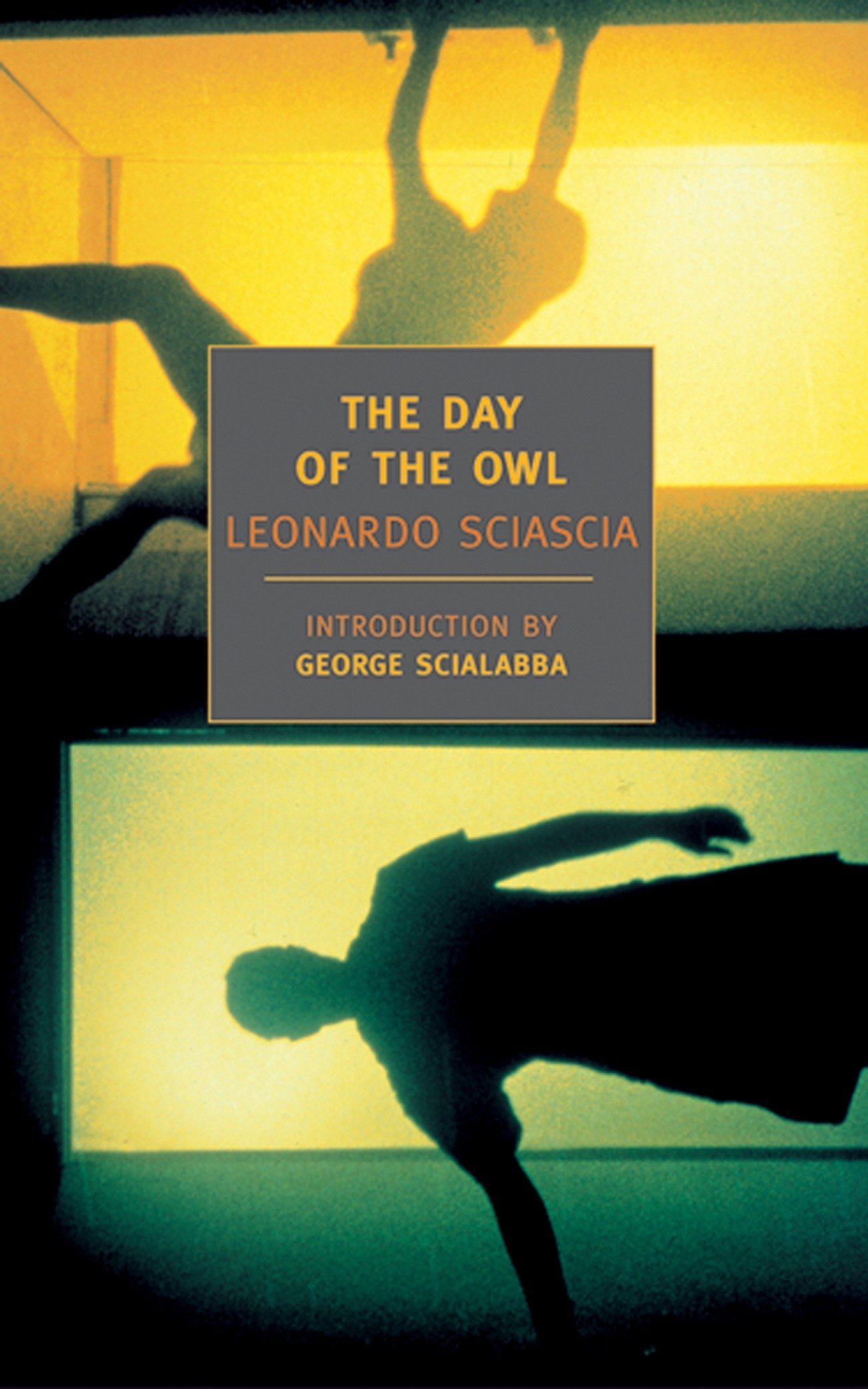
With a whopping 893 pages, my longest for the year was Roberto Bolaño’s 2666. This is, however, significantly shorter than my longest read in 2022, Vikram Seth’s A Suitable Boy (1,474 pages). Meanwhile, my shortest read is Leonardo Sciascia’s The Day of the Owl which is 120 pages long. The mystery fiction was my first by the Italian writer.
The graph below shows the number of books I read based on length. Nearly half, 58 to be exact, of the books I read during the year are between 101 to 300 pages long. Another 55 books are of medium length, with length ranging from 301 to 500 pages. This underlines how I prefer longer reads, books that are at least 200 pages. The other 800-pager I read during the year was John Irving’s latest novel, The Last Chairlift, which was just four pages shorter than 2666.

By Nationality and Language
It was in the past year that I started tracking the nationality of the writers whose works I read. I also rebuilt data from books I have already read. One thing I noticed was how the scale tipped heavily in favor of American writers. Nearly half of all the books I read were written by American writers. Even if I separate writers who have other legacies, American writers still dominate my read list. In fact, four of my five most-read writers are Americans, with Danielle Steel heads and shoulders above everyone else, with 42 books. Agatha Christie was the only anomaly.
This disparity prompted me to take action. I resolved to read more works of non-American writers. I guess I was unconsciously doing this in the past three years because I have been reducing the gap. The below map shows the origin of the writers whose works I read during the year:

Interestingly, or perhaps not, I have read more works of Japanese writers, with 26 books. I guess this comes as no surprise as Japanese literature is one of my favorite parts of the world of literature. Moreover, my recent trips to Japan reinforced my growing appreciation of Japanese literature. Writers from the United Kingdom come in second while American writers are third, with 16 and 15 books, respectively.
Other important notes include:
- Most works written by Filipino writers read in a year, with four.
- Most works written by Chinese (mainland China) writers read in a year, with five.
- Most works written by Argentinian writers read in a year, with four.
- Most works written by South African writers read in a year, with three.
- I read works of writers from 38 countries, including my first books written by writers from the following countries:
- Bangladesh – Tahmima Anam
- Bulgaria – Georgi Gospodinov
Perusing my books read list, I also noted another glaring statistic: the majority of the books I read were originally written in English. As of the start of 2023, more than 80% of the books I read were written in this language. This was also palpable in the previous year wherein books originally written in English dominated my reading list. However, it can also be noted that the gap between English and non-English books is reducing. In fact, this year, for the first time since I started reading, I read more books originally written in other languages other than English. Below is the breakdown:

Sure, books written in English still dominate the list but they comprise less than 50% of all the books I read during the year. This is a huge development and sets the tempo for how I plan to proceed with my 2024 and succeeding reading years. For non-English books, books written in Japanese lead the pack, with 25 books. This also sets my record for the most books written in Japanese I read in a year. The number of books written in Spanish (10), French (6), Chinese (3), Arabic (3), and Korean (3) are also my current personal bests. In 2023, I read works originally written in 20 different languages. This is also a personal record.
On top of these, I read my first books written in the following languages:
- Bengali
- Bulgarian
- Hebrew
- Hiligaynon
- Tagalog
- Tamil
- Vietnamese
By Genre and Original Publication Date
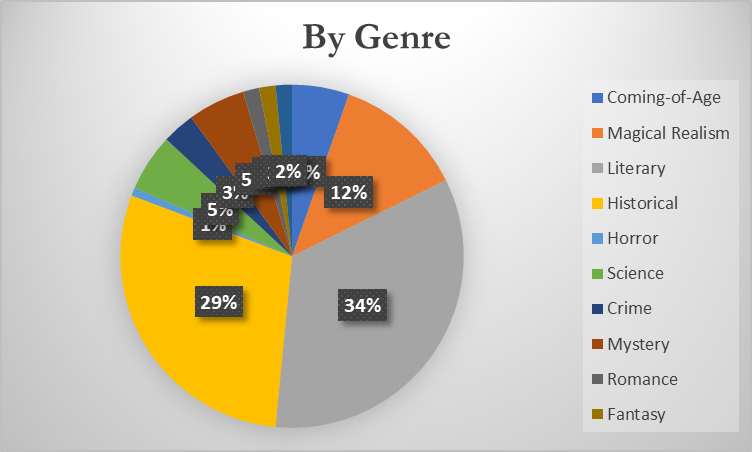
It comes as no surprise that my two most-read genres are literary and historical fiction, with 44 and 38 books, respectively. These two genres have become fixtures in my reading journey. Magical realism, with 16 books, rounds up my Top 3. An interesting presence is science fiction, with seven books. I rarely read works of science fiction although I have been trying to explore this genre recently. The number for 2023 was driven by the last four books of Douglas Adams’ The Hitchhiker’s Guide to the Galaxy. It has been my goal to complete the series and 2023 gave me that opportunity.

Another aspect of my reading journey I have been trying to tweak is my fixation with backlists. Over the past few years, I have been trying to read as many new books as I can. However, it is challenging to take out the backlist reader in me. How can I when I know that there are a lot of wonderful books out there? HAHA. Anyway, the graph only underscores this inclination. I read 118 backlists during the year. Interestingly, more than half of the books I read during the year were published in the twenty-first century. Books published in the second half of the twentieth century came in second, with 40 books.
The only pre-twentieth-century books I read were José Mármol’s Amalia (1851) and Thomas Hardy’s Far From the Madding Crowd (1851). The former is the oldest book – at least in terms of original publication date – that I read during the year. For 2024, my goal is to read at least 15 new books; this was my goal in 2023 but I fell short by three books.
And that completes my numerical analysis of my 2023 reading journey. Are there any parts of this update you want me to dig into deeper or at least improve? Or are there statistics you feel I ought to include? Do feel free to share in the comment box.
 The Pine-Scented Chronicles
📖
LikeLiked by 1 person
The origin of the Bengali language is deeply rooted in the historical and cultural landscape of the Indian subcontinent. Bengali, also known as Bangla, is an Indo-Aryan language primarily spoken by the Bengali people of Bangladesh and the Indian state of West Bengal. With over 230 million speakers worldwide, Bengali holds the distinction of being the seventh most spoken language globally. Its origins can be traced back to the early stages of human civilization in the region.
https://www.indianetzone.com/54/origin_bengali_language.htm
LikeLike