
Happy Wednesday everyone! Woah. It’s a new day and a new month. We are four months down this year. So far, the previous weeks have been scorching here in the Philippines, something that is also experienced by our South East Asian neighbors. I hope that wherever you are, you are feeling comfortable and cool. Regardless, I hope that the year is going great for everyone. I hope and pray that the rest of the year will be brimming with good news, positive energy, and blessings. I also hope that everyone will be happy and healthy, in body, mind, and spirit.
Wednesdays also mean WWW Wednesday updates. WWW Wednesday is a bookish meme hosted originally by SAM@TAKING ON A WORLD OF WORDS. The mechanics for WWW Wednesday are quite simple, you just have to answer three questions:
- What are you currently reading?
- What have you finished reading?
- What will you read next?

What are you currently reading?

In a way, I am in the midst of a Nobel Laureate in Literature reading swing as I have been reading works written by highly regarded awardees of the prestigious literary award. This journey started with Doris Lessing’s The Grass is Singing. I am pursuing this path with my current read, Hermann Hesse’s Narcissus and Goldmund. This is my third novel by the German laureate but my first since 2019 (Demian). This is also one of the reasons why I wanted to read one of Hesse’s works this year. I just started reading the book although it already introduced me to the two main characters, the titular Narcissus and Goldmund. I guess I am not going to be surprised if it tackles religious philosophies. I will be sharing more of my impressions of the book in this week’s First Impression Friday update.
What have you finished reading?

Like in the case of Hesse, it has been years since I read my last (and only) novel by Alice Walker. I must say, I was not a fan of The Color Purple even though it has received several wonderful feedback. Although I had a grasp of the book’s message, the book’s use of colloquial wedged between my appreciation and understanding of the novel. I was reluctant at first but I wanted to give her prose a chance, hence, my purchase of The Temple of Familiar. Unfortunately, it was left to gather dust on my bookshelf.
It is for this reason that I included The Temple of Familiar in my 2024 Beat the Backlist Challenge and also my 2024 To 24 Reading List. Widely considered the sequel or at least a companion to The Color Purple, The Temple of Familiar is a polyphonic novel that charts the fortunes of an eclectic cast of characters: Carlotta and her mother Zedé, Suwelo and his wife Fanny, and Arveyda, among others. Zedé was born and raised in Latin America but fled to the United States with her young daughter to escape poverty and the communist regime. It was in San Francisco that they met Arveyda. Carlotta married Arveyda but a devastating twist of events left Carlotta betrayed. Carlotta then met Suwelo, a history professor who was grappling with his own realizations vis-a-vis how men failed women. His wife Fanny also used to teach but was now running a massage parlor that Carlotta frequented. Their individual threads would diverge and converge in a story that examined several seminal subjects such as the feminine experience, and the legacy of colonialization. I must say I prefer The Temple of My Familiar over The Color Purple. Or maybe it is time to revisit the latter.

From one highly decorated writer to another. It has been years since I first encountered the Nobel Laureate in Literature, Doris Lessing. I believe it was The Golden Notebook that first piqued my interest and back then, I didn’t know she was awarded the Nobel Prize in Literature. I have long wanted to read the book but I am yet to obtain a copy of the book. This, however, has not precluded me from obtaining a copy of her other works such as The Grass is Singing and The Good Terrorist.
The Grass is Singing, I learned, was Lessing’s first published novel. I guess it is a good starting point then for the rest of her oeuvre. The novel started off in a way I was not expecting. Set in 1940s Southern Rhodesia (present-day Zimbabwe), the story opens with a newspaper clipping about the murder of Mary Turner. A white woman married to Dick, a farmer, Mary’s lifeless body was discovered on the veranda by Tony Marston, the assistant of Charlie Slatter, the owner of the neighboring farm. It was also Slatter who notified the local police sergeant, Sergeant Denham. From the get-go, it was an open-and-shut case as, at the murder scene, the Turner’s black houseboy Moses immediately confessed to the crime. But was it really as simple as that? The story then flashes back to the past and rebuilds the Turner’s backstory, with a focus on Mary. Mary used to be career-driven and was reluctant to marry until she had been pressured by her peers. Dick, like Mary, was also reluctant to get married because of his poverty. Nevertheless, life had other plans. What ensued was a less than idyllic life. The novel seemed simple but its slenderness belied a complex story that grappled with the legacy of colonialization and racism. Overall, it was a good introduction to Lessing’s body of work.
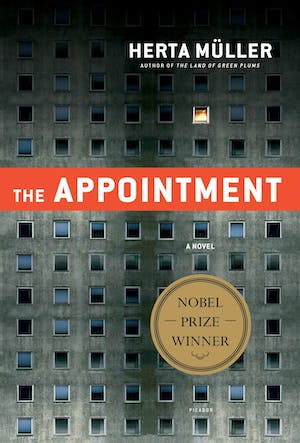
In the history of the Nobel Prize in Literature, only a handful of women were awarded the distinction; the criticism of the Swedish Academy is valid. Among them is Romanian-born writer Herta Müller whom I first encountered during the pandemic through online booksellers. I was able to obtain a copy of The Hunger Angel, a book that impressed me despite the dark and heavy subjects it tackled. This made me look forward to reading more of Müller’s works and The Appointment gave me that opportunity.
Set in Romania during Nicolae Ceauşescu’s communist regime, The Appointment opened with an unnamed woman on her way to an interrogation with Major Albu, an officer with the secret police. A factory seamstress, she was cognizant of her offense. She sewed notes 10 white suits destined for Italy; the notes contained her name and address and asked anyone who found them to marry her. The secret police deemed it as a form of prostitution. On the tram journey from her home to the titular appointment, the unnamed character – it was a deliberate choice to underscore how her experience was ubiquitous in communist Romania – reflected on her past, examining the factors that led to where she was in the present. She ruminated on the men she was involved with and her friendship with Lilli. All over the story, the atrocities of the regime were vividly captured. Censorship, violence, and invasion of privacy were prevalent. It was a good read with solid writing, as can be expected from Müller. However, it can be taxing and it requires focus to wade through the images of daily life in communist Romania.
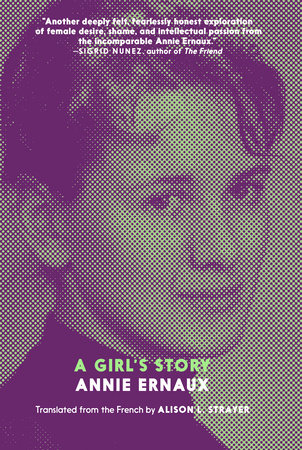
Somehow, I feel that in order for female writers to be lauded with the Nobel Prize in Literature, they must accomplish something extraordinary or their bodies of work are a notch above everyone else. Take the case of French writer Annie Ernaux. She was lauded for how she managed to integrate memoirs into fiction. Her works have a quality of being nonfictional and fictional, at least from what I understand from the write-ups following her awarding in 2022. Memory plays a seminal role in her oeuvre, as can be gleaned in her memoir A Girl’s Story.
Originally published in French in 2016, A Girl’s Story backtracks to Annie’s teenage years. The year was 1958 and Annie Duchesne was just eighteen years old. Immediately following Annie’s graduation from high school, she joined a summer camp as one of the group leaders. It was her first time staying away from her family. Alas, she was free from the clutches of an overbearing mother, albeit for a short period. She also yearned for some semblance of freedom, something the summer camp offered her. She wanted to experience love and passion. At the camp, she was swept by H, a head instructor. It was a time of liberation for the young Annie who was on the precipice of adulthood. It was at the summer camp that she lost her virginity and innocence. In a way, the memoir was a reflection of Annie’s attitude toward sexuality; it was not the generally accepted view of her time. At times, her peers saw her as shameless. Occasionally, the Annie of the present interjects, providing a different vantage point. Overall, it was an interesting and welcome experience. There is a fictional quality that reeled me in and the author’s quandary kept me hooked.
What will you read next?


Finished- Fragile Threads of Power
Currently- The Lost Bookshop
Next- A Wrinkle in Time (however, might need to be read overlapping The Lost Bookshop)
LikeLike
They look like interesting books. The weather here has been good. We did have a storm last night to clear the mugginess that suddenly appeared.
Have a great week!
Emily @ Budget Tales Book Blog
My post:
LikeLiked by 1 person