
Happy Wednesday everyone! Wednesdays also mean WWW Wednesday updates. WWW Wednesday is a bookish meme hosted originally by SAM@TAKING ON A WORLD OF WORDS.
The mechanics for WWW Wednesday are quite simple, you just have to answer three questions:
- What are you currently reading?
- What have you finished reading?
- What will you read next?

What are you currently reading?

With the year slowly drawing to a close – time is flying fast, and we barely notice it – I hope the year has been kind and great to everyone. I hope the remainder of the year will shower everyone with blessings and good news. I hope everyone gets repaid for all their hard work. I hope we will end the year with a bang and sans any regrets. Reading-wise, October will be a mixed bag for I have several things I want to accomplish before the year ends. For one, I want to complete all my reading challenges although I am glad I am nearly finished with my 2024 Top 24 Reading List. I can’t say the same for my 2024 Beat the Backlist Challenge. I am also looking at reading novels shortlisted for the Booker Prize although the books are still in transit. In the meantime, I am reading books in my ongoing reading challenges such as Orhan Pamuk’s The Black Book which is part of my 2024 Beat the Backlist Challenge.
In a way, reading the book is in line with the season because tomorrow, the newest Nobel Prize in Literature awardee will be announced; besides, I just finished reading Olga Tokarczuk’s The Empusium. Anyway, The Black Book is my fifth novel by the Turkish laureate in literature. It was originally published in Turkish as Kara Kitap in 1990. The story commences on a winter night when Galip, an Istanbul lawyer, returns home to find that his wife, Rüya, has disappeared. Rüya’s half-brother, Jelal, a famous Istanbul columnist also disappeared; Galip secretly admired Jelal since he was a child and wanted to be like him. To get to the bottom of the mysteries, Galip retraces his Rüya and Jelal’s steps. In doing so, he must navigate the labyrinth that is Istanbul. Like in Pamuk’s other works, Istanbul transforms into one of the book’s main characters. Galip walks the readers through subterranean passageways, affluent neighborhoods, and even the city slums. There is so much to look forward to in the novel and should I not finish it before Friday, I will be sharing more of my impressions of the book in this week’s First Impression Friday update.
What have you finished reading?
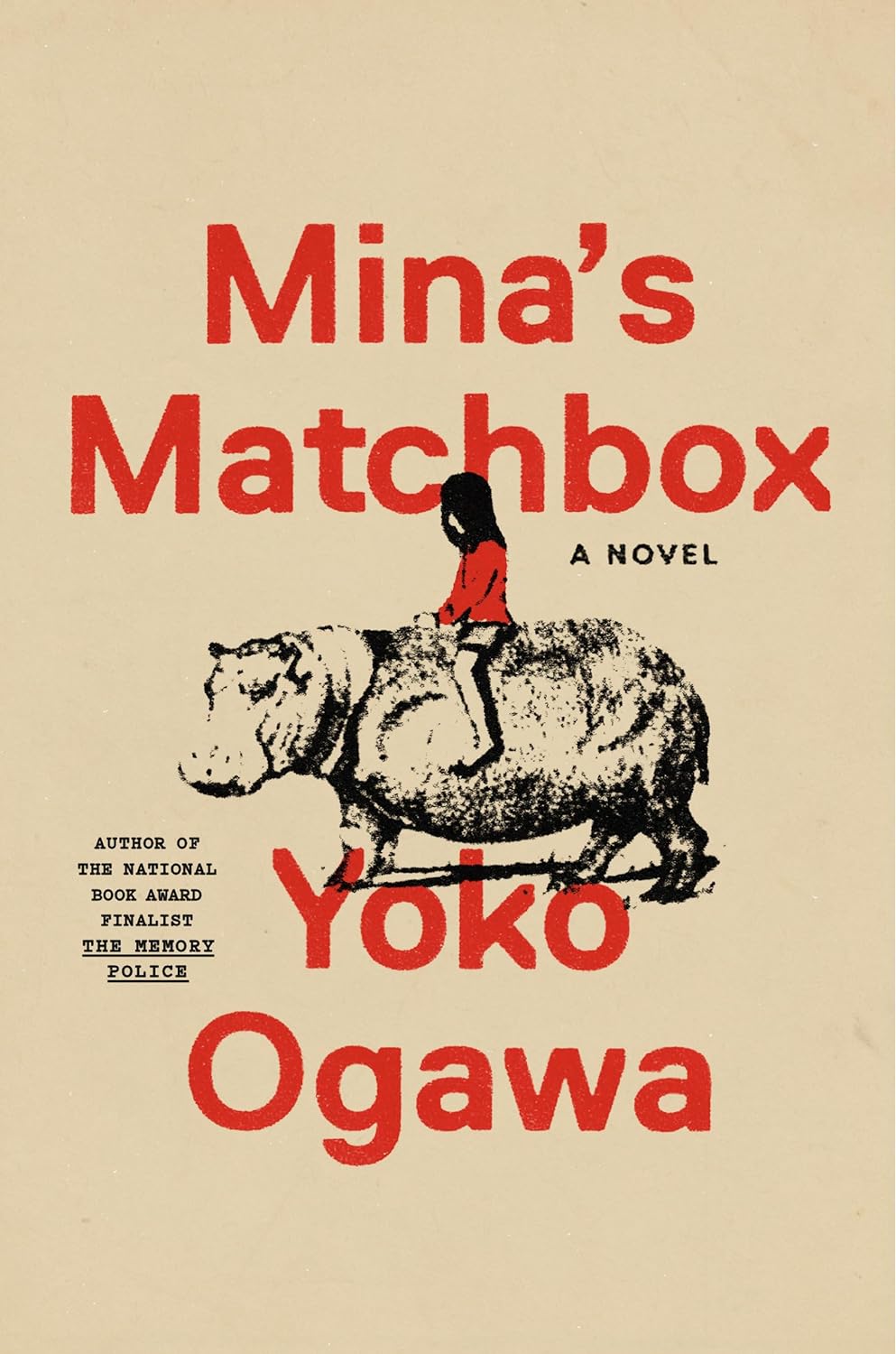
The past week was rather slow in terms of reading. I was able to complete just two books in the past week. It is still a good number, all things considered. Due to an office event, I had to walk and go out more to gain more steps; it is part of the company’s sustainability commitment. Regardless, I am still happy because the last two books I read are the 99th and 100th books I read this year. This means that I have read at least 100 books in the past three years. Imagine, reading 100 books used to be just a farfetched dream but I was finally able to make it come true and even sustain it. Anyway, the first of two books I read in the past week is Yōko Ogawa’s Mina’s Matchbox.
I was not even aware that the Japanese writer was releasing a newly translated book. Regardless, I am in for the ride, making Mina’s Matchbox the third book by Ogawa I read. The story is set in 1970s Japan and is narrated by Tomoko, a teenage girl. Now that she was twelve, she was sent by her mother to her cousin Mina’s affluent estate in Ashiya while her mother was learning a trade to support Tomoko while her father passed away when she was just six. Tomoko’s aunt was eccentric and rich; she agreed to keep Tomoko for a year. Interestingly, it was Tomoko’s first time meeting the family. At Mina’s home, Tomoko discovers a lot of things. First off, the estate used to be a zoo. Vestiges of the zoo are still present, including Pochiko, a pygmy hippopotamus who is also the family’s pet. Tomoko’s stay with her cousin was a revelation; I recognized from the onset that it was a coming-of-age story, one that I did not expect from Ogawa but was still excited about because it provided me a different dimension to appreciate the diversity of her oeuvre. While the narrator is Tomoko, the story captures the coming-of-age of the cousins. The premise is promising. The story detailed the two young girls’ sexual awakening, for one. For Tomoko, it was an eye-opener as she got to experience a different facet of life far removed from the realities she had to deal with at home. Overall, Mina’s Matchbox was eccentric but, nevertheless, a compelling read.

Like in the case of Ogawa, I was not even aware that Olga Tokarczuk was releasing a new work, The Empusium. When I recently learned about its release, I did not waste time adding it to my reading list and, thankfully, I did not have to wait long before I could obtain copies of the book. It was by design that I made the Polish Nobel Laureate in Literature’s latest work as my 100th read this year. The Empusium is also my fourth by Tokarczuk who I first heard of during the awarding of the 2018/2019 Nobel Prize in Literature. This makes Tokarczuk my most-read female laureate; Kazuo Ishiguro, with eight books, remains my most-read laureate.
The Empusium takes inspiration from a beloved novel written by another Nobel Laureate in Literature, Thomas Mann’s The Magic Mountain which happened to be one of my favorite reads last year. Tokarczuk’s latest work takes us to the years before the First World War. In September 1913, a young Polish man named Mieczysław Wojnicz, a student of hydroengineering from Lwów arrives at Wilhelm Opitz’s Guesthouse for Gentlemen in the village of Görbersdorf, a health resort in the Silesian mountains. Professor Sokołowski sent the engineer-in-training to the Guesthouse, which is near a sanitarium, to convalesce from tuberculosis. Wojnicz shares several parallels with Hans Castorp, the main protagonist of Mann’s literary masterpiece. Like Castorp, Wojnicz met an eclectic cast of characters at the Guesthouse who were waiting for a place to open up at the sanitarium. Among the characters he met are Longis Lukas, a Catholic professor; August August, a Viennese lover of ancient Greek mythology; and Thilo von Hahn, a German Fine Arts student. There is a layer of mystery settling on the story as the wife of Opitz, the Guesthouse overseer, was found lifeless; the husband was quick to conclude her death as a suicide. On to of this, the characters were embroiled in intellectual discussion, again, a paean to Mann’s masterpiece. While there were several parallels between The Magic Mountain and The Empusium, The Empusium stands out on its own. Overall, it is an interesting book brimming with philosophical intersections and profound commentaries about a bevy of subjects that remain germane in the contemporary.
What will you read next?

 The Pine-Scented Chronicles