A Black Love Story
For centuries, American literature has established a rich literary tradition that has produced some of the most prominent and popular voices in world literature. It boasts some of the world’s most recognized writers, such as Herman Melville, Edgar Allan Poe, Mark Twain, Walt Whitman, Emily Dickinson, Willa Cather, Harriet Beecher Stowe, and Louisa May Alcott, among others. Each of them is a titan in the realm of world literature. Their writings span a plethora of genres, including novels, poetry collections, essays, short stories, and even plays. Their works—such as Melville’s Moby-Dick, Twain’s The Adventures of Huckleberry Finn, Stowe’s Uncle Tom’s Cabin, and Alcott’s Little Women—have transcended time and remain integral to contemporary literary discourse. They are hallmarks not only of American literature but of world literature.
Among the many prominent voices that contemporary American literature has produced is Toni Morrison. Born Chloe Anthony Wofford Morrison, she was raised in the American Midwest by a working-class family devoted to the appreciation of African-American culture. Morrison’s formative years were filled with African-American stories, songs, and folktales. These childhood narratives were seminal in shaping her appreciation not only for literature but also for her heritage. All of these influences would eventually be translated into her literary works. After completing her degree in English at Howard University and her master’s in American literature at Cornell University, Morrison worked as an editor and also taught at prestigious universities. While editing and teaching, she began writing fiction. One of her early short stories, about a young Black girl who yearned to have blue eyes, would eventually become the backbone of her debut novel, The Bluest Eye (1970).
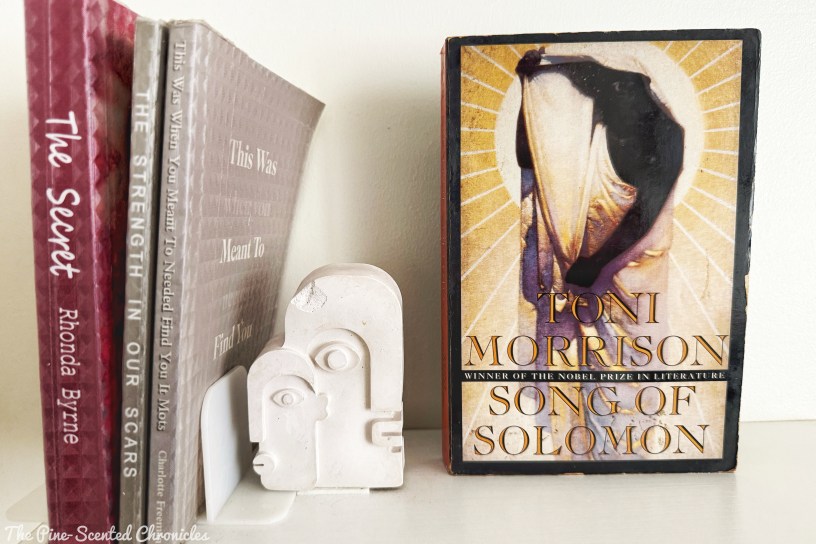
Interestingly, Morrison was nearly forty when she published her first novel. As the saying goes, it is never too late to pursue one’s passions, and for Morrison, this marked a pivotal shift. The Bluest Eye was warmly received by both literary critics and the general public. Building on its success, Morrison published Sula three years later. It was nominated for the National Book Award in 1975, drawing attention to her burgeoning career. While her first two novels were exceptional, it was her third, Song of Solomon, that made Morrison a household name. Published in 1977, it won the National Book Critics Circle Award and became the first book cited by the Swedish Academy when they awarded Morrison the Nobel Prize in Literature in 1993. With this recognition, Morrison became the first Black female writer in history to be honored by the Academy.
You can’t own a human being. You can’t lose what you don’t own. Suppose you did own him. Could you really love somebody who was absolutely nobody without you? You really want somebody like that? Somebody who falls apart when you walk out the door? You don’t, do you? And neither does he. You’re turning over your whole life to him. Your whole life, girl. And if it means so little to you that you can just give it away, hand it to him, then why should it mean any more to him? He can’t value you more than you value yourself.
Toni Morrison, Song of Solomon
Song of Solomon opens in 1931 with a tragic event. An African-American insurance agent, Robert Smith, attempts to fly before a crowd by jumping off Mercy Hospital, located on Not Doctor Street in an anonymous Michigan town. Amid the chaos, Ruth Foster Dead—the daughter of the town’s first Black doctor—gives birth to Macon Dead III. Ruth, married to Macon Dead Jr., becomes the first Black woman to give birth at the hospital. The street was named in honor of her father. Macon Dead Jr., from an obscure working-class Southern background, had built a reputation as a cold and often violent man who amassed wealth as a landlord. His real estate success was rooted in the exploitation of African-American tenants in Southside—the Black section of the city, also known as the Blood Bank due to its frequent eruptions of violence.
Macon Dead III, the novel’s protagonist, earns the nickname Milkman after one of his father’s employees sees Ruth breastfeeding him. A pivotal event in his childhood occurs when, at age four, he learns that men cannot fly. This realization causes him to lose interest in himself and others, straining his relationship with his family. His apparent lack of compassion mirrors that of his father. Still, Milkman is raised in a home filled with love. His older sisters, First Corinthians and Magdalene (called Lena)—named whimsically by their father from the Bible—look after him. Ruth loves him unconditionally. In his teenage years, his eccentric aunt, Pilate, becomes an influential figure. A bootlegger and conjure woman, Pilate was once close to her brother Macon Jr. Though Milkman is forbidden from seeing her, he reconnects with Pilate through his friend, Guitar Bains.
Milkman’s relationship with Pilate becomes fateful. She provides him with glimpses into his father’s murky past—secrets Macon Jr. has long concealed. This sets Milkman on a journey to uncover his family history and, ultimately, his identity. When Macon Jr. learns of his son’s connection with Pilate, he finally opens up about his own childhood. Macon Dead I, Milkman’s grandfather, was an illiterate slave freed at the end of the Civil War. A clerical error at the Freedman’s Bureau gave him his unusual name when a drunk registrar misunderstood that Macon’s father had died in Macon, Georgia. After gaining freedom, Macon Dead I moved north in a wagon filled with former slaves. He eventually built a successful farm near Danville, Pennsylvania. After tragedy struck, Macon Jr. and Pilate became estranged, diverging in values and paths.
These revelations, however, did little to satiate Milkman’s curiosity. The more he learns, the deeper he is subconsciously digging into his family’s history. This would take him on a quest across states, driven primarily by one story from his father and aunt’s childhood days. While wandering the forest after their father’s death, the siblings uncovered a bag of gold in a cave they slept in. However, they did not take any of it due to fear of reprisal. From Michigan, Milkman’s odyssey takes him to Danville, Pennsylvania, to Lincoln’s Heaven which was once owned by his grandfather. The quest for the gold was all for naught. However, it set Milkman toward a different direction, to the fictional town of Shalimar, Virginia, his grandfather’s ancestral home. What initially started as a quest for a cache of gold eventually turned into a quest for family history. More importantly, it develops into a quest for understanding himself.
And talking about dark! You think dark is just one color, but it ain’t. There’re five or six kinds of black. Some silky, some woolly. Some just empty. Some like fingers. And it don’t stay still, it moves and changes from one kind of black to another. Saying something is pitch black is like saying something is green. What kind of green? Green like my bottles? Green like a grasshopper? Green like a cucumber, lettuce, or green like the sky is just before it breaks loose to storm? Well, night black is the same way. May as well be a rainbow.
Toni Morrison, Song of Solomon
The central theme of Song of Solomon is a young man’s quest for his own identity. At the onset, Milkman was the quintessence of an aimless and purposeless young man drifting through life. We initially meet a man who is content to go “wherever the party is.” He has become a spitting image of his father: apathetic, materialistic, and sexist, chauvinistic attitudes toward women. He lacks spirituality and looks down on those who he perceive to be beneath him. He is the portrait of the proverbial anti-hero. Further, Milkman’s aimlessness allowed him to be pulled into different directions by the people around him; they were all vying to control his life. His mother wanted him to pursue a medical degree. His father, on the other hand, wanted him to join the business. Pilate’s granddaughter, Hagar, wanted them to settle down.
This makes Milkman a fascinating character study. Though his journey begins with the pursuit of wealth, it transforms through a series of coincidences into something more profound. His trip to Shalimar is serendipitous, though the reception he receives there is hostile. Harassed for his arrogance, Milkman experiences a eureka moment. He had always believed himself different from his father, but through the mishaps and misadventures he undertook, he begins to recognize his flaws. His physical journey through Pennsylvania and Virginia becomes a metaphysical and spiritual quest. Through this, Milkman gains self-awareness, learns to love himself, and becomes a better version of himself.
Integral to this transformation is his discovery of family history. During his journey, Milkman learned more about his ascendants and their complicated history. He learns that grandfather’s real name, for instance, is Jake. In Virginia, he heard the children playing and singing a nursery rhyme based on his own family, the titular Song of Solomon; his memory reminds him of the same song his aunt sang. He learns that his great-grandfather was the legendary flying African Solomon. While Solomon’ flight was successful, it came at the cost of abandoning his wife and children. Milkman is not only connecting the past to the present but also reconnecting with his “tribe” and embracing his African-American heritage. His evolution is one of the novel’s most remarkable achievements.
Threaded through Milkman’s journey are significant cultural and social themes. Set between the 1930s and the 1960s, the novel captures several milestones for Black culture in the 20th century, such as the Civil Rights Movement and the Black Power Movement. True to Morrison’s style, racism is at the forefront of the novel. With the lack of white characters, the novel explores how White racism drives the internalized racism within African American communities. This can be observed in how Macon Jr. exploited the poorest African Americans for pecuniary gains. He looked down on his fellow African Americans. Hagar, on the other hand, dislikes her hair and dark skin because they mark her as a Black woman. She yearns to be light-skinned. On the other hand, Guitar exhibits a different form of racism. Due to a tragic past, he felt an intense loathing for White people, even those sharing sympathy.
In fact her maturity and blood kinship converted her passion to fever, so it was more affliction than affection. It literally knocked her down at night, and raised her up in the morning, for when she dragged herself off to bed, having spent another day without his presence, her heart beat like a gloved fist against her ribs. And in the morning, long before she was fully awake, she felt a longing so bitter and tight it yanked her out of a sleep swept clean of dreams.
Toni Morrison, Song of Solomon
A powerful motif in Song of Solomon is the significance of names. Not only do names identify an individual but names also tell stories and record history. Doctor Street, for instance, is a celebration of Dr. Foster’s achievement. However, government officials refused to acknowledge it. referring to it as Mains Street. Acknowledging it as Doctor Street would provide pride to African-American denizens. In return, the African-Americans sarcastically called it as Not Doctor Street. While names hold power, they can also imprison individuals. This is true in the case of Milkman who felt trapped by his name. By carrying his grandfather and father’s name, he felt the weight of walking the same path as they did. He would often remark to Guitar how he felt dead because his surname is “Dead.”
The trapping caused by names is also observed in the other characters. Milkman’s sisters have unconventional names. The method in which their father chose their name was akin to how slaveowners picked names for their slaves. This is another depiction of the racism Macon Jr. exuded. By extension, this is a portrayal of the misogyny and gender roles that permeate the story. Women were subjected to abuse by men. Some women were even deemed worthless. Abandoned women were ubiquitous. Further, while men, like Milkman, were expected to inherit their business, women were expected to be subservient to their spouses. Women were expected to be confined to the house and perform domestic duties. Women not only had to deal with racism but also with the oppression from men.
Cultural touchstones further provide different textures to the landscape of the novel. Music was a prevalent and germane theme in the novel. This highlights the importance music – blues, jazz, and gospel songs – holds in preserving African American culture. The novel also drew inspiration from a plethora of myths, stories, and legends from a diverse range of cultures. The Bible, for one, provides thematic inspiration. The novel’s title was taken from Song of Songs, the twenty-second book of the Old Testament and a collection of love songs taking the form of a dialogue between two lovers. While Morrison’s novel includes romantic undertones, its true arc is a journey toward self-love and spiritual awakening. References to fairy tales, American myths, and African oral traditions enrich the novel’s texture.
Richly layered, Song of Solomon is quintessential Morrison. It is, on the surface, the story of Macon Milkman Dead III, an aimless man drifting through life. But more importantly, it is about a man unearthing his family’s painful yet empowering past, and, in the process, learning to embrace his identity and heritage. Milkman’s story mirrors the African-American experience—fractured by slavery and racism yet resilient and filled with hope. Morrison portrays how racism shapes identity and how reclaiming heritage can be an act of healing. In the end, Milkman’s journey is a thoroughly enthralling odyssey toward self-acceptance and spiritual triumph. With its timeless themes, Song of Solomon is a literary masterpiece, fully deserving of the accolades it has received.
In fact her maturity and blood kinship converted her passion to fever, so it was more affliction than affection. It literally knocked her down at night, and raised her up in the morning, for when she dragged herself off to bed, having spent another day without his presence, her heart beat like a gloved fist against her ribs. And in the morning, long before she was fully awake, she felt a longing so bitter and tight it yanked her out of a sleep swept clean of dreams.
Toni Morrison, Song of Solomon
Book Specs
Author: Toni Morrison
Publisher: Plume/Penguin
Publishing Date: 1987
Number of Pages: 337
Genre: Historical, Literary
Synopsis
Milkman Dead was born shortly after a neighborhood eccentric hurled himself off a rooftop in a vain attempt at flight. For the rest of his life he, too, will be trying to fly. With this brilliantly imagined novel, Toni Morrison transfigures the coming-of-age story as audaciously as Saul Bellow or Gabriel García Márquez. As she follows Milkman from his rustbelt city to the place of his family’s origins, Morrison introduces an entire cast of strivers and seeresses, liars and assassins, the inhabitants of a fully realized black world.” (Source: Goodreads)
About the Author
To learn more about the awardee of the 1993 Nobel Prize in Literature, Toni Morrison, click here.
 The Pine-Scented Chronicles