The Legacy of Colonialism
In 2021, the Swedish Academy surprised the literary world when it awarded the Nobel Prize in Literature—long considered the pinnacle of any literary career—to Tanzanian writer Abdulrazak Gurnah. Born on December 20, 1948, in Zanzibar, Gurnah had largely flown under the radar. Literary pundits and betting sites ranked him among the least likely candidates. He was competing against prominent and perennial contenders such as Japan’s Haruki Murakami, India’s Salman Rushdie, France’s Annie Ernaux (who would receive the Prize a year later), Canada’s Margaret Atwood, and Kenya’s Ngũgĩ wa Thiong’o—Gurnah’s own professor in African literature. Despite the stiff competition, Gurnah’s win was monumental. He became only the fifth African writer (or sixth, if Doris Lessing is included) to receive the prestigious Prize. He is also the first Black writer to be honored by the Swedish Academy since Toni Morrison in 1993.
In their selection of Gurnah, the Swedish Academy commended him “for his uncompromising and compassionate penetration of the effects of colonialism and the fate of the refugee in the gulf between cultures and continents.” This holds especially and personally true for Gurnah who, when he was just eighteen years old, was forced to flee from Zanzibar. Following the declaration of Tanzania’s independence from British rule, Zanzibar was swept by a revolution where citizens of Arab origin were persecuted and oppressed. Gurnah settled in England as a refugee; he eventually gained British citizenship but he maintained close ties with his home nation. He has since crafted a career as an academician and creative writer. In 1987, he published his first novel, Memory of Departure. This would set the tone for Gurnah’s career and announce the arrival of a new voice.
It was, however, with his fourth novel that Gurnah would make a breakthrough. Published in 1994, Paradise was conceived during a research trip to East Africa in the early 1990s. Divided into six segments, the heart of the novel centers on Yusuf, a Swahili boy born in the fictional town of Kawa, Tanzania, at the turn of the 20th century. One day, a wealthy Arab merchant named Uncle Aziz visited Yusuf and his family. Yusuf used to look forward to these visits because his mother would prepare a feast and Uncle Aziz would give him a coin. This visit, however, was different from his previous visits. Uncle Aziz was pressuring Yusuf’s father to settle his debts; Yusuf’s father was a hotel owner who, unfortunately, had fallen into bad times and was buried deep in debt. Following an intense discussion among the adults, Yusuf’s father informed him that he would be joining Uncle Aziz on a trip.
They offered me freedom as a gift. She did. Who told her she had it to offer? I know the freedom you are talking about. I had that freedom the moment I was born. When these people say you belong to me, I own you, it is like the passing of the rain, or the setting of the sun at the end of the day. The following morning the sun will rise again whether they like it or not. The same with freedom. They can lock you up, put you in chains, abuse all your small longings, but freedom is not something they can take away. When they have finished with you, they are still as far away from owning you as they were on the day you were born. Do you understand me? This is the work I have been given to do, what can that one in there offer me that is freer than that?
Abdulrazak Gurnah, Paradise
Yusuf was brimming with enthusiasm only because he did not know the implications of the discussion and the journey. With Uncle Aziz, Yusuf traveled to a coastal town where Uncle Aziz lived. Yusuf was introduced to Khalil, a young man who ran Uncle Aziz’s commercial establishment. Khalil was tasked to train Yusuf. As a mentor, Khalil taught Yusuf how the shop operated. He was also the first one to give Yusuf a dose of reality check: Yusuf had no blood relation to Uncle Aziz. Further, he had been pawned by his father into slavery to settle a portion of his father’s debt. Yusuf should then refer to him as “a seyyid” instead of uncle because Yusuf’s father, like Khalil’s father, sold him to the merchant as a rehani (a pawn or an unpaid worker) to pay off debts. Not only was Khalil Yusuf’s mentor, but he was also Yusuf’s friend and older brother who had no qualms reprimanding his naïve little brother.
As time took its natural course, Yusuf grew into a good-looking and good-natured adolescent who learned the ropes of Aziz’s trade. Meanwhile, Aziz has been harboring aspirations of heading an expedition across East Africa. When Yusuf came of age, Aziz asked him to join him on a trade journey to the interior; Yusuf looked forward to the journey as it was a break from the monotony of running the merchant shop. In the company of a caravan of porters and Mohammed Abdalla, the mnyapara or leader of the crew, Yusuf embarked on a new journey. However, Yusuf’s journey was short-lived and his enthusiasm cut short when the caravan arrived at a village near the mountains. Aziz left his young ward in the custody of his relative Hamid and his wife Maimuna. A mysterious cargo left by Aziz in the care of Hamid left Hamid in a state of worry.
While Yusuf is initially devastated by his abandonment, he soon adopts to the activities in Hamid’s shop where he runs errands and does odd jobs. They even embarked on a trade journey of their own with Hamid’s Sikh friend Kalasinga. It was an eventful trade journey and their return conjoins with the return of Aziz from his own trade journey. Aziz’s journey was marked with challenges, leaving some of his men injured. Yusuf would once again be left in the care of Hamid when Aziz and his caravan embarked on yet another journey across the interior. At this point, one can surmise how trade is a germane theme in the story. The story’s action focuses on the caravans and the various trade networks that intersected the region. Yusuf spent his first years as rehani in Aziz’s shop attached to his mansion before he eventually joined his master in his trade journeys across the region.
For the characters, trade served as a calling, almost in a religious sense. As Abdalla elaborates, This is what we’re on this earth to do. … To trade. We go to the driest deserts and the darkest forests, and care nothing whether we trade with a king or a savage, or whether we live or die. It’s all the same to us. You’ll see some of the places we pass, where people have not yet been brought to life by trade, and they live like paralysed insects. There are no people more clever than traders, no calling more noble. It is what gives us life. Trade, attached to Islamic values, then is essential in the novel’s portrayal of civilization. Aziz then takes a subtly germane role of being a catalyst for the novel’s examination of trade as a way of life. He is a man of contrasts who is cool-headed and respects others but is also cunning. He delegates any form of cruelties required by his trade. He also uses the gullibility of small-time merchants to have them invest in his business ventures.
With his refined airs and his polite, impassive manner, he looked more like a man on a late afternoon stroll or a worshipper on the way to evening prayers than a merchant who had picked his way past bushes of thorn and nests of vipers spitting poison.
Abdulrazak Gurnah, Paradise
An imbalance existed. When his business is doing well, the profits go to Aziz. However, when he incurs losses, it is his business partners who suffer. In the process, Aziz gains indentured slaves. This is the fate of Yusuf. However, the two develop a strange relationship which, at times, is endearing. As Yusuf fails to see the complications of their relationship, they develop a kind of filial but intriguing relationship that deviates from the typical master and slave relationships. In a way, Yusuf is Aziz’s apprentice, accompanying him on his trading caravans. This dynamic obscures the harsh realities of dispossession and displacement, germane subjects the novel explores. This is a form of slavery starkly different from the form of slavery experienced by Africans sold by Europeans to Americans. Yusuf and Khalil, despite their apparent captivity, were allowed freedom. Still, it is slavery with Yusuf and Khalil working without getting paid.
As the story develops, the trading situation during the period slowly develops into a springboard for the other relevant themes and subjects. While the trading caravan was rummaging across East Africa, Gurnah was capturing the complex interaction of social and political conditions that persisted during the period. A melting pot, in the region converged different cultures. Zanzibar, off the coast of Tanzania and Gurnah’s birthplace, is predominantly Islamic. Meanwhile, across the water, East Africa was primarily non-Islamic. Further muddling this complex identity is the arrival of European colonialists, particularly the Germans, who brought with them their own ideologies. The presence of the Germans hung heavily on the air as they imposed new hierarchies and economic dependencies in the region.
Colonialism forms the mantle of the novel. Its remnants overran the story and influenced the lives of the characters in various ways. Anchored on the legacy of colonialism, historical contexts riddled the novel. The novel explores how German colonialism has impacted the lives of the indigenous people who eventually developed a fear of the colonizers. The indigenous people were witnesses to the atrocities perpetrated by the Germans; these atrocities struck fear into the hearts of the locals. The First World War also loomed in the story. The struggle to gain dominance in the region came to a head when the British and Germans engaged in direct conflict. The war and colonialism held consequences for the local communities. Their lives were disrupted and they were displaced. It was a tumultuous period as the war also incited further cultural clashes.
The cultural clashes underscore how the region, and by extension, the entire continent, is teeming with different ethnicities who practice and observe different cultures. Paradise captures this cultural diversity vividly with Yusuf’s adventure into the interior serving as a crucible for the novel to capture a region under which different social mores, languages, and ways of life thrived. It is a lush but complex cultural landscape where tensions are rife. Gurnah explores the complex relationships of Muslims, Africans, and Europeans while also capturing the tensions that existed within African communities. This is an extension of the novel’s exploration of the impact of colonialism. The characters grapple with the changes brought about by external forces. As the colonizers imposed their beliefs and values, local traditions were dismantled.
I’m afraid, you’re right…though not only of them. We’ll lose everything, including the way we live,’ Hussein said. ‘And these young people will lose even more. One day they’ll make them spit on all that we know, and will make them recite their laws and their story of the world as if it were the holy word. When they come to write about us, what will they say? That we made slaves.
Abdulrazak Gurnah, Paradise
Details of culture, beliefs, practices, and traditions add depth and nuance to the story. The novel’s rich tapestry is woven with elements of oral tradition and storytelling. Storytelling plays a vital role in the survival and preservation of cultural heritage. These tales, conveying wisdom, are passed down through generations and shared by the characters. The novel also explores social roles and power dynamics within African indigenous communities. The influences of cultural norms and colonialism are evident within these social hierarchies. Adding a layer of authenticity is the use of different languages, which also underscores the linguistic diversity of the region. However, this diversity can create barriers to communication and poses challenges to the coexistence of diverse cultures.
Beyond themes of slavery and colonialism, and the examination of socio-political structures, Paradise is, at its heart, the coming-of-age story of Yusuf. At the beginning, he is the embodiment of innocence and naïveté. It is this naïveté that blinds him to his circumstances, despite Khalil’s guidance. Nevertheless, as he spends time with Aziz and Khalil, Yusuf begins to blossom. Initially a blank canvas—sheltered by the protective barrier of his family—he slowly starts to develop his own identity. As he grows, he loses some of his innocence, but his interactions with various people broaden his perspective. He also experiences love and desire. These experiences shape him. In a way, Yusuf serves as an allegory for Africa, particularly in the ease with which he succumbs to colonization. The absence of a foundational recognition of human freedom—mirrored in Yusuf’s own journey—contributes to this vulnerability.
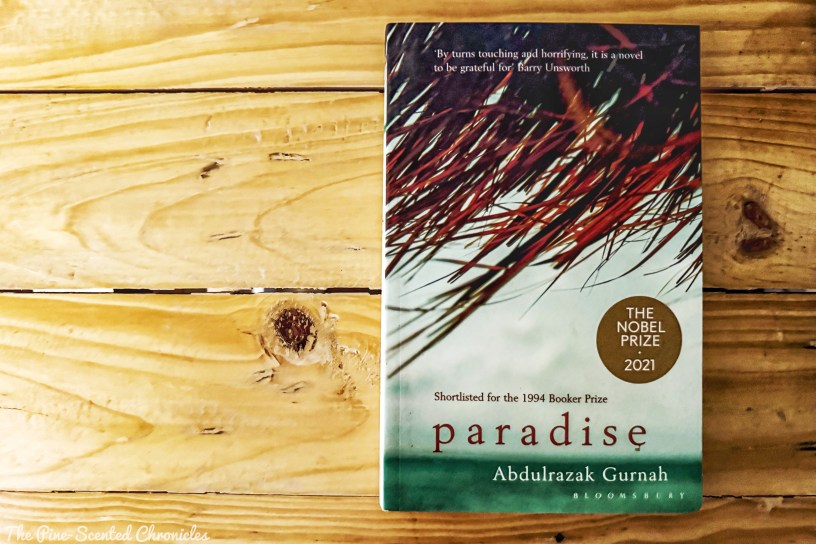
Shortlisted for the prestigious Booker Prize, Paradise catapulted Abdulrazak Gurnah to global recognition. It tells the story of Yusuf, who begins as a paragon of innocence but gradually loses the vestiges of that innocence as he travels with Aziz and his caravan. Along the way, he begins to see and understand the complex reality surrounding him. He witnesses a world marked by linguistic and cultural diversity. It is a kind of paradise—a garden that serves as a recurring motif in the novel. This paradise was ultimately undone by external forces that altered the landscape, a landscape that the characters must learn to navigate while dealing with their internal strifes. With its exploration of complex themes such as colonialism, displacement, and political upheaval, Paradise has established the thematic foundation of the Tanzanian writer’s oeuvre. Richly detailed and immersed in both historical and cultural context, Paradise is a triumph of storytelling.
Everything is in turmoil. These Europeans are very determined, and as they fight over the prosperity of the earth they will crush all of us. You’d be a fool to think they’re here to do anything that is good. It isn’t trade they’re after, but the land itself. And everything in it … us.
Abdulrazak Gurnah, Paradise
Book Specs
Author: Abdulrazak Gurnah
Publisher: Bloomsbury
Publishing Date: 2004
Number of Pages: 247
Genre: Historical
Synopsis
Born in East Africa, Yusuf has few qualms about the journey he is to make. It never occurs to him to ask why he is accompanying Uncle Aziz or why the trip has been organised so suddenly, and he does not think to ask when he will be returning. But the truth is that his ‘uncle’ is a rich and powerful merchant and Yusuf has been pawned to him to pay his father’s debts. Paradise is the story of Yusuf’s coming of age against the backdrop of an Africa of myth, dreams and Biblical and Koranic tradition, growing corrupt with violence and the influence of colonialism.
About the Author
To learn more about the awardee of the 2021 Nobel Prize in Literature, Abdulrazak Gurnah, click here.

