The Empire Unraveling
The landscape of Japanese history is marked by several pivotal events that are often the subject of its national literature. In the contemporary period, the legacy of the Second World War is subtly woven into modern Japanese literary works. With a colorful but often tumultuous past, Japanese literature never runs out of subjects to explore. Take the case of the Genpei War (源平合戦, Genpei Kassen, Genpei-Gassen), more locally referred to as the Jishō–Juei War (治承・寿永の乱, Jishō–Juei no Ran). Lasting from 1180 to 1185 during the late Heian period, it was a national conflict between two powerful and influential rival clans: the Taira and the Minamoto. Both claimed a rightful inheritance to the imperial throne. The name “Genpei” is derived from alternate readings of the kanji for “Minamoto” (源, Gen) and “Taira” (平, Hei, pronounced -pei in some compounds).
The two clans had been in conflict for decades. Tensions came to a head in 1179 when the Taira clan led a coup d’état, removing all Minamoto members from government posts and subsequently banishing them. In 1180, the Minamoto responded by calling their allies to arms. The ensuing Battle of Uji, just outside Kyoto, marked the start of a five-year war. Accounts of this medieval conflict were eventually compiled into an epic narrative known as the Heike Monogatari (平家物語, The Tale of the Heike). Derived from oral traditions and variant texts composed between 1190 and 1221, its origin remains the subject of speculation. Nevertheless, it earned a reputation as the Japanese equivalent of Homer’s Iliad, becoming a prolific source of later dramas, ballads, and tales.
Inspired by these epic historical accounts – and also influenced by other prominent literary works, such as The Tale of Genji, The Water Margin, and Romance of the Three Kingdoms 0 preeminent historical novelist Yoshikawa Eiji (吉川 英治, born Hidetsugu Yoshikawa 吉川 英次) rendered them into prose in the 1950s. The prose rendering carried the title 新・平家物語 (Shin Heike monogatari, trans. The New Tale of the Heike) and was published in serialized form in the weekly magazine Asahi Shukan from June 1950 to March 1957. Rather than a completely faithful account of the original text, Yoshikawa took the liberty of transforming the old narrative into a more modern adaptation. Nevertheless, this modern adaptation would be the most defining work of Yoshikawa’s literary career.
The winter sea darkened slowly, taking on the indigo iridescence of fish scales as the sun dropped toward the horizon. Far out on the waters the crest of the waves gleamed white. It was the hour when the vast wheeling of the earth’s orb was almost perceptible to the senses in the swiftly ebbing light. The long coastline of Kii Peninsula wrinkled away to the south in a succession hills, and between them the harbor in Kiribé Bay lay sheltered, smooth as a millpond. A few lights dotted the hamlet lying between the rivermouth and the sea.
Eiji Yoshikawa, The Heike Story
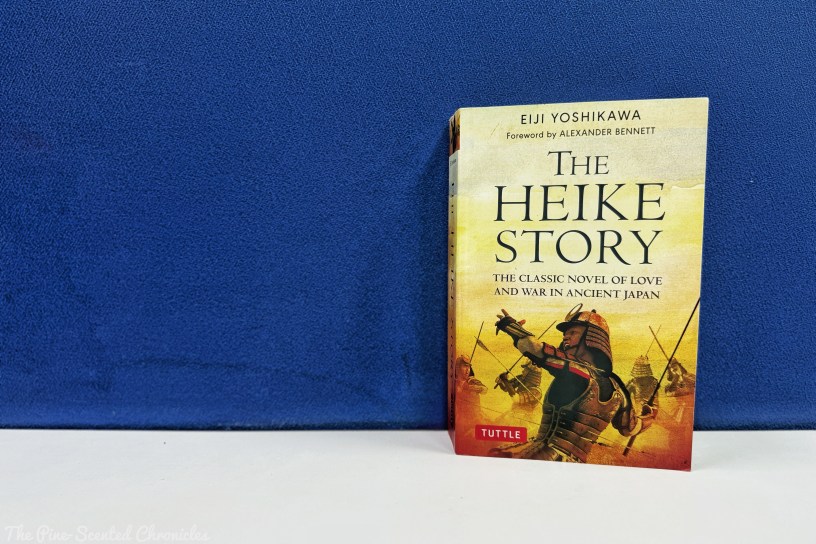
Interestingly, The Heike Story: A Modern Translation of the Classic Tale of Love and War does not cover the Genpei War directly. Instead, it immerses readers in 12th-century Japan, particularly the imperial capital of Kyoto, where several powerful clans thrived and vied for influence in the Imperial Court. The narrative focuses primarily on the titular Heike clan, chiefly through the figure of Heita Kiyomori, whom we first meet in his twenties. He is the eldest son of Tadamori, a trusted figure within the Imperial Palace. Tadamori was so beloved by the Emperor that former Emperor Shirakawa gifted him his favorite mistress, the Lady of Gion, Yasuko. Yasuko would later give birth to Kiyomori. Despite Tadamori’s influence, the family lived in poverty and was further strained by marital discord.
When he was in his early twenties, Kiyomori found himself in a quandary. Morito, his schoolmate from the Imperial Academy, informed him of the rumors regarding his provenance. According to rumors, Tadamori is not his biological father and that his real father is either the abdicated Emperor Shirakawa or a priest of Gion. This prompted Kiyomori to confront his mother. Despite the confrontation, Kiyomori still opted to acknowledge Tadamori as his father. On the other hand, he disowned his mother, who then decided to leave the household. It was at this juncture that fate started to smile on the family. Kiyomori has long blamed his father’s indolence and lack of ambition for their destitution. Exacerbating their poverty was the deviance of their mother. Following the departure of Yasuko and their eventual separation, Tadamori resumed service with the Imperial Guards.
Tadamori eventually improves his status and court, creating opportunities for his son, who also became part of the Imperial Guard. Kiyomori used this as a springboard to rise through the ranks. Through strategic alliances and sound judgement, he outpaces his peers. He was selective of who to associate with and who to support in the constant struggles for power. In the 12th century, following years of harmony, the Empire was destabilized by tensions between abdicated emperors, current emperors, and courtiers. The insei system, prevalent during the Heian period, allowed the retired emperors – they abdicated and took monastic life – to maintain a degree of political power from behind the scenes. This resulted in a splintered political system where two loci of power existed: the Imperial Palace and the Cloistered Palace.
With everyone, including courtiers and other prominent clans, stealthily plotting for the seizure of power and control, Kiyomori navigates this political landscape wisely. His calculated support of key figures earns him wealth and influence. Slowly, he managed to restore the lost glories and reputation of the Heike clan. By the time he was in his fifties, the Heike clan had reached the zenith of its power. However, the Heike clan’s rise in prominence sparked friction with rival warrior clans, particularly the Genji clan. These clans were caught in the middle of the power vacuum created by the conflict between the Imperial Palace and the Cloistered Palace. While the Heike clan was thriving, the Genjis were quietly gaining strength, awaiting for the right moments to challenge their rivals.
Earlier, court circles regarded seasonal excursions and poetry parties as the natural complement to living; yet never had men at large regarded all things as its playthings during this new age which sought to transmute even its religion and politics into exquisite pastimes – all, with the exception of war. At the word “war,” both high and low trembled, for the seeds of conflict were now sown far and wide: among the powerful armed clergy, to the east; to the west, where the pirates of the Inland Sea periodically made their forays; and close at hand in the very capital itself, where the Court and the Palace were at odds with each other.
Eiji Yoshikawa, The Heike Story
Ironically, the two rival warrior clans once joined forces to restore order amidst widespread civil unrest that swept the empire. The story was juxtaposed against the tumult of twelfth-century Japan when the Empire was undone by general decline. The Heian period (平安時代, Heian jida) is akin to Pax Romana, a period marked by the great flourishing in Japanese culture, from literature to paintings; this period produced the beloved The Tale of Genji. However, this also came with the rise of the warrior class and clans and the domination of one clan, the Fujiwara clan. Toward the end of the Heian period, several warrior clans claimed ascendancy to the throne, creating havoc across the Empire. Toward the end of the Heian period, multiple clans vied for supremacy, plunging the empire—and Kyoto—into turmoil.
Kiyomori’s journey takes place against this backdrop. The Cloistered Palace has become the de facto source of power, becoming the real seat of power. Meanwhile, the Imperial Palace’s significance wanes, undermined by weak leadership and the concentration of influence and power on one clan, the Fujiwara clan. his decline marks the twilight of the nearly three-century Heian era. Amid this chaos, Kiyomori steadily works to restore his clan’s reputation. Ambitious and pragmatic, he rises from poverty, leapfrogging several obstacles along the way, to a position of immense power, further reflecting the increasing influence of and reliance on the samurai class by the Imperial Palace.
Kiyomori’s—and by extension, the Heike clan’s—rise was solidified by their role in suppressing the Hōgen Rebellion (保元の乱, Hōgen no Ran) in 1156 and the Heiji Rebellion (平治の乱, Heiji no Ran) from 1159 to 1160. The former centered on imperial succession and the Fujiwara clan’s control over the court. Emperor Go-Shirakawa enlisted the warrior clans to help suppress the short civil war. The Heiji Rebellion, an extension of the previous conflict, focused more on power struggles between samurai clans. It would serve as a precursor to the Genpei War. Both events were later chronicled in their respective gunki monogatari (military tales): The Tale of Hōgen (保元物語, Hōgen Monogatari) and The Tale of Heiji (平治物語, Heiji Monogatari), from which Yoshikawa also drew material.
The clan’s influence and power grew further after Kiyomori’s daughter became the emperor’s wife. The Heike clan was then granted control over more than half of Japan’s provinces. Kiyomori’s prominence within the Imperial Palace increased when he was appointed as the emperor’s chief councilor. He subsequently engineered the first samurai-led government. However, Kiyomori was not immune to human foibles. As he accumulated power, he was increasingly becoming arrogant and tyrannical. He had no scruples about burning temples and exiling those who opposed him. In a way, he was undoing the progress he had built for decades. His descent was hastened by the death of his level-headed son, Shigemori. Kiyomori’s decline mirrors a timeless truth: the higher one rises, the more fragile one’s position becomes.
He had yet to learn to accept life with all its good and evils, to love life in all its manifestations by becoming one with nature. And for this he had abandoned home, wife, and child in that city of conflict. He had fled to save his own life, not for any grandiose dream of redeeming mankind; neither had he taken the vows with thoughts of chanting sutras to Buddha; nor did he aspire to the brocaded ranks of the high prelates. Only by surrendering to nature could he best cherish his own life, learn how man should live, and therein find peace.
Eiji Yoshikawa, The Heike Story
While the novel centers on Kiyomori’s decades-long rise and fall, it also weaves in other characters and plotlines. A notable subplot involves the militarization of monastic sects from Mt. Hiei and Nara. In one episode, armed monks march on the Imperial Palace to protest the misconduct of Heike retainers, particularly Tokitada. Kiyomori, armed only with a bow, confronts the monks and prevents them from storming the palace—a courageous act that earns him both respect and enmity. Another key figure is Yoshitsune, a descendant of the Genji clan. Trained by the “mythical tengu of Kuramadera” based on the original tale – Yoshikawa rationalizes this – he becomes a master swordsman who plays a pivotal role in the Heike’s downfall.
Yoshikawa took creative liberties in his modern adaptation of the Heike monogatari. He filled in the gaps, rationalized certain elements, and provided deeper contexts for certain elements of the original story. However, the English translation, by the translator’s own admission, alters parts of the story to make it more accessible to Western readers. The translation presumed assumes lack of historical knowledge and limited cultural understanding, resulting in an abridged version that lacks some of the depth of the original. Some characters and themes are omitted or underdeveloped, making it difficult to fully appreciate Yoshikawa’s literary style. Still, this is not the author’s fault.
Despite these limitations, Yoshikawa’s adaptation offers readers around the world a valuable window into a crucial chapter of Japanese history. The Heike Story serves as a primer on the Genpei War and the conflict between two of medieval Japan’s most influential warrior clans. Brimming with historical context, the novel chronicles the rise and fall of the Heike clan through the story of Kiyomori, a courageous and ambitious man who rose from poverty to become a central figure in the Imperial Court. It is a story of triumph over adversity, but also a meditation on impermanence. Power, wealth, and influence – once gained – can just as easily be lost. The Heike Story: A Modern Translation of the Classic Tale of Love and War is a rich tapestry that offers an engaging glimpse into Japanese history and cultural heritage.
His ears were now sharpened to every bird cry, and the sight of rabbits and deer no longer startled him. He felt himself one with the birds annd beasts of this wild solitude. But the slightest sound of men approaching made his hair bristle. There they were – coming!
Eiji Yoshikawa, The Heike Story
Book Specs
Author: Eiji Yoshikawa
Translator (from Japanese): Fuki Wooyenaka
Publisher: Tuttle Publishing
Publishing Date: October 11, 2022 (January 1, 1956)
Number of Pages: 541
Genre: Historical
Synopsis
This fast-paced novel recounts the titanic struggle between two rival Japanese clans – the Heike and Genji – as they seek to pacify a fractured nation. Written by the great Eiji Yoshikawa, this classic work brings to life the wars, intrigues, feuds and romances surrounding the most dramatic episodes in all of Japanese history.
Yoshikawa’s tale begins in the capital of Kyoto, where crime and disorder are running rampant. In despair, the Emperor’s calls for help are answered by the leaders of the Heike and Genji families. Once order is established, however, the two clans fall out over dividing the spoils of war, which plunges the country into even greater turmoil. The end result is a great war to end all wars.
This new edition has a foreword by historian Alexander Bennett. Combining raw narrative power, pageantry and poetry, The Heike Story will enthrall readers interested in the drama and spectacle of ancient Japan.
About the Author
Yoshikawa Eiji (吉川 英治) was born Yoshikawa Hidetsugu (吉川 英次) on August 11, 1892, in Kuragi, Kanagawa Prefecture, Japan. The failure of his father’s business resulted in Yoshikawa’s limited education; he received only a primary-school education. At the age of eleven, he was forced to work for a living in the docks of Yokohama before moving to Tokyo to learn the trade of gold lacquerer. It was also around this time that he became interested in comic haiku.
He joined a poetry society and started writing comic haiku under the pseudonym “Kijiro.” In 1914, his novel 江の島物語 (The Tale of Enoshima) won the first prize in a renowned literary contest sponsored by the publisher Kodansha. In 1921, he joined the newspaper Maiyu Shimbun as a journalist and got more seriously into writing. Yoshikawa – a pen name he chose after nineteen others – became a household name with the publication of 鳴門秘帖 (Naruto Hichō; trans. Secret Record of Naruto) which was serialized in the Japanese newspaper Osaka Mainichishimbun, between 1926 and 1927. It was re-released in book format in 1927 and 1933.
However, it was Yoshikawa’s works of historical fiction that elevated him to popularity. Musashi: An Epic Novel of the Samurai Era (宮本武藏) appeared in serialized form from 1936 through 1939 and was followed by 三國志 (1939-40; Romance of the Three Kingdoms) and Taiko: An Epic Novel of War and Glory in Feudal Japan (新書太閣記: 1941). Internationally noted are The Heike Story: A Modern Translation of the Classic Tale of Love and War (新平家物語: 1951) and Fragments of a Past: A Memoir (忘れ残りの記: 1957).
Yoshikawa Eiji died in Tōkyō, Japan, in September 1962.

