The Anatomy of Masculinity
In the landscape of contemporary literature, feminist theory, or women’s studies, has long been a prevalent and recurring theme. It has a long-standing history, spanning literary classics of the nineteenth century by renowned female writers such as George Eliot (Mary Ann Evans) and Margaret Fuller, to the more critical works in women’s studies and gender studies by so-called “third-wave” authors. The first two waves were more concerned with women’s authorship and the representation of women’s conditions within literature. Prominently, feminist literary criticism examines the exclusion of women from the literary canon. With seminal works such as Virginia Woolf’s A Room of One’s Own and Simone de Beauvoir’s The Second Sex, feminism has taken firm root in the vast literary landscape. Not only did these works help advance feminism and gender-related discourse, but they also played a fundamental role in shaping modern literature.
Feminism is prevalent in literature and literary discourse, an offshoot of its growing relevance in nearly every facet of society. However, the same cannot be said of masculinity studies. In contrast to feminist theory, masculinity studies is a relatively new approach to analyzing and understanding literature. While masculinity has been explored in literary classics such as Daniel Defoe’s Robinson Crusoe, the examination of the subject is not as extensive as its feminist counterpart. Nevertheless, writers such as Ernest Hemingway, James Baldwin, and William Golding have gradually shed light on masculinity, albeit to varying degrees. Traditional masculinity is also heavily associated with the works of highly decorated authors such as Cormac McCarthy and Yukio Mishima. Truly, masculinity studies in literature are as integral as feminist literary studies.
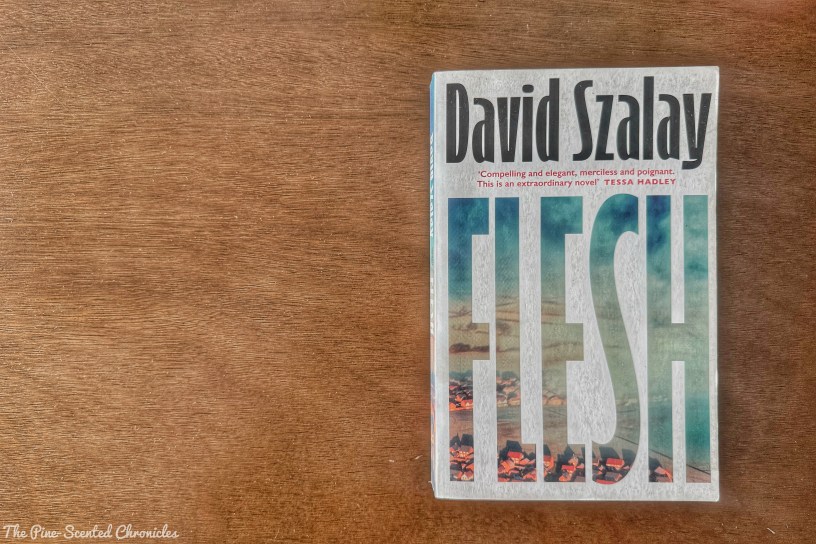
Among more recent fictional works exploring masculinity is Canadian-Hungarian writer David Szalay’s latest novel, Flesh. Having made his literary debut in 2008 with London and the South-East, Szalay has made steady progress in establishing his literary mettle, earning a Booker Prize shortlisting for his short story collection All That Man Is (2016). In 2025, he made a literary comeback with his sixth novel, Flesh, which charts the fortunes of a Hungarian man—named István—whose background echoes Szalay’s own Hungarian heritage. Flesh opens in 1980s Hungary, where fifteen-year-old István lives with his mother in a quiet apartment complex. The flat they occupy is described as “small, its walls thin, and the silence pressed against my skin.” Young István is shy and both socially and psychologically isolated. He struggles to connect with his peers, both at school and around the estate.
He has this feeling, with women, that it’s hard to have an experience that feels entirely new, that doesn’t feel like something that has already happened, and will probably happen again in some very similar way, so that it never feels like all that much is at stake. There’s often this feeling of—Yes, I like you, but I like other people as well. It’s not even that I like them more. It’s just that I don’t like them less. So to be with any one person feels like an arbitrary thing, and that arbitrary feeling has started to undermine any lingering sense that there might be a particular person that he’s somehow meant to be with.
~ David Szalay, Flesh
Nevertheless, István finds solace in running errands for his neighbor, a forty-two-year-old married woman, whenever his mother is away. What initially seems innocuous gradually turns into a clandestine sexual relationship initiated by the neighbor: “Her hands moved like they knew me, though I barely knew myself.” This development occurs shortly after István is sexually rejected by a girl his own age. At one point, he begins to believe that he is in love with his married neighbor. He neither has control over nor fully understands the affair, which eventually spirals into tragedy after it is discovered by the neighbor’s ailing husband. A confrontation in the stairwell ends in the husband’s accidental death. The authorities, however, treat the incident as intentional, and the adolescent István is sent to a youth detention center. There, he learns how to survive in a harsh environment, relying largely on physical toughness and emotional withdrawal.
Due to his criminal record, István struggles to find steady employment. He drifts through low-level jobs and petty crime in post-communist Hungary. He also develops intense feelings for his older cousin, Noémi. Living a more cosmopolitan life, she embodies the freedom he yearns for. However, Noémi chooses a wealthier, older partner instead of him. This rejection, combined with his craving for structure, prompts István to enlist in the Hungarian army. He is sent to Iraq, where he serves alongside Norwegian soldiers. Upon his return, he earns a medal and gains a reputation as a veteran. However, he feels no sense of achievement; instead, the war amplifies his trauma. He turns to drinking and gambling and continues drifting, taking whatever work he can find. Eventually, he becomes a bouncer at a seedy Budapest strip club—a pivotal turning point in his life.
One night, outside the club, István intervenes when a client is attacked on the street. The man, Mervyn, is a wealthy British patron impressed by István’s composure and physical presence. Mervyn offers him a job with his London-based private security firm. István accepts and moves to England. In his new environment, he learns the ropes, keenly observing how the global elite live. He learns which suits to wear and how to open car doors, and he is indoctrinated into keeping silent about everything he witnesses. Mervyn becomes a mentor, teaching him how to navigate spaces that would once have terrified him. Slowly and almost inadvertently, István insinuates himself into the family’s inner circle—flying in helicopters and private jets, dining in exclusive restaurants, and moving within rarefied social spheres.
Despite his newfound refinement, some habits die hard. While luxurious Tom Ford suits gloss over his physicality, István remains coarse, inarticulate, and emotionally distant. He rarely initiates conversations, underscoring his detachment: “I said little, because silence was safer than words.” Much of his speech consists of inflected repetitions of “yeah,” “I don’t know,” and, most of all, “okay.” He is blunt, reactive, and incurious—lacking charisma in the conventional sense. Yet this detachment proves strangely irresistible to a certain demographic of women. Notably, his physical appearance is rarely described in detail. His life appears anchored to forces beyond his control, shaped by the erotic and material desires of others and by shifts in the global economy, particularly once he becomes an investor in London property developments.
And all that burgeoning physicality is held within yourself as a sort of secret, even as it is also the actual surface that you present to the world, so that you’re left absurdly exposed, unsure whether the world knows everything about you or nothing, because you have no way of knowing whether these experiences that you’re having are universal or entirely specific.
~ David Szalay, Flesh
Palpably, István is the backbone of this character-driven narrative. The novel traces his life from childhood to adulthood, culminating in a series of events that lead him back to Hungary. Yet even then, he remains detached—mentally and emotionally. A cipher at the outset, he remains one throughout the story, a bystander to his own experiences. This narrative choice is deliberate: very little information about his inner life is provided, compelling readers to infer his emotional state through interactions rather than introspection. Ironically, even his dialogue rarely extends beyond short, functional remarks. This minimalist approach is one of the novel’s most striking features. Despite its spare prose, Flesh conveys profound emotional depth, reinforcing István’s detachment: “She looked at me like I could save her, but I was only there.”
Sure, he moves, even rising in ranks. He was rarely moved by anything around him. His icy emotional detachment and passivity make the book both a fascinating and infuriating character study. From the outset, István appears to believe that his life was never meant to be remarkable. He believes his life has been predetermined for him: he was meant to be a drifter who would stay in his anonymous Hungarian town until he passed away. He was meant to be a forgettable face in a sea of crowds. is ascent into elite circles feels accidental, the product of chance rather than ambition. A series of serendipitous encounters turned his fate around. Viewed through another lens, however, his story resembles a reluctant rags-to-riches narrative. From a young age, he becomes aware of class divisions, and the novel underscores how the desire for money and status shapes human lives.
Still, over the course of the story, there were subtle hints of István’s development. The narrative reaches its emotional climax when a relationship with another older woman forces him to confront what an authentic connection means. In the process, he grapples with the past traumas that left him stuck. It can be surmised that his detachment was the numbing effect of his traumas. When tragedy struck, István plunged into isolation, grief, and self-reflection. He learned what it meant to confront loss and loneliness. This also underscores the fragility of human happiness. Beyond his facade of icy detachment, there is a longing inside István. He yearned for meaning, experience, and, above all, belonging. The novel’s global scope—from Hungary to Iraq to London—reinforces themes of displacement and existential alienation. István, however, is not immune to emotional pain; while he hides behind a veneer of stoicism, he was more easily wounded than he lets on.
He’s not the only man wearing a suit. There’s quite a few of them in there, he notices, turning his head for a moment. That was one of the things that struck him about London when he first arrived here, central London in particular – how many people you see wearing suits. The streets are full of them. He’d never seen anything like it.
~ David Szalay, Flesh
This makes him a relatable character, although the characters’ complexities rarely make them sympathetic. Yet his destiny ultimately remains beyond his control. Just as he begins to believe that he deserves the life he has built, it collapses like a house of cards. A final twist sends him back to his hometown, completing the narrative’s circular structure. Impermanence resonates throughout the novel: wealth, status, and mobility prove fleeting. Szalay critiques the illusion of social mobility, suggesting that while one can acquire the trappings of wealth, true entry into higher social strata often remains elusive. The fall, when it comes, is swift and unforgiving. Above all, the novel emphasizes the constancy of alienation. From youth to middle age, István remains an outsider, his profound loneliness shaping both his choices and his existence.
The novel’s central theme crystallizes around masculinity. István’s identity is inseparable from his masculinity, which overrides his emotional detachment. One character describes him as embodying “a primitive form of masculinity.” Throughout the narrative, he performs masculinity in various ways—from being a subservient lover to an older married woman to engaging in hypermasculine professions as a soldier, bouncer, and investor. He acts on instinct before reflection—flesh before mind. The novel was at its most analytical when it was tackling carnal experiences. István’s limited speech is a further illustration of this impulsive thought process. His masculinity is also expressed through existential isolation, a condition he endures from adolescence onward. Szalay’s sparse prose becomes an effective vehicle for reflecting this detachment.
Awarded the 2025 Booker Prize, Flesh is a haunting portrait of a man who lives much of his life on the margins. Born into poverty, István rises above his circumstances not through deliberate ambition but through a series of external forces. His physical and emotional journey—from an unnamed Hungarian town to London—is transformative yet curiously uneventful. While the novel explores bodily experience, it ultimately grapples with broader metaphysical concerns, addressing themes of alienation, displacement, consumerism, trauma, and, existentially, the crisis of masculinity. Szalay masterfully conveys István’s interiority through his minimalist prose; even the sparse dialogues vividly reflect the kind of character István is. Flesh finds its power in restraint, allowing what remains unsaid to speak the loudest.
He lays his things down on the low table next to one of the wooden loungers and takes off his T-shirt. He deliberately took a lounger at some distance from them so that if they want to they can keep talking without feeling that he has to be included. Perhaps to addtionally emphasise that, to indicate that there’s no need to include him, that in fact he doesn’t want to be included, he picks up his book.
~ David Szalay, Flesh
Book Specs
Author: David Szalay
Publisher: Jonathan Cape
Publishing Date: 2025
Number of Pages: 349
Genre: Literary
Synopsis
Teenaged István lives with his mother in a quiet apartment complex in Hungary. New to the town and shy, he is unfamiliar with the social rituals at school and soon becomes isolated, with his neighbour – a married woman close to his mother’s age – as his only companion. Their encounter shift into a clandestine relationship that István barely understands, and his life soon spirals out of control.
As the years pass, he is carried gradually upwards on the twenty-first century’s tides of money and power, moving from the army to the company of London’s super-rich, with his own competing impulses for love, intimacy, status and wealth winning him unimaginable riches, until they threaten to undo him completely.
Spare and penetrating, Flesh is the finest novel yet by a master of realism, asking profound questions about what drives a life: what makes it worth living, and what breaks it.
About the Author
David Szalay was born in 1974 in Montreal, Quebec, to a Canadian mother and a Hungarian father. The family moved to Beirut, Lebanon, but was forced to flee after the onset of the Lebanese Civil War. They then moved to London, where he attended Sussex House School. Szalay read English at the University of Oxford, where he was an undergraduate student of Brasenose College, Oxford. Post-university, he worked at various jobs in sales in London.
However, Szalay has always aspired to become a writer. With this in mind, he moved to Brussels, then to Pécs in Hungary. Back in London, he has written several radio dramas for the BBC. In 2008, he made his literary debut with the publication of London and the South East (2008). It was an immediate critical success, earning Szalay the Betty Trask Prize and the Geoffrey Faber Memorial Prize. This was followed by The Innocent(2009) and Spring (2011). His fourth book, All That Man Is (2016), was a major breakthrough. The collection of nine, intertwined short stories – his website refers to it as a “novel” – was shortlisted for the 2016 Man Booker Prize and won the 2016 Gordon Burn Prize. Szalay would one this up with his 2025 novel, Flesh, which won the Booker Prize. This made him the first Hungarian–British author to receive the award.
He was named one of The Telegraph’s ‘Top 20 British Writers under 40’ in 2010, a Granta Best Young British Novelist in 2013, and in early 2016, he won the Plimpton Prize for Fiction, awarded by the Paris Review for an outstanding contribution to the magazine. In late 2016, David was awarded a Travel Scholarship from the Society of Authors. Szalay lives in Vienna, Austria, with his wife.
 The Pine-Scented Chronicles