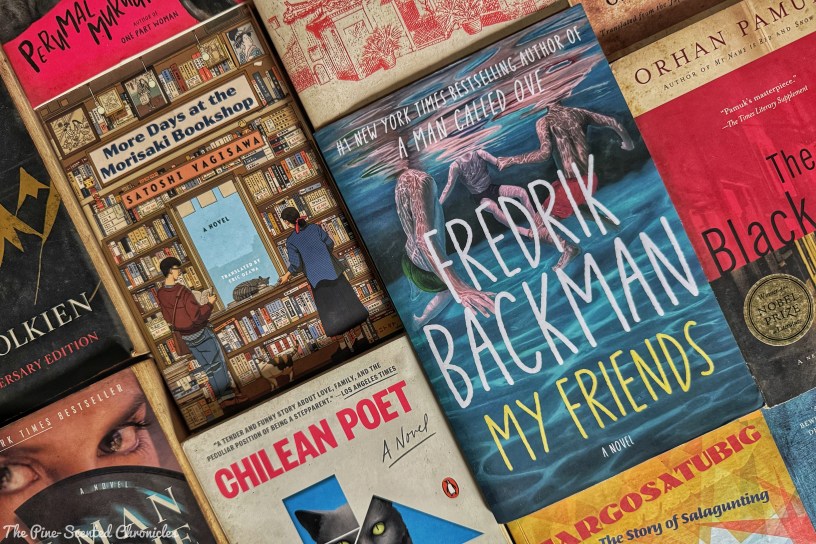
Of Healing and Friendship
A foray into contemporary Swedish literature would not be complete without encountering Fredrik Backman. Tracing his writing origins to Swedish newspapers—Helsingborgs Dagblad—and the Swedish men’s magazine Moore Magazine, he published his debut novel En man som heter Ove in 2012. It was an instant sensation, warmly received by literary pundits and the general reading public alike, marking the entrance of a literary star. The heartwarming story of a reticent old man earned accolades for its blend of humor and profound themes. The book’s local success did not go unnoticed by a global audience. Its English translation, A Man Called Ove, further catapulted Backman to international recognition. Now a household name, Backman’s debut novel was adapted into films in both Sweden and Hollywood. No less than acclaimed actor Tom Hanks starred in the Hollywood adaptation, A Man Called Otto (2022).
Backman is both a product of and a continuation of the long-established tradition of Swedish literature, which has produced eight Nobel Laureates in Literature. Building on the success of his debut novel, Backman followed A Man Called Ove with a series of equally successful and warmly received books: Saker min son behöver veta om världen (2012; Things My Son Needs to Know About the World, 2019); Min mormor hälsar och säger förlåt (2013; My Grandmother Asked Me to Tell You She’s Sorry, 2015); Britt-Marie var här (2014; Britt-Marie Was Here, 2016); And Every Morning the Way Home Gets Longer and Longer: A Novella (2016); and Folk med ångest (2019; Anxious People, 2021). As the old adage goes, strike while the iron is hot. The success of these works further underscored Backman’s ascent as one of the most compelling voices not only in Swedish literature but in world literature.
In 2025, Backman made his literary comeback with the publication of Mina Vänner, his first novel since Vinnarna (2022; The Winners), the final installment of the Beartown trilogy. Mina Vänner was immediately made available to Anglophone readers as My Friends. The novel opens with seventeen-year-old Louisa, a troubled orphan who has run away from her foster home. Highly independent and an aspiring artist, she sneaks into a posh art auction carrying a backpack full of spray paint. Intent on making her protest heard, she plans to make a statement against the commodification of art. Louisa has another motive as well: she wants to see the famous painting The One of the Sea, which she has long dreamed of seeing in person. She carries a postcard reproduction of the artwork in her backpack. Mourning the death of her friend Fish, Louisa paints a small red fish on the wall beside the painting, prompting security to remove her.
That’s all of life. All we can hope for. You mustn’t think about the fact that it might end, because then you live like a coward, you never love too much or sing too loudly. You have to take it for granted, the artist thinks, the whole thing: sunrises and slow Sunday mornings and water balloons and another person’s breath against your neck. That’s the only courageous thing a person can do.
~ Fredrik Backman, My Friends
After being thrown out of the auction, Louisa ends up in an alley, where she collides with a sick, homeless man. She pours out her story to him, and he, moved by her pain, makes her promise not to hurt herself and even encourages her to graffiti the wall. Chaos ensues when the police arrive. They tackle the man—C. Jat—prompting Louisa to run and hide in his car. The furor is abruptly halted when a well-dressed man named Ted intervenes. Realizing who the homeless man is, Ted advises the police not to arrest C. Jat because he is a famous artist—the painter of The One of the Sea. The encounter is serendipitous: Ted had attended the auction to see the painting one last time. He ultimately repurchases it at a steep price. Meanwhile, in the hospital, C. Jat asks his friend to locate Louisa. Shortly thereafter, he passes away in his friend’s arms.
The following day—Louisa’s birthday—Ted manages to find her and gifts her the painting. Louisa, however, is reluctant to accept it due to its immense value. With nowhere else to go, she follows Ted as he travels to his hometown to scatter his friend’s ashes. She convinces him to let her come along. The painting, it becomes clear, is no ordinary artwork. Though it appears to be a simple seascape to casual viewers, The One of the Sea holds deep sentimental value for Ted. It depicts four friends sitting on a pier—an important detail often overlooked. Louisa, however, sees through the façade. To her, the painting symbolizes friendship, longing, and the hope of belonging. As the train moves toward its destination, Ted reveals that he was one of the four friends in the painting.
Backman then transports readers twenty-five years into the past as a second storyline unfolds. In a seaside town, the paths of four teenagers—Joar, Kimkim (later known as C. Jat), Ted, and Ali—converge one summer. The friendship begins with Ted, Kimkim, and Kimkim’s best friend Joar, before Ali joins them after moving to town with her father. Bonded by shared grievances and experiences, they form a close-knit group. At the center is Kimkim, a sensitive and anxious boy who is bullied at school and neglected at home. He finds refuge in drawing. His life changes after a chance encounter with a kind janitor named Christian, who recognizes his talent and encourages him to keep painting regardless of public opinion. Together, they paint a mural behind the school. Tragedy strikes when Christian dies due to substance abuse.
Kimkim’s friends rally around him and encourage him to enter an art competition. Joar, in particular, supports him, even selling the bicycle his mother had gifted him for his birthday so Kimkim could buy art supplies. Over the summer, the quartet’s bond deepens. They frequently gather at Ted’s house—the safest among them—but their favorite place is an abandoned pier where they swim, talk, and watch the sea. When Kimkim finishes his painting, he signs it “C. Jat,” an acronym formed from the initials of his friends and Christian. Unfortunately, they discover that the competition is restricted to children, disqualifying Kimkim. Undeterred, they break into the museum to hang the painting themselves. When caught by a security guard, Christian’s mother—an art history teacher—confirms that the painting is Kimkim’s.
Becoming a parent? Someone said it’s an invisible tidal wave that hits you with such force that you lose your breath and never quite get it back. You spend your whole life gasping, someone else said, because it’s a love so immense that it squeezes the air out of your lungs. Everyone else thinks you look like the same person afterward, a third said, but you don’t understand any of it, because there’s such a clear before and after. A completely new you.
~ Fredrik Backman, My Friends
That fateful and transformative summer was forever embedded in the quartet’s minds. Even when their paths diverged because life takes its natural course, their memories lingered. They were bonded by their shared experiences. Each had a personal cross to bear. Like Louisa, they were all raised in dysfunctional households and exist as social outcasts. This is one of the prevalent themes explored by the novel. At home, Ted was bullied by his older brother. Their father was suffering from terminal cancer. Joar, despite being physically strong, suffers abuse at the hands of his own father, though his love for his mother and loyalty to his friends remain unwavering. Ali has lost her mother, leaving her to the care of her irresponsible father. Her father rarely paid the bills and left them without food and utilities.
Their shared struggles strengthen their bond. In each other, they found a semblance of safety, comfort, and camaraderie. Their flourishing friendship vividly captured the beauty of found families; the theme was explored by Backman with nuance and emotional depth. The story reiterates that family transcends blood. Dismissing traditional definitions, family is forged through love, loyalty, and mutual support. The friends’ chosen family provided them with a sense of belongingness and acceptance. It offered them a safe space that allowed them to be themselves, sans the weight of prejudice and judgment. As the quartet demonstrates, found families can be just as meaningful and enduring as traditional ones, serving as both an escape from harsh realities and a source of resilience in times of adversity.
As life unfolds, their paths inevitably diverge. Christian’s mother helped Kimkim find an art school. Ali moves away, but her life is tragically cut short. Joar’s father eventually passed away, and so did Kimkim’s. Ted—the glue that once held them together—finds solace in his memories. Friendship emerges as the novel’s overarching theme. Despite their differing backgrounds, the four form a lasting and profound connection that helps them navigate youth and adversity. Loyalty, understanding, and acceptance prove essential in establishing and, more importantly, sustaining authentic connections. Real friends stand by each other, whether in fair weather or through a storm. The bond they share becomes a lifeline, illustrating how chosen relationships can become families that offer sanctuary and support.
Adding nuance to the story are the challenges the characters face as they enter adolescence. Beyond their homes, they each grappled with identity. This makes their convergence on that fateful summer all the more meaningful. Adolescence is a turbulent period, marked by uncertainty and emotional intensity. It is a crucial period when we start questioning our place in the world. This is a universal experience that the four friends, and even Louisa, had to go through. In the five main characters, Backman crafted a diverse set of relatable characters. In the early stages of their youth, they started to experiment. It was a period of trial and error. Yet, these experiences are crucial in shaping the course of their own lives. The characters would experience the entire emotional spectrum, from love, heartbreak to self-identity issues. They would even grapple with mental health issues.
If a homeless man in the street had tried to sell the painting of the children on the pier, it would have been worthless, but once it was hanging on a white wall in a beautiful gallery, it cost a fortune. When sufficiently wealthy people want something bad enough, it becomes invaluable, because then art isn’t experienced through the eyes, but by the ears; they’re not paying for the picture but for its name and history. In their world it isn’t the artist who should be admired, it’s the owner, because only something which has a price can have any value. That’s why the children in the painting are so important that they’re protected by guards, but the children on the pier in real life could die without anyone even caring.
~ Fredrik Backman, My Friends
Examined primarily through the lens of friendship, the novel possesses an expansive scope. It is equally a story of trauma and healing. Backman was unflinching in his exploration of trauma and how it adversely affects people. Despite the humor, the novel was riddled with abuse, addiction, abandonment, and violence. The inevitability of death and loss was also woven into the novel’s emotional fabric. Loss manifests in many forms—not only death, but also the loss of innocence and dreams. Backman highlights the varied ways people cope with grief, emphasizing the importance of support, understanding, and resilience. Art emerges as a central avenue for healing. The characters’ creative endeavors provided them with solace and purpose. It was a crucible through which they conveyed and processed their emotions and experiences.
Art becomes both a personal outlet and a means of connection. As the friends’ lives intersect, creating art evolves into a collaborative act that strengthens their bond. This underscores how art transcends the aesthetic; it is also transformative. Still, Backman resists offering neat resolutions. Healing takes time and is nonlinear. The friends moved forward in life, carrying with them their wounds. Rather than erasing them, the characters learn to live with their scars, which become integral to their identities. They are part and parcel of who we are. Backman ultimately suggests that survival itself is a triumph and that happiness remains possible even amid loss and adversity. Grief, rather than an ending, becomes a catalyst for growth and self-discovery.
Ultimately, My Friends captivates through its expansive scope and tender exploration of friendship. The novel explores trauma, dysfunctional families, grief, abuse, and even mental health concerns. But the novel resonates with healing, particularly through friendships and chosen families. Circumstance brings Kimkim, Joar, Ali, and Ted together, but shared experiences allow them to forge a bond that endures across decades. Their friendship becomes a sanctuary, a refuge from chaos, and its testament lives on through an artwork that inspires a young girl years later. Art, both universal and transformative, emerges as the novel’s lasting symbol. As in Backman’s earlier works, My Friends tugs at the heartstrings, capturing the beauty of human connection and the complexity of the human condition with unflinching honesty.
You feel strange because you still have your wings, rubbing beneath your skin. You think you’re alone, but there are others like you, people who stand in front of white walls and blank paper and only see magical things. One day one of them will recognize you and call out: ‘You’re one of us!’ And then you won’t feel lost anymore. You’ll realize that you’ve always been able to speak a secret language, one that has no boundaries, because you have no nationality. Art is your homeland.
~ Fredrik Backman, My Friends
Book Specs
Author: Fredrik Backman
Translator (from Swedish): Neil Smith
Publisher: Atria Books
Publishing Date: 2025
Number of Pages: 434
Genre: Literary
Synopsis
Most people don’t even notice them – three tiny figures sitting at the end of a long pier in the corner of one of the most famous paintings in the world. Most people think it’s just a depiction of a wide expanse of sea. But Louisa, soon to be eighteen years old and an aspiring artist herself, knows otherwise. She is determined to find out the story behind these three enigmatic figures.
More than two decades before, in a distant seaside town, a group of teenagers find refuge from their bruising home lives by spending long summer days on an abandoned pier telling silly jokes, sharing secrets, and committing small acts of rebellion. These lost souls find in each other a reason to get up every morning, a reason to dream, a reason to love.
Out of that summer emerges a transcendent work of art, a painting that, after a chance encounter in an alleyway, will unexpectedly be placed into Louisa’s care. She embarks on a surprise-filled cross-country journey to discover how the painting came to be and to decide what to do with it. The closer she gets to the painting’s birthplace, the more anxious she becomes about what she’ll find. Louisa’s complicated life is proof that happy endings are sometimes possible, but they don’t always take the form we expect them to.
Fredrik Backman’s signature charm, humor, and attention to the poignant details of everyday life are on full display in this funny, moving novel. His most heartfelt and personal tale yet, My Friends is a stunning testament to the transformative, timeless power of art and friendship.
About the Author
To learn more about Fredrik Backman, click here.
Adults often think that self-confidence is something a child learns, but little kids are by their nature always invincible, it’s self-doubt that needs to be taught. And oh, how the artist was taught, because the world has spent thousands of years practicing how to puncture the lungs of children who are different.
~ Fredrik Backman, My Friends
 The Pine-Scented Chronicles