
Hello, readers! It is Monday again! As it is Monday, welcome to another #5OnMyTBR update. The rule is relatively simple. I must pick five books from my to-be-read piles that fit the week’s theme.
This week’s theme: No Prompt
Since there is still no prompt this week, I opted to feature works of Brazilian writers. This is in connection with my ongoing venture into the works of Latin American literature. Admittedly, my foray into the works of Brazilian writers is quite limited. For the longest time, it was only the works of Paulo Coelho that I read. Recently, Jorge Amado has earned a fan in me. However, there is still more dimensions of Brazilian literature I want to explore. Without ado, here are some works of Brazilian writers I am looking forward to reading.

5OnMyTBR is a bookish meme hosted by E. @ Local Bee Hunter’s Nook where you choose five books from your to-be-read pile that fit that week’s theme. If you’d like more info, head over to the announcement post!

Title: Brazil-Maru
Author: Karen Tei Yamashita
Publisher: Coffee House Press
Publishing Date: 1992
No. of Pages: 248
Synopsis:
Karen Tei Yamashita’s eagerly anticipated second novel tells the little-known story of Brazil’s huge Japanese immigrant population This multi-generational saga relates one group’s attempt to build a utopia while surviving the suspicions of World War II, the conflict between individual freedom and community responsibility, and the dangeo=rous allure of a charismatic leader.
Karen Tei Yamashita went to Brazil in 1975 on a Thomas J. Watson Fellowship and spent two years following the path of one particular immigrant story which began in Sao Paulo. She married a Brazilian and stayed in Brazil for nine years before returning with her family to her native California. She won the Janet Heidinger Kafka Prize and an American Book Award from the Before Columbus Foundation for her first novel, Through the Arc of the Rain Forest, and her plays have been produced at a variety of West Coast locations.

Title: Blues for a Lost Childhood
Author: Antônio Torres
Translator (from Portuguese): John Parker
Publisher: Readers International
Publishing Date: 1989 (1986)
No. of Pages: 201
Synopsis:
It’s another hot, sleepless night in Rio, punctuated by the sounds of Jazz, TV, and gunshots from the cafes and shanties. In the narrator’s drink-bruised mind, a nightmare begins with a parade of coffins and a cascade of memories. Here lies all the fascinating and convulsive history of Brazil during the past twenty-five years.
One figure stands out: Calunga, the iconoclast, idealist, joker and fixer, who breaks his way out of the stagnant “Backlands” of his boyhood to become a big-city journalist. Defeated by the city and his own weakness, he is reclaimed b the land. Only his irony remains.
In this his sixth novel, Antônio Torres creates a collage of Brazilian life: through its legends, poetry, popular songs and through the narrator’s hallucinations, fantasies and flashbacks as well as snippets from newspapers and the media.
A novel of innovative structure and great psychological depth, Blues for a Lost Childhood was chosen Novel of the Year by Brazilian PEN.

Title: A Different World
Author: Zulfikar Ghose
Publisher: The Overlook Press
Publishing Date: 1986
No. of Pages: 292
Synopsis:
The final volume of Zulfikar Ghose’s widely acclaimed Brazilian Trilogy is his most erotic and dramatic in equal parts. Set in the 1970’s Brazil is ruled by a military dictatorship; terrorists, intellectuals and students have been arrested and there have been horrifying accounts of torture. Amid this turbulent setting is Gregorio Xavier, the second reincarnation of “The Incredible Brazilian,” who becomes involved in a political drama which makes him a powerful symbol of modern man struggling against the political turmoil of his times.

Title: The Chandelier
Author: Clarice Lispector
Synopsis:
Fresh from the enormous success of her debut novel Near to the Wild Heart, Hurricane Clarice let loose something stormier with The Chandelier. In a body of work renowned for its potent idiosyncratic genius, The Chandelier in many ways has pride of place. “It stands out,” her biographer Benjamin Moser noted, “in a strange and difficult body of work, as perhaps her strangest and most difficult book.” Of glacial intensity, consisting almost entirely of interior monologues—interrupted by odd and jarring fragments of dialogue and action—the novel moves in slow waves that crest in moments of revelation. As Virginia seeks freedom via creation, the drama of her isolated life is almost entirely internal: from childhood, she sculpts clay figurines with “the best clay one could desire: white, supple, sticky, cold. She got a clear and tender material from which she could shape a world. How, how to explain the miracle …” While on one level simply the story of a woman’s life, The Chandelier’s real drama lies in Lispector’s attempt “to find the nucleus made of a single instant … the tenuous triumph and the defeat, perhaps nothing more than breathing.” The Chandelier pushes Lispector’s lifelong quest for that nucleus into deeper territories than any of her other amazing works. (Source: Goodreads)
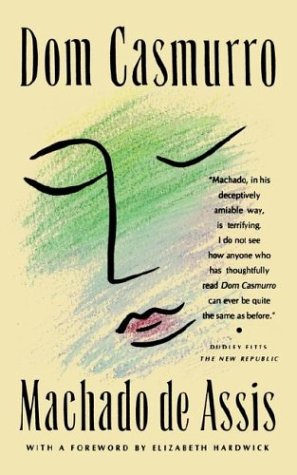
Title: Dom Casmurro
Author: Machado de Assis
Synopsis:
Bento Santiago, the wildly unreliable narrator of Dom Casmurro, believes that he has been cuckolded—he suspects that his wife has cheated on him with his best friend and that her child is not his. Has Capitú, his love since childhood, really been unfaithful to him? Or is the evidence of her betrayal merely the product of a paranoid mind? First published in 1900, Dom Casmurro, widely considered Machado de Assis’s greatest novel and a classic of Brazilian literature, is a brilliant retelling of the classic adultery tale—a sad and darkly comic novel about love and the corrosive power of jealousy. (Source: Goodreads)
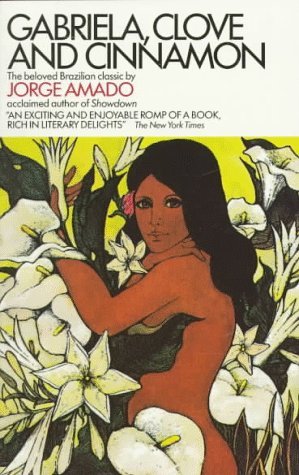
Title: Gabriela, Clove and Cinnamon
Author: Jorge Amado
Synopsis:
One bright spring day in 1925, Gabriela arrives from the poverty-stricken backwoods of Brazil to the lively seaside port of Ilhéus amid a flock of filthy migrant workers. Though wearing rags and covered in dirt, she attracts the attention of Nacib, a cafe owner, who is in desperate need of a new cook. So dire is his situation that he hires the disheveled girl. The savvy young woman quickly proves to be an excellent chef and—once well-scrubbed and decently dressed—an eye-catching beauty. Nacib quickly finds himself the owner of the most prosperous business in town—and the employer of its most sought-after woman. (Source: Goodreads)
 The Pine-Scented Chronicles
Cool Post!
LikeLike